
Folks from far and wide know all about Queens’ two state-of-the-art airports, LaGuardia and JFK.
Not nearly as many people know that Jackson Heights had one nearly a century ago, before today’s facilities were even ideas. The short life of Holmes Airport lasted from 1929 to 1940.
The New York Times in 1937 reported that the airport’s owners sought an injunction to stop the city from developing the nearby North Beach Airport, which the court rejected. That development would become LaGuardia Airport by 1939. Rendered obsolete, Holmes shuttered a year later.
Nonetheless, Jackson Heights has retained much of its rich historical character over the last century, as have other planned communities built around the same time.
The neighborhood now touted as the city’s first cooperative and “garden apartment” community was a vast stretch of farmland when the Queensboro Corp., led by Edward Archibald MacDougall, bought it in the early 20th century.
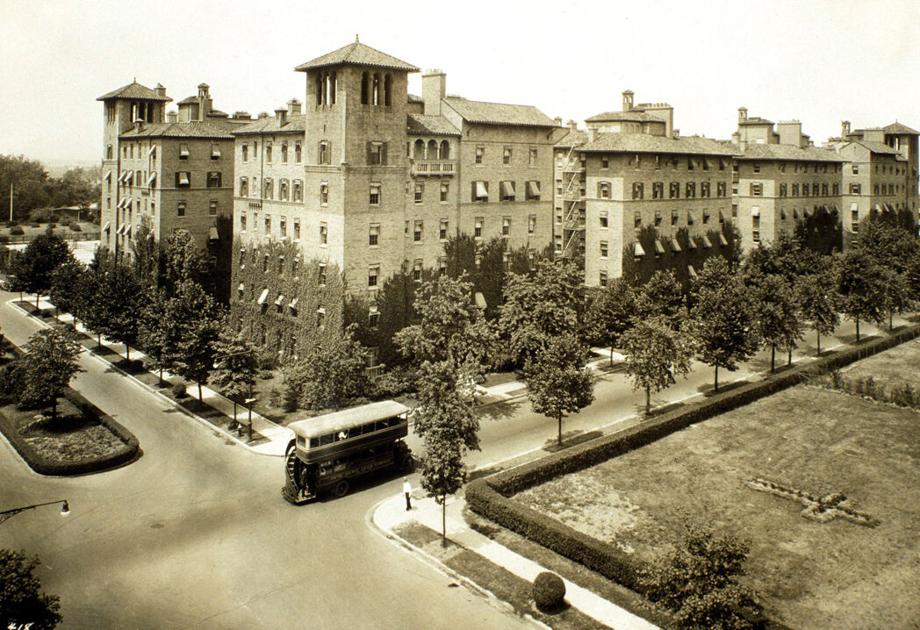
Initial developments there in the 1910s consisted of conventional five-story walkups, Jackson Heights Beautification Group board member Daniel Karatzas explained. But, he said, the design changed in 1917, when the Queensboro Corp. built what are now known as the Greystone Apartments.
“They built apartment buildings that were between four and six stories, that were one apartment deep, with two to four exposures. Some of the buildings were then separated,” he said. “So instead of building one mega building along the side street, they built six, seven buildings with separate entrances that were identical or near identical.”
In developing Jackson Heights, Queensboro Corp. leaders were inspired by the “garden cities” they had seen in Europe during the World War I era, Karatzas said. That concept was to maintain an enclosed green space in the middle of the block.
Queensboro’s innovation, also influenced by the tenement reform movement, was to build garden apartments from about 1917 to 1925, placing apartment buildings around the perimeter of a block with private green space in the center. Karatzas said the idea had been “alien” to most builders, as it left developable land aside for residents’ shared use.
Private homes, mostly semiattached, also were built around that time. It was typical for them to have yards in the front, side and rear.
“The idea was that if you’re going to aim to the middle- or upper-middle class, you’re going to have to give them things, like some open space — their own private open space — that they weren’t going to get on the island of Manhattan,” Karatzas said.
He said there is still a “general pleasantness” to walking the residential avenues, which are architecturally coherent. Dozens of blocks in Jackson Heights were designated as a historic district in 1993, an effort pioneered by the JHBG, which formed years prior.
The gardens lived on well past the ’20s, Karatzas said — they still absorb rainwater and provide oxygen to this day, and there are residents who tend to street trees.
“If you had an apartment in Jackson Heights, you were guaranteed a beautiful view,” Queens Borough Historian Jason Antos told the Chronicle, whether residents could see Manhattan, other parts of Queens or open areas.
Tennis courts and golf courses between buildings were further draws for residents, Antos said, as was the proximity to new transit.
Developers knew the 7 train was coming long before it arrived in 1917, and that its path would be down the newly mapped Roosevelt Avenue. They built along that stretch in anticipation of what was to come.
Antos said Queens’ development largely coincided with that of transit.
“The mentality was, if there’s a train here, we’re going to show the importance of transit by putting the transit first and showing that the neighborhoods will follow,” he said.
Construction came to a halt after the United States entered World War I in 1917, and by 1919, there was a “mad rush” to address a housing shortage, Karatzas said. To meet demands, the Queensboro Corp. from 1919 to 1924 sold its apartments as cooperatives rather than renting them out.
That was partially for economic reasons, Karatzas explained — builders hadn’t done much construction on the land they bought before the war, and their capital came from monthly rents as the ’20s started to boom.
“By selling the apartments, they could hopefully make a profit and take all of that capital and then build the next complex,” Karatzas said. Virtually all the larger complexes were sold as co-ops, and the buildings got bigger as the enterprise proved successful.
They also had more amenities, including the automatic push-button elevator, which was legalized in the early ’20s.
But by around 1924, Karatzas said, the Queensboro Corp. realized they had “overreached.” Apartments were selling at a fraction of the cost of construction. In the Towers complex, which cost more than $2.5 million to build, an 1,800 square-foot unit went for about $25,000.
So instead of co-ops, developers took a more profitable shift toward private homes. According to an excerpt from Karatzas’ book, “Jackson Heights: A Garden in the City,” on the JHBG’s website, Queensboro built English Garden Homes on more than 15 streets in the late ’20s, with front and rear gardens and brick construction.
They also were expensive, costing between $20,000 and $38,500. Prices increased as Queensboro kept building, which meant most New Yorkers, including groups facing discrimination, could not afford to live in Jackson Heights.
The group kept at it with private homes until around 1929, and then the stock market crashed.
Sunnyside Gardens
Sunnyside Gardens was built between 1924 and 1928 as the “working person’s response to Jackson Heights,” Antos said.
While Jackson Heights’ apartments appealed to middle- and upper-middle class folks, Sunnyside Gardens served mostly blue-collar workers, such as city employees, and public school teachers. Karatzas said it was home to “fairly modest” sized houses and some apartments.
That is not so much the case anymore. Like Jackson Heights, Sunnyside Gardens is on the National Register of Historic Places, and that designation spiked costs further.
Sunnyside Gardens, too, was one of the city’s first garden apartment complexes. Antos said the neighborhood was built up in sectors, in which apartment buildings sit in a semicircle around an interior courtyard.
The Department of City Planning in 1974 named the area a special planned community preservation district to prevent changes to the historic courts and landscaping, after the original easements that did so expired. The city’s Landmarks Preservation Commission named it a historic district in 2007.
Antos said also that the original Sunnyside from the colonial era was in what is now known as Sunnyside Yard, located opposite from Sunnyside Gardens. The Bragaw family built a homestead there and called it Sunnyside Hill.
Forest Hills Gardens
Also part of the garden apartment movement was Forest Hills Gardens, built by the Russell Sage Foundation in the early 20th century. With Sunnyside Gardens and Jackson Heights as respective blue-collar and upper-middle class enclaves, Forest Hills Gardens became one for the affluent, Antos said. Connection to transit was, as ever, a major draw.
Forest Hills saw more development through the ’20s as infrastructure evolved and Queens Boulevard widened, as per the city Historic District Council’s Six to Celebrate program. The Gardens’ first apartment building, Forest Arms, was built in 1924. Other complexes also came to the Queens Boulevard corridor at that time.