
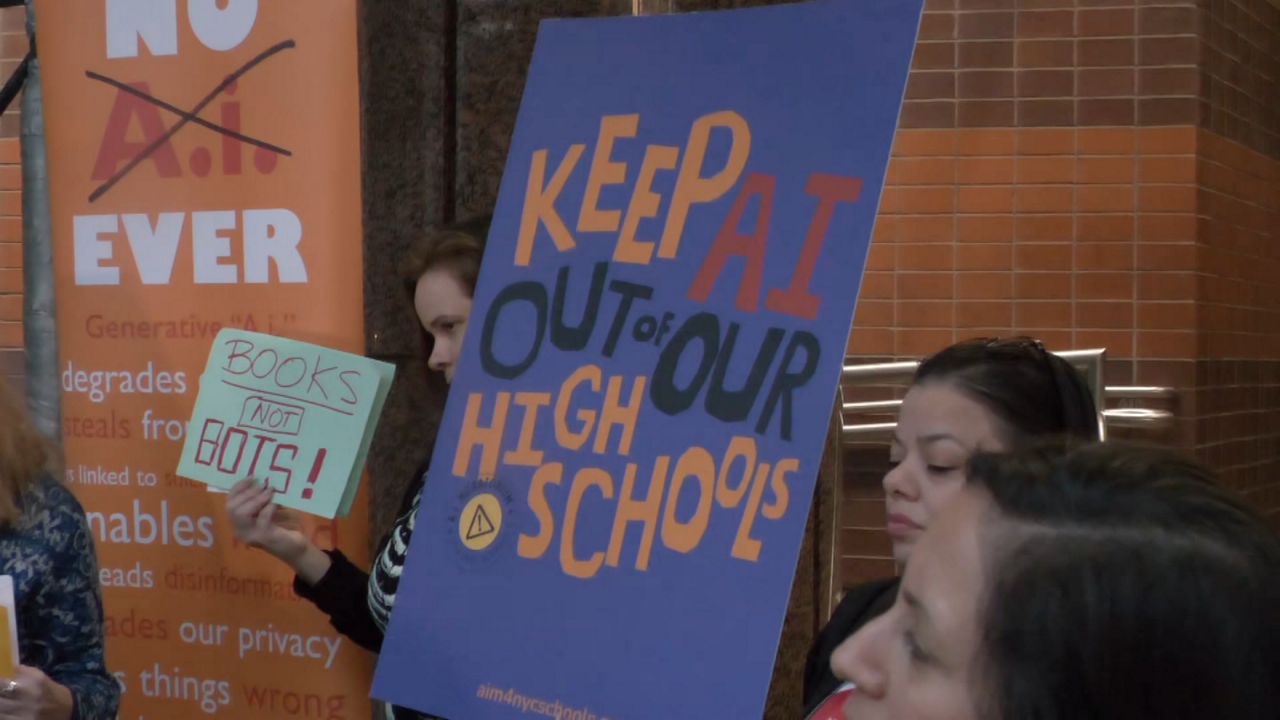
About two dozen students, teachers and advocates gathered ahead of the Panel for Educational Policy’s monthly meeting to protest the city Department of Education’s artificial intelligence pilot program for high school students.
The pilot program is expected to roll out next month for high schoolers. In September, the mayor’s office announced the introduction of five AI pilots, and only 5% of public school students are expected to be part of the program.
There is currently a moratorium on AI for 2K through eighth grade for the 2026 to 2027 school year. Protesters called for that moratorium to be extended to high school students.
“We’re here asking the mayor and the chancellor to extend the AI moratorium to high schoolers,” Liat Olenick, the co-founder and co-chair of Climate Families NYC, said. “We feel that the risks to students, to student privacy, to student learning, to the planet are as great for high schoolers as they are in early childhood and elementary and middle school, and that we’re calling on them to cancel the AI, quote unquote, pilots that are going to be rolling out in high school.”
Some students who attended the meeting voiced concerns about AI to the panel, including one who asked why high schoolers could not have the same limits as students in pre-K through eighth grade.
Danielle Giunta, the first deputy chancellor, said the DOE is committed to keeping the pilot program as part of its plan this year.
“We will see what we learn from those pilots, the impact on student learning, the effectiveness in a student experience, and we’ll get feedback from the students who experience it, the teachers who implement it,” Giunta wrote in a statement. “We’re going to see how they are as a tool and a resource for learning.”
Giunta also said the AI pilots are bound by Education Law 2D, which requires student data privacy protections.
Juno Hayes, a student at Hunter College High School, also spoke to the panel and presented a petition signed by more than 1,000 New Yorkers who oppose the use of AI in schools.
“My own classmates have been relying on AI to complete assignments,” Hayes said. “Teachers are not able to give the same kind of assignments as they used to and I feel like it is kind of it’s some Some degree of it feels like our teachers are giving up on us, the state’s giving up on us because they can’t figure out a good way to combat this intense push from AI companies. That’s not a society I want to live in and I want to show people there’s another way.”
A source at the DOE said families will be notified in writing before a pilot tool is used. The source said families can request alternative assignments that achieve the same learning goals.