
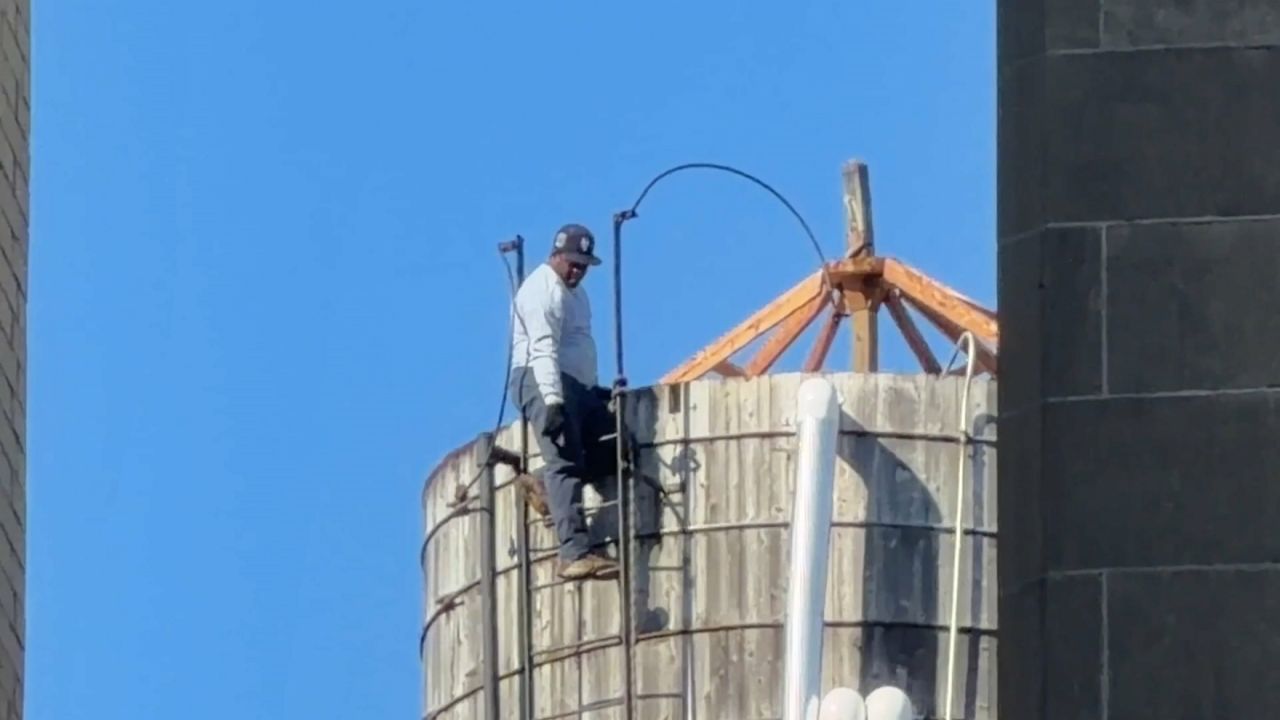
The state Department of Environmental Conservation came to the building to get the people working on the water tower for a second day to stop.
Elected officials and members of the New York City Bird Alliance are furious as construction continues for a second day on a water tower where a rare family of barn owls nested in Manhattan.
They marched up to the foyer of the building that the water tower is on top of, banging on the door.
Manhattan Borough President Brad Hoylman-Sigal, trying to reach the superintendent, saying, “Your workers have to stop now.”
“You’re violating federal law,” he added.
The state Department of Environmental Conservation came to the building to get the people working on the water tower for a second day to stop. Later, the DEC delivered a cease and desist letter.
“It’s illegal to disturb the nest of these birds,” David Barrett, the Creator and Manager of Manhattan Bird Alert said. “These owls were the first ever in modern history to nest in Manhattan.
The five young barn owls have captivated the upper west side since they were first spotted on the water tower in early October.
On Thursday morning, the NYC Bird Alliance says it received calls that the roof of the water tower was being torn down.
Police officers for the DEC told building managers to pause the demolition of the water tower unit while they investigate.
Then on Friday, bird enthusiasts and elected officials were shocked to see someone working up there again.
“The department of environmental conservation police were here yesterday. I was with them. I watched them tell the superintendent and call the property manager and tell them to stop working,” Jessica Wilson of the NYC Bird Alliance told Hoylman-Sigal, who then said, “It’s obviously a case of them ignoring the law.”
As for the young owls, all five of them were accounted for on Thursday evening, flying back to the water tower to be fed.
According to bird experts, at this age, the young fledglings know how to fly, but they don’t know how to hunt for themselves.
“These birds were vulnerable and sensitive to begin with,” Wilson said. “A second day will definitely disturb these birds. We are afraid they might leave this site entirely and not be able to be fed by their parents.”