
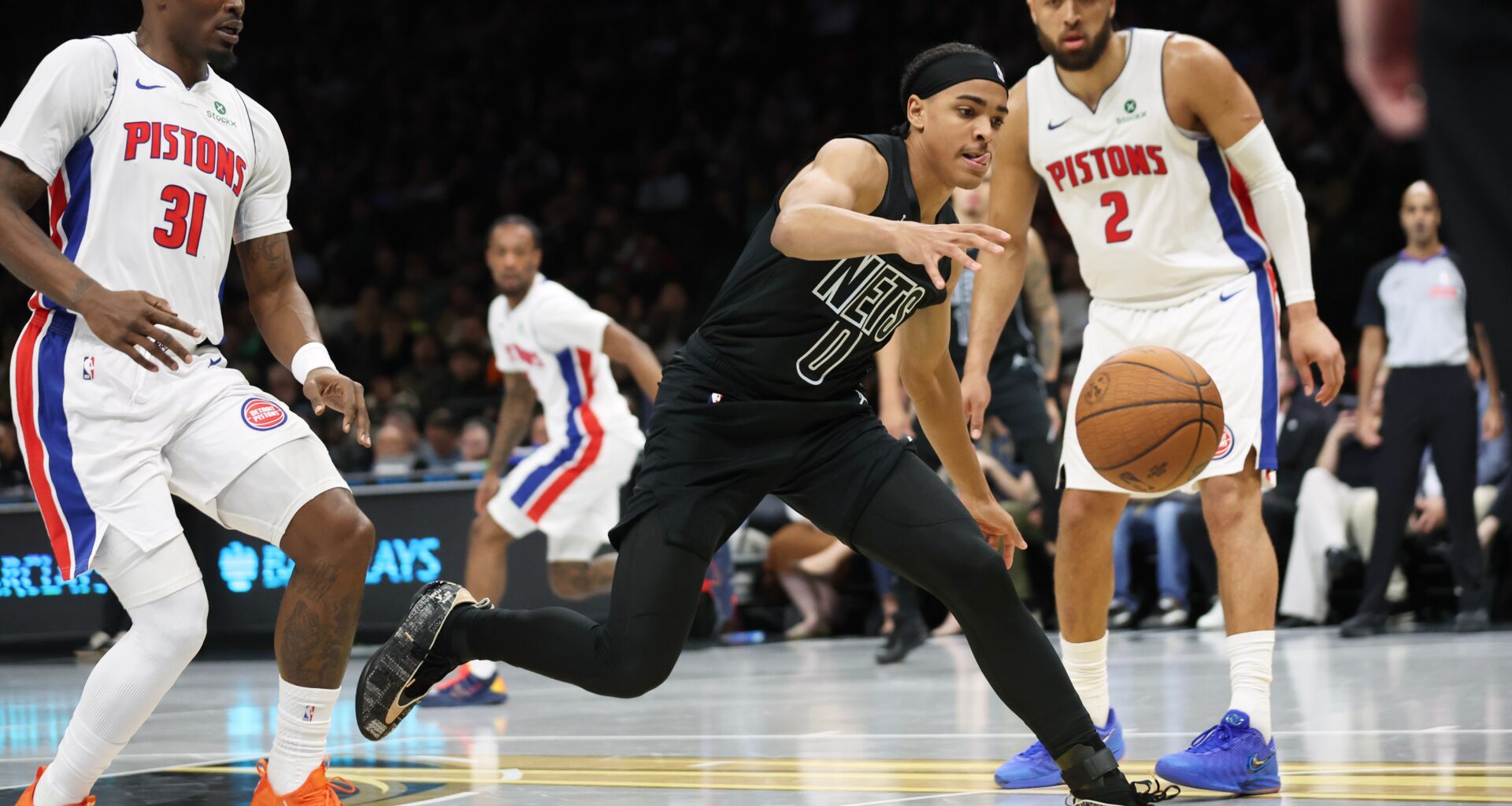
First, the shoulders sag. Then the heads drop. The ball sticks, defensive assignments get lost, and the Nets begin to resemble five players waiting for a bad night to end.
Brooklyn was always going to have ugly nights. The NBA’s youngest roster opened against demanding opponents, and nobody should be grading this group against a championship standard. But a rebuilding team still needs habits it can trust when the shots stop falling.
Through their first five games, the Nets too often lost those along with the lead.
That demands answers from head coach Jordi Fernández and his players. It also demands scrutiny of the roster general manager Sean Marks assembled, and the direction owner Joe Tsai continues to endorse.
Because at some point, rebuilding has to look like building something.
“I think just generally speaking, when stuff doesn’t go our way, we kind of put our head down a little bit and lose our connectivity,” Moritz Wagner said after Friday’s loss to the Detroit Pistons. “And I think that’s one of our staples. And we worked way too hard all summer and probably set a much higher standard than that for ourselves.”
Fernández saw “dropping shoulders and not the same energy” when the Pistons responded to Brooklyn’s strong start. Julius Randle described the same retreat.
“I think we get adversity right now as a group and it just deflates us as a team,” Randle said.
These are the Nets describing their own problem. The standard they’re struggling to meet is one they set themselves.
The numbers give that frustration some shape. Through Friday, Brooklyn was allowing 121.2 points per game, committing 19.2 turnovers and losing by an average of 11 points.
Still, there were meaningful exceptions to the bleak picture. The Nets pushed Cleveland to the closing seconds and took Boston to overtime before Jayson Tatum’s buzzer-beater. Those efforts belong in any honest assessment of the group.
“It’s also not all bad. I want to get rid of that narrative,” Wagner said. “We’re close. I’m convinced. I think we’re a really good team.”
Indiana and Detroit exposed the distance still to travel. Brooklyn led after the first quarter against both, then was outscored by a combined 149-92 over the second and third periods. The opening energy gave way to stretches in which the Nets struggled to generate good shots or interrupt an opponent’s run.
A missed assignment doesn’t establish that a player has stopped trying. Confusion can look like passivity, particularly when a young team is facing a defense it cannot solve. Randle offered a more useful explanation than simply demanding that everyone play harder.
“It’s like we’re just kind of stuck and then we’re just sitting there watching each other,” Randle said.
Fernández acknowledged that better spacing, cutting and preparation were needed against Detroit’s pressure. Helping players find those answers is his job.
“Teams just go in separate ways and I’m responsible for that,” Fernández said.
The responsibility extends to whether this roster gives him enough ways to respond.
Brooklyn is asking inexperienced point guards to lead an offense without an established veteran at that position. Day’Ron Sharpe’s foul trouble has complicated his impact inside, and the center combination of Sharpe and Wagner has yet to provide a dependable defensive foundation.
Randle and Michael Porter Jr. give the group scoring experience. The roster still asks its young guards to learn how to run an NBA offense while carrying much of the responsibility for keeping it functional.
Those are roster choices, with consequences the front office has to own.
The same scrutiny should apply to how Brooklyn develops its draft investments. The Nets made a record five first-round selections in 2025. Early in their second seasons, Drake Powell, Ben Saraf and Danny Wolf are still working to establish regular NBA roles.
Five games can’t settle what any of these players will become. Egor Dëmin’s shooting in Cleveland, Nolan Traoré’s penetration in Boston and rookie Mikel Brown Jr.’s late scoring burst there supplied reasons to keep watching. Dëmin’s bone bruise and Brown’s managed workload have also limited the early evaluation.
What the organization owes them is a coherent route from those flashes to dependable contributions: clear responsibilities, reps and a team that keeps functioning through their mistakes. Fernández has described a development plan spanning Brooklyn and Long Island. Its value will show in the players’ decisions and performance.
Giving young players time also requires judging how well the organization uses it.
Marks has directed Brooklyn’s basketball operations since 2016. His tenure has produced one playoff series victory. The past three completed seasons brought 32 wins, then 26, then 20.
The full record includes real accomplishments, like restoring a depleted franchise to playoff relevance, attracting Kevin Durant and Kyrie Irving, adding James Harden and recovering substantial draft capital after that era unraveled.
Those were distinct phases of the franchise. They all belong in the evaluation of the executive who oversaw them.
Brooklyn’s collection of picks and financial flexibility gives Marks options. Their value ultimately depends on the players those resources bring in, and the team built around them. The Nets still need someone to establish himself as the cornerstone of their next contender.
And don’t forget that Houston can swap first-round picks with Brooklyn in 2027. The Nets could endure the losses and surrender the better selection.
Tsai told NetsDaily in August that the rebuild was on a “positive trajectory.” Ownership has every right to stay patient. It also has a responsibility to establish what progress should look like and hold basketball operations to it.
The early schedule and the roster’s youth explain some of the difficulty. Neither removes the need to evaluate the plan, the people executing it or the support available to the players being asked to grow.
That evaluation should become more demanding as the season develops. Young guards should get better at recognizing coverages. Teammates should rotate with greater certainty. An opponent’s run should prompt a response before it becomes a rout.
Those are reasonable expectations even when a playoff berth isn’t.
The players need to keep their heads up. Fernández needs to give them clearer answers when the game turns. Marks and Tsai need to show that the next version of the Nets is taking shape.
Nets fans keep being asked to believe in the future.
The people responsible for it owe them evidence.