
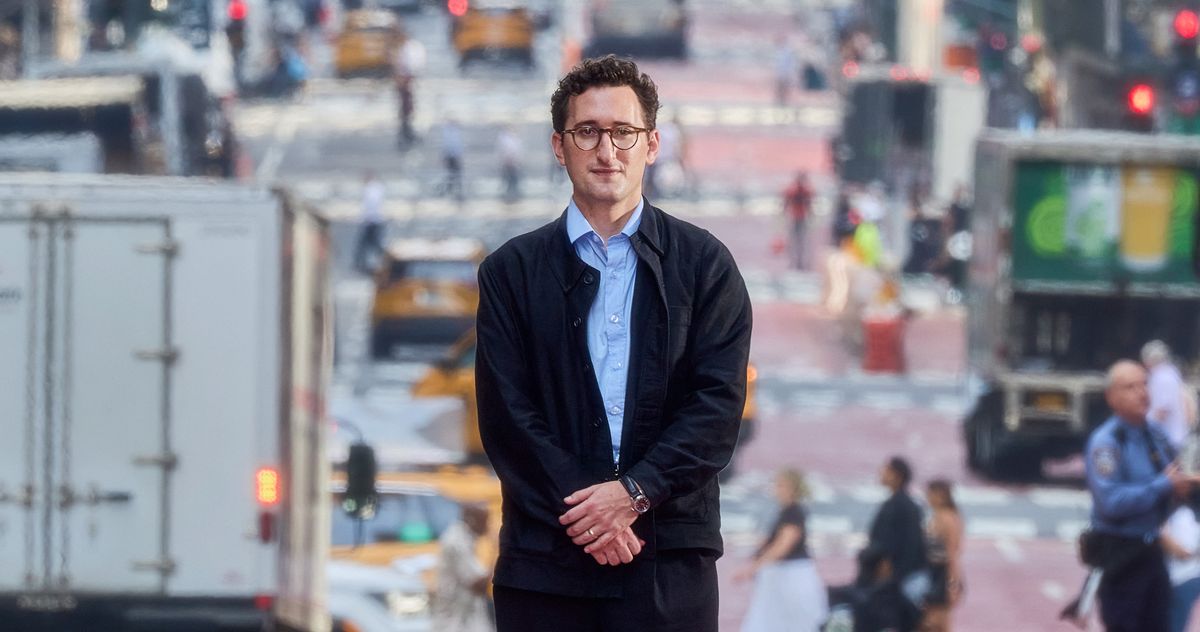
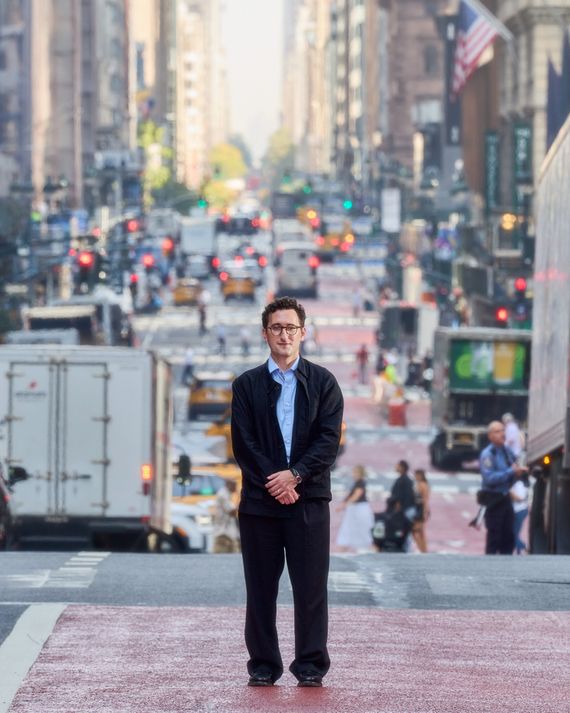
Photo: Chris Maggio for New York Magazine
Spoilers ahead for the plot of You Can See Everything.
On Elizabeth Holmes’s last day of freedom, Lance Oppenheim and Nathan Fielder, who had spent the previous month filming every facet of her life, considered giving her some space. Holmes was about to begin an 11-year sentence at a federal prison in Bryan, Texas, for defrauding investors in her blood-testing company, Theranos, of hundreds of millions of dollars. Her parents had come to see her off; she might have preferred to spend her remaining time with her partner, Billy Evans, and their two young children unobserved. But Oppenheim wanted the perfect shot of Holmes entering the prison — so he drove the whole family there, playing Bob Marley’s “Buffalo Soldier” at Evans’s behest while the cinematographer David Bolen crouched in the trunk with his camera trained on Holmes’s face. “I remember Lance and Nathan really fighting about the approach,” Bolen says. “But Lance just pushed and pushed and pushed. No matter how awkward the ask is, Lance will make the ask.”
The resulting documentary, You Can See Everything, is a shockingly intimate probe of Holmes’s beliefs and her persona. Fielder, who literally moved in with the family, plays the role of tricksterish inquisitor; Oppenheim imbues their interactions with cinematic flair. Already, awards prognosticators are speculating that You Can See Everything could make Oscars history as the first documentary nominated for Best Picture. Its release caps off a whirlwind year for the 30-year-old director. His first narrative feature, Primetime, starring Robert Pattinson as To Catch a Predator host Chris Hansen, debuted in Venice less than 24 hours before You Can See Everything’s surprise premiere at Telluride — a head-spinning scenario under the best of circumstances. It didn’t help that he had microdosed LSD in Italy and was still feeling the effects when he landed in Colorado: “I got to Telluride, and I was like, Oh no,” he tells me.
We’re at Tatiana, a Russian restaurant in Brighton Beach, for lunch the day after the New York Film Festival screening of You Can See Everything. Moments after sitting down at an outdoor table, Oppenheim breathes in the ocean air and starts cheerfully free-associating. The neighborhood reminds him of his native Florida’s Hollywood Beach Broadwalk, so he visits as often as possible; his second date with his now-wife, the producer Abigail Rowe, whom he’s trying to persuade to move to the area, was at this very restaurant. He orders expansively but not before checking in with me about each dish: Do I eat meat? How do I feel about pickled vegetables? And have I ever tried red caviar? “It’s the cheaper version — it’s like Temu caviar,” he explains. “When in Rome, man!”
Oppenheim, wearing round glasses and a green-and-white-striped shirt, has a guileless smile and a boyish energy that belies his ambition. Charismatic and neurotic, he speaks in paragraphs and is constantly observing — as we wait for our food, he comments on the Europop soundtrack and on a shirtless guy who wanders by “flicking his bag of blow.” He hates texting and loves phone calls. Fielder says Oppenheim regularly picks up even when he’s in the shower. “He doesn’t tell you he’s in the shower when the call begins,” he says. “But he’s always honest when you ask.”
In a filmmaking context, Oppenheim’s candor serves him well: Being vulnerable with his subjects generally inspires them to return the favor. His first feature, 2020’s Some Kind of Heaven, about the Villages, an insular, well-off retirement community in his home state, finds many of its central characters grappling with failed relationships, unrealized ambitions, and their own mortality. His second, Spermworld, follows participants in the unregulated sperm-donation market: people meeting, as Oppenheim puts it, “on the edges of the Earth to try and conceive a child with a complete stranger.” He’s seen subjects go to trial, face romantic rejection, and lose their jobs on-camera; he’s also been holed up in a dingy motel bathroom while two of them had sex in the other room.
His innovation lies in the dreamy way he renders these experiences, with lush scores, bright colors, and precisely composed shots that help a viewer get inside his protagonists’ psyches. “Most people, when they’re going through something dramatic, the stakes can feel impossibly high. It’s almost like they’re living through a Hollywood drama,” he says. “But if you just observe it normally, through vérité means, you don’t really get that feeling.” Bolen, who has worked with Oppenheim on all of his features, explains their philosophy: “As soon as you bring a camera into a space, the atmosphere changes, the people change, we change. There is no objective reality. We’ve always been interested in how we can best present someone’s subjective truth in a visual way.” Ren Faire, a 2024 docuseries Oppenheim shot for HBO about the succession crisis at the Texas Renaissance Festival, marked the apotheosis of this strategy. Many of the major players were performers in their daily lives, used to inhabiting a fantasy world. The festival’s octogenarian founder was convinced he could hear angels, so Oppenheim hired voice actors to play them; when the crew flagged down a guy in a dragon costume and asked him to deliver a few lines externalizing the anxieties of the fair’s general manager, he happily obliged.
Oppenheim’s eagerness to explore and his embrace of artifice in order to “find something real on the other side of it” have made him one of the most unorthodox documentarians working today. The incentives of the streaming era mean many documentaries are now preordained affairs: true-crime narratives populated by talking heads and pitched when the outcome is already known, or cozy, authorized docs about celebrities. Oppenheim, like Fielder and John Wilson, is after something more heightened and less predictable; unlike them, he doesn’t have a writers’ room or make himself a character in the proceedings. He borrows from the tradition of nonfiction filmmakers like Frederick Wiseman, seeking out stories that can unfold in real time. Often, the process involves a lengthy “fishing expedition,” leaving him with hundreds of hours of footage to sift through in the edit. Then there are the surreal flourishes that bring the work into the realm of what Oppenheim calls “docufantasia.” None of Wiseman’s institutional portraits have the voices of angels talking to the guy in charge.
On each project, Oppenheim works with a tiny crew, and some repeat collaborators have become the most important people in his life. It was in the course of making Ren Faire that he fell in love with Rowe, who’d first found the story. A month after it premiered, he proposed to her. (Knowing that she loved monkeys, he hired one to present her with the ring.) She’s been part of everything he’s done since. Last spring, they had a son. Rowe says of her husband, “It’s almost like he was an alien beamed down to Earth and the only piece of software that was downloaded was like, ‘You are going to make movies.’”
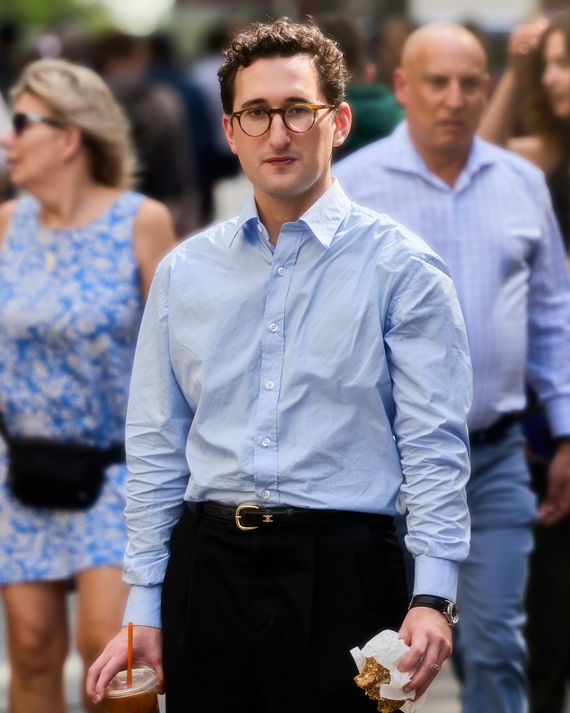
Photo: Chris Maggio for New York Magazine
For as long as he can remember, Oppenheim wanted to be a director. On Halloween in fourth grade, the year War of the Worlds came out, he dressed up not as Tom Cruise’s character but as Steven Spielberg. (His favorite film is a different Cruise vehicle, Cameron Crowe’s Vanilla Sky, a notoriously polarizing fantasy-versus-reality thriller that he estimates he’s seen upwards of 85 times.) His parents, both real-estate lawyers, were supportive of his ambitions — his dad, a Kubrick fan, blithely showed him A Clockwork Orange when he was 9.
A few years later, the recession hit. The family decamped to a patch of as-yet-undeveloped swampland near the Everglades, convinced that others would join them. Instead, Oppenheim found himself stranded nearly an hour from his school in Fort Lauderdale, cut off socially by the commute. Without friends nearby, he would spend some weekends watching three films a day. “I lived through movies,” he says. At 13, he got his first DSLR and started making them. He pored over his local newspaper, the Sun Sentinel, and earmarked stories he could pursue; at one point, he talked a group of activists into letting him ride along with its armed effort to rescue abused dogs. Real-life dramas seemed better than anything he might come up with himself. “I tried to write stuff, but I was a horrible writer,” he says. “I was doing, like, knockoff Nolan.” Soon, he was uploading shorts on Vimeo and pitching the New York Times’ “Op-Docs” division.
His parents’ stories about clients who had lost their homes sparked an enduring interest in the power of self-delusion. “During the foreclosure crisis, my dad would represent all these people who were living inside garages with all their stuff and still going about their day as if nothing was going on,” Oppenheim says. “People who’d entrapped themselves in a way of thinking — almost in a dream. All the movies I’ve made touch on that in a weird way. I like living inside a different reality with somebody, and I like the idea of what that can offer cinematically. When you come back to your own reality, everything feels different or a little more uncanny.”
Oppenheim went to Harvard, where he was taught by Ross McElwee, Robb Moss, and Dennis Lim, the artistic director of the New York Film Festival. “He was always very interested in this idea of the constructed nature of documentaries — fictional devices, uses of staging and reenactment, hybrid forms,” Lim says. (Oppenheim once submitted an essay titled “A Defense of the Hyper-Real.”) Some Kind of Heaven began as his thesis project. Authorities at the Villages denied him access, and the shoot required him to dodge security guards, charm subjects, and occasionally adopt disguises. He’d run out of money to keep filming when Darren Aronofsky, whom he’d sent a steady stream of chipper emails, agreed to meet — and ultimately came aboard as a producer. The finished version premiered at Sundance on Oppenheim’s 24th birthday.
He arrived at his signature approach while still in college. What it entails is less reenactment — common practice in docs — than stage-managed enactment. Oppenheim orchestrates moments that are “spiritually true,” letting an encounter unfold without interference but encouraging the participants to meet, say, in a garden at sunset rather than a plain office building at midday. Often, he actively collaborates with his subjects, showing them cuts, playing them the music he has in mind, and enlisting them in the effort to inhabit their perspective. Their involvement doesn’t spare them unflattering moments; plenty of characters are shown behaving strangely, badly, or both. Yet because of Oppenheim’s process, they tend to come away feeling seen rather than exposed.
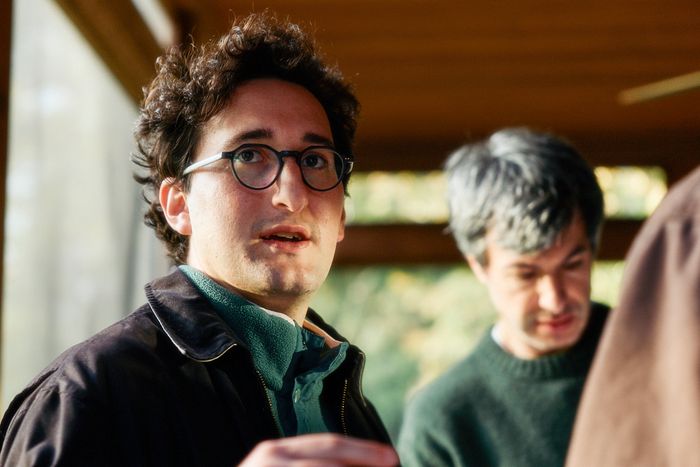
With Nathan Fielder.
Photo: Chris Maggio/Courtesy of A24
You Can See Everything began, as many of Oppenheim’s projects do, with a cold email. The tactic dates back to his teenage years, when, in the aftermath of the Sony hack, he’d searched the names of filmmakers he idolized, then decided to shoot his shot. (Multiple directors have introduced themselves to Oppenheim now that he’s made it only to learn he’d emailed them as a minor.) He grew up loving Nathan for You, a docu-comedy series in which Fielder “helped” struggling real-life business owners by proposing questionable fixes for their woes — so in 2020, when his screener system informed him that Fielder had watched 60 percent of Some Kind of Heaven, Oppenheim wrote to let him know there was another 40 percent after that. Fielder replied the same day. (He tells me he appreciated the film’s “uncanniness” and the fact that “these mundane moments had all these layers to them,” adding, “I forget why I took a break 60 percent through, but I’m sure it was important.”) Over long calls — and, once pandemic restrictions lifted, nights spent talking at bars until 1 a.m. — they became friends and started scheming about how they might collaborate.
One evening, Fielder invited Oppenheim to the Magic Castle, a private magic club in L.A. with a suit-and-tie dress code. (He lent Oppenheim an oversize jacket and a tie with a “weird drum set” pattern for the occasion — “maybe to mess with me, maybe because that’s what he likes,” Oppenheim says.) In response to a magician’s prompt, someone called out Elizabeth Holmes’s name, and after the show, Oppenheim mentioned a rumor he’d heard: that she had just approached A24 about a documentary.
Fielder called the studio the next day, then set up a preliminary meeting with Holmes. He went back to A24 with his terms. He would do it only if the studio could promise immediate funding to start shooting and a kill clause so he and Oppenheim could pull the plug at any time. “We got to decide that if we don’t like what we’ve done, they’re not getting their money back and that’s it,” Oppenheim recalls. A24 agreed. A week and a half later, they’d assembled a team and were setting up cameras at Holmes’s home in Del Mar, California.
Oppenheim had already read John Carreyrou’s Bad Blood and seen Holmes’s rise and fall dramatized by Amanda Seyfried in the Hulu series The Dropout. He was familiar with the contours of the story: the way she’d defrauded investors, misrepresented the capabilities of her technology, and vigorously insisted on her own innocence throughout. But he wasn’t prepared for how deep the denial went. Even when they arrived, just over a month before she went to federal prison, she was still talking as though her sentence wasn’t a sure thing.
For the next month, Fielder, Oppenheim, and a seven-person crew shot in her home for up to 16 hours a day. They agreed not to film privileged legal calls; virtually everything else was fair game. “You get to their house, and her computer’s open. All of her emails are open. Her journal is open on the side of the couch,” Oppenheim recalls. The performance of total transparency could reach comical heights. One day, he accompanied Holmes’s partner, Evans, to the gym and asked what else he was planning to do that afternoon. Evans mentioned that he’d have to shower, and before Oppenheim could propose a tasteful, minimally invasive approach, he stripped and hopped in. What follows is the sequence that earned You Can See Everything its R for graphic nudity. “It seems like he really had something he wanted to show to us and to the world,” Oppenheim says.
The look of the film was born of necessity. To avoid missing a potentially significant reaction, the team learned to keep a camera on each of the principals throughout. They soon found their way to something unexpectedly immersive. Large swaths of the film are composed of close-ups of people’s faces or hands, giving seemingly mundane exchanges and gestures — say, a moment when Evans, unimpressed with Holmes’s egg-whisking technique, confiscates the bowl — greater weight. Ordinarily, Oppenheim would cut anything that called attention to a presence behind the camera. In You Can See Everything, glimpses of crewmembers and equipment serve to heighten the immediacy. “It’s all about the difficulty of capturing those moments,” he says. “And about the difficulty of trying to make sense of them.”
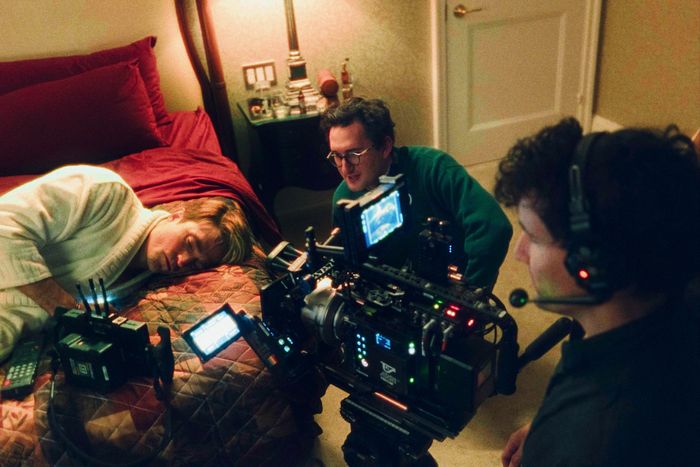
With Robert Pattinson and David Bolen on the set of Primetime.
Photo: Sinna Nasseri/Courtesy of A24
Primetime, which Oppenheim worked on simultaneously, is in many ways You Can See Everything’s opposite. Where one is a stripped-back effort to get to the truth of a person, the other is scuzzy, hyperstylized, and deliberately over the top. Real-life events take on a mythic dimension: During one sting, Hansen sees a demon lurking in the darkness. Oppenheim describes Primetime as a “fever dream” and an “elaborate form of fan fiction” rather than a conventional biopic. And he is in fact a fan of Hansen’s; as a kid, long before he saw films like F for Fake and Close-Up, he was riveted by the interplay of artifice and reality on To Catch a Predator.
Originally, Pattinson had planned to produce Primetime but not to star in it. Ajon Singh, who wrote the screenplay, spent a frantic week retooling it to persuade him to change his mind. Oppenheim resorted to bribery. “Rob, at the time, was grappling with a Zyn addiction,” he says. There was a shortage in the U.S., so Oppenheim enlisted a friend who was working in Canada to send 200 canisters to Pattinson’s place in L.A. Then he dropped off the latest draft with a letter that began, “Dear Chris Han-Zyn.” When Pattinson called to say he was in after reading the new script, “it was like LeBron making the announcement that he was joining the Heat.”
Though the form was new for Oppenheim, much of the thematic terrain of Primetime — including the question of how a staged situation, like the houses rented by Hansen’s team and the actors paid to play children, might be used to expose the truth — was familiar. His obsession with spontaneity shaped his approach. He threw out the shot list, routinely kept the cameras rolling long after a scene was supposed to end, and encouraged improv. “If you come in with a plan and you execute that plan perfectly, Lance will hate it,” Bolen says.
“He has very unique whims,” Pattinson says. In one scene, Hansen spits out mouthwash; at first, Pattinson did it normally. “Lance is like, ‘Ugh! So boring! This is not working!’ And he says, ‘Rob, just try one where you go crazy,’” Bolen recalls. “Everyone on set is looking at him like, What?” Finally, Pattinson threw his whole body into the movement — arms back, face hurtling toward the sink. It was the take that ended up in the film and that launched a thousand memes upon release.
As in his documentaries, Oppenheim got the visuals he wanted, whatever they required. One shot of a computer’s innards involved a colonoscopy camera; several sequences were filmed with a camera that was actively degrading because he loved the effect on the image. “We found it on eBay for, like, 50 bucks,” Pattinson recalls. “It was so humid the camera was literally dying. Every day it would get worse and worse. And we’d shoot entire scenes, and Lance would be like, ‘Okay, we got it.’ And then I’d look at the dailies, and he’d only shot on the broken camera. He’s like, ‘But it looks great!’ I’m like, ‘You’re a crazy person.’” But he appreciated Oppenheim’s collaborative impulse — and his willingness to argue. “We would go head-to-head about stuff, and it never damaged the relationship. We always ended up with the interesting version,” he says. “And 99 percent of the time it was Lance’s.”
The actual Hansen condemned the movie before he’d seen it and wasn’t particularly pleased when he did, calling it a “hit piece” and a “complete fiction.” He has taken to tagging Oppenheim in random Instagram posts but hasn’t otherwise reached out. “I’m bummed!” Oppenheim says. “I want to talk to him.” But he suspects that Hansen, who recently posed for a photo in the Los Angeles Times wearing what appeared to be a bulletproof vest, is now in “messianic territory”; he’s no longer engaging with Oppenheim as a real person, either.
Until Holmes, the characters in Oppenheim’s documentaries had been relative unknowns — people with far less incentive to deceive him. Though he opened up to the subjects of You Can See Everything (“I did share a lot about myself,” he says a little uneasily), they did not review cuts. Oppenheim also knew that the kind of stagecraft he typically deployed would only compound the authenticity problem inherent in a film about, as he puts it, “quite possibly the biggest manipulator in the world.” To capture something real, he would have to dispense with “all of the bells and whistles that I usually do” and embrace a style he’d once rejected: pure, rigorous vérité.
This being a Fielder-and-Oppenheim production, there’s a little more going on than that. Both are preoccupied with questions of truth and performance; inevitably, there’s a meta layer to the proceedings. Yet the most significant twist arose almost by accident. The two filmmakers had been struggling to get anyone else in Holmes’s orbit on-camera when Emma Stone, a close friend of Fielder’s, connected him with Amanda Seyfried. On a preliminary Zoom call, Fielder said only that they’d been working in secret on a project that involved extensive access to Holmes. Could they show her, and would it be okay if they recorded her reaction? Seyfried agreed — though Oppenheim recalls that, as a fan of Fielder’s past work, she was wary of getting “punked.” Immediately upon meeting Seyfried in person, they handed her a laptop with material from their month in Del Mar and started filming, hoping her response might give them “a deeper understanding of what we’d made.”
When Seyfried expressed a sudden impulse to play Holmes again, the next phase of the documentary began to take shape. Her involvement dramatically expanded the project’s scope. She could help Fielder and Oppenheim by playing Holmes in sequences a camera couldn’t capture, but she also had her own interests and her own relationship to the subject. “As soon as Elizabeth leaves, the movie is sort of haunted by her absence. Everyone in it is attempting to remember her in different ways and also create a version of her,” Oppenheim says.
The reenactments that ensued came with new challenges even for Fielder, whose HBO series The Rehearsal hinges on elaborate simulations of real-life events. The visitor area of Federal Prison Camp Bryan, where Fielder and Holmes would meet, had to be reconstructed essentially from memory. “You can’t take pictures of the prison. You can’t bring a recorder in. You can’t even bring a pen and paper in,” Oppenheim says. Fielder would call him immediately upon leaving for a “moment-by-moment play-by-play” with Oppenheim transcribing everything that had occurred. Small discrepancies in delivery or uncertainties around word choice became an engine of drama: How had Holmes really said it, and what did she really mean?
Oppenheim has spent a lot of time thinking about what he calls the “inherently vampiristic relationship” between subject and documentarian. (His favorite book, naturally, is Janet Malcolm’s The Journalist and the Murderer.) When the stars of some of his early shorts reacted unfavorably, he was crushed. He developed his usual collaborative approach in part to minimize the sting of betrayal — and his lasting bonds with many of his subjects suggest he’s succeeded. He still talks with Reggie and Anne, the central couple of Some Kind of Heaven; Brian Brier, who appears in Spermworld, even had a bit part in Primetime.
For You Can See Everything, he had to suppress his queasiness about his subjects’ disapproval. “I have no idea how Billy and Elizabeth are going to react to the film. But everything that’s in there is the truest form of what Nathan and I experienced dealing with them,” he says. “I made a movie about it because that’s the only way I can really express my feelings.” When I wonder aloud whether Fielder’s responses to Holmes — by turns subtly skeptical, outright incredulous, and surprisingly sympathetic — are sincere, Oppenheim assures me that none of it is for show. “I feel like this is the closest we’ve ever come to actually seeing Nathan not being a character onscreen or doing a bit,” he says.
The onscreen friction with Evans, who emerges as something of a villain, was also real. “I do believe she’s very much in love with Billy,” Oppenheim tells me. “I believe that they’re very much in love with each other — and that’s interesting, too, because for a long time I was like, What’s happening? ” But he says tensions escalated after Holmes went to prison and Evans attempted to assert control over the film. For the first time in Oppenheim’s career, his relationship with a subject broke down seemingly beyond repair. When he was working on Primetime, he would wrap a full day of shooting and then talk with Evans and Fielder late into the night; now, neither director has spoken to Evans in months. (Evans did not respond to a request for comment.)
Oppenheim is restless by nature. “You put something out into the world,” Bolen says, “and the next day Lance is anxiously being like, ‘Okay, wait, what’s next?’” He hopes to make a documentary with Pattinson and an adaptation of Nick Drnaso’s graphic novel Acting Class. Then there’s a “found-footage revenge movie” Oppenheim describes as “American Movie meets John Wick,” constructed entirely from iPhone and Android videos. This, too, would be docufantasia: “It’s all real — for the most part.”
For now, though, he’s still puzzling over You Can See Everything. Even having watched the film “300 times, maybe more,” Oppenheim still doesn’t quite know what to make of what he saw. “Usually, when I’m done with something or I’ve worked on it for many years, I’m like, I know every part of this,” he says. “This is a mysterious object that keeps growing in meaning.”
Thank you for subscribing and supporting our journalism.
If you prefer to read in print, you can also find this article in the October 19, 2026, issue of
New York Magazine.
Want more stories like this one? Subscribe now
to support our journalism and get unlimited access to our coverage.
If you prefer to read in print, you can also find this article in the October 19, 2026, issue of
New York Magazine.
Sign up for the Vulture Daily
An entertainment newsletter for the pop-culture obsessed.
Vox Media, LLC Terms and Privacy Notice
Related