
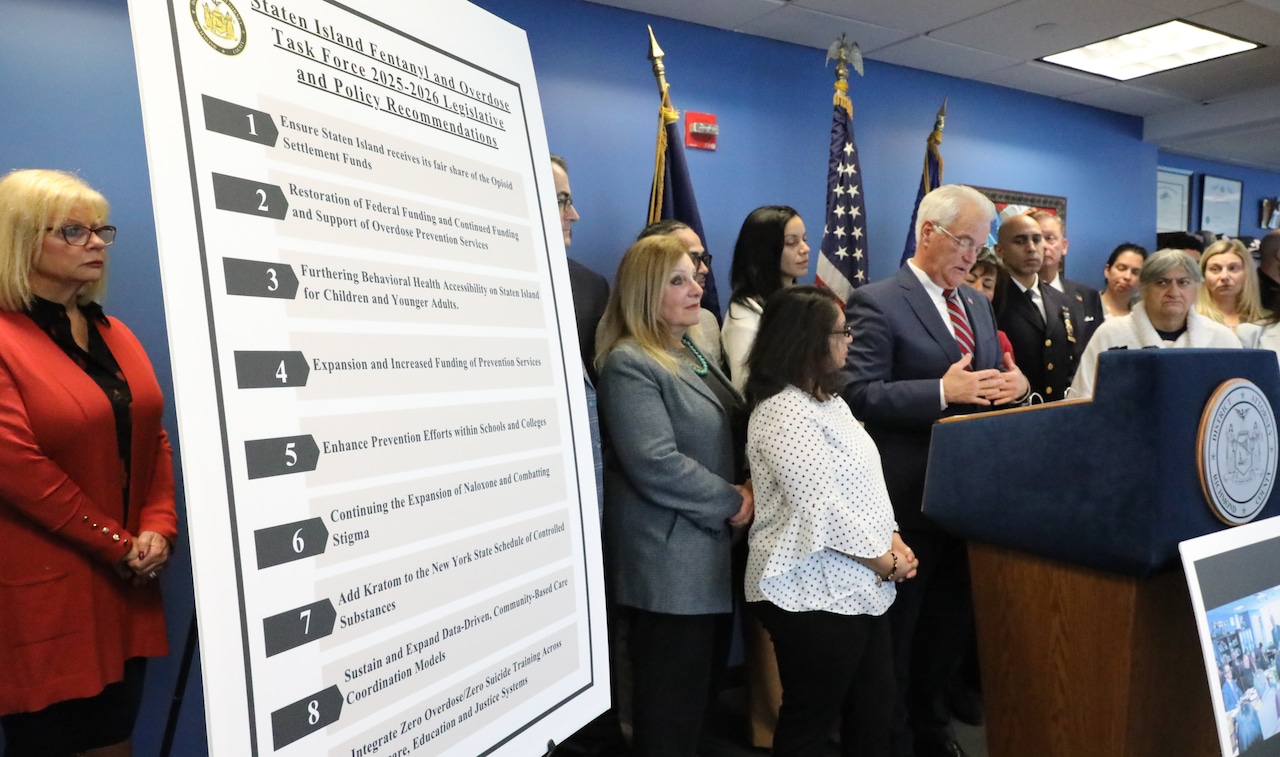
STATEN ISLAND, N.Y. — The Staten Island Fentanyl and Overdose Task Force is publicly demanding more state funding for addiction treatment and prevention, highlighting significant unspent funds and a lack of local representation in allocation decisions.
These are five key takeaways from the original article by the Advance/SILive.com.
1. Significant progress in reducing deaths, but the fight continues
The task force’s efforts have been credited with a crucial 49% reduction in fatal overdoses on Staten Island in 2024, a decline that leads all other boroughs. Despite this progress, officials stress the crisis is far from resolved.
District Attorney Michael E. McMahon stated, “we’re not celebrating; the battle is far from over,” pointing to the 81 lives lost last year and the 78 suspected overdose deaths recorded as of Nov. 9 this year.
The ultimate goal remains zero overdoses, and the task force insists that while progress has been made, more work is essential to prevent further loss of life.
2. Hundreds of millions in opioid settlement funds remain unspent
A central point of frustration for the task force is the vast amount of unallocated state money intended to combat the opioid crisis. The report highlights that $500 million from the state’s Opioid Settlement Fund remains unallocated.
Furthermore, since 2022, the fund has accrued $35 million in interest, a substantial portion of which also remains unspent.
Dr. Joseph Conte, executive director of the Staten Island Performing Provider System, called for the immediate release of these funds, stating, “They are sitting useless in the bank” while communities like Staten Island face a deadly, ongoing epidemic.
3. Current funding is insufficient for Staten Island’s needs
While Staten Island has received some financial support, the task force deems it inadequate. In 2024, $12 million in settlement funds were allocated to eight borough organizations, with each set to receive $375,000 for four years.
However, the task force’s report explicitly states that “while this funding is deeply appreciated, it remains insufficient to meet the borough’s widespread and escalating needs.” This highlights a significant gap between the resources provided and the on-the-ground reality of the overdose crisis in the borough.
4. A call for local representation in fund distribution
The task force identified a critical flaw in the state’s funding allocation process: a complete lack of local input. The report notes there are no Staten Islanders on the advisory board that determines how the state’s Opioid Settlement Funds are distributed.
Task force members, including McMahon, believe this absence is a primary reason the distribution system “fails to prioritize high-risk counties” like Staten Island. They argue this structural issue leads to providers being underfunded and residents being underserved, and they are demanding the situation be rectified.
5. Fentanyl continues to drive a deadly epidemic
The urgency of the task force’s demands is rooted in the lethality of the current drug supply. The report underscores that overdose deaths are now predominantly linked to illicit fentanyl, a synthetic opioid up to 50 times stronger than heroin.
The scale of the national crisis was put into perspective by Conte, who noted that drug overdoses have claimed “over a half a million lives since 2019” in the United States. This statistic frames the local fight on Staten Island as part of a catastrophic nationwide public health emergency fueled by powerful synthetic drugs.
A draft of this story was generated using AI. It was reviewed, edited and approved by Advance/SILive.com staff.
If you purchase a product or register for an account through a link on our site, we may receive compensation. By using this site, you consent to our User Agreement and agree that your clicks, interactions, and personal information may be collected, recorded, and/or stored by us and social media and other third-party partners in accordance with our Privacy Policy.