
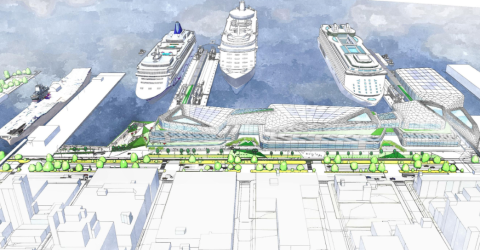
The New York City Economic Development Corporation has unveiled a “master plan” for the redevelopment of the Manhattan Cruise Terminal, which would allow for the docking of three large ships, each housing up to 8,000 passengers.
The 12th Ave. port, which runs from W. 39th St. to W2. 45th St., can currently host a maximum of two 4,000-passenger ships. The overhaul would also completely electrify the port, not to mention modernize its 90 year-old piers.
The plan still needs to acquire a few stamps of approval, not least the federal government’s. It does not yet have a price tag, and would build on a planned $3.5 billion redevelopment of its sister facility, the Brooklyn Marine Terminal.
According to the NYCEDC, the reimagined port would be “integrated” into the surrounding Hudson River Park. They’re touting the plan as the result of a 12-month “community engagement process.”
A record total of 1.5 million passengers were received by both the Manhattan Cruise Terminal and its Brooklyn counterpart in 2024, the state development agency says, which created 3,000 jobs; while NYC lags behind Caribbean cities as a go-to cruise destination, officials are clearly betting that the sector has room for continued growth in NYC, given how much the Manhattan terminal would expand.
“The Manhattan Cruise Terminal Master Plan is a bold, forward-looking vision that will redefine the future of cruising in New York City,” NYCEDC President & CEO Andrew Kimball said in a statement.
“By modernizing and electrifying the terminal, this plan will meet urgent industry demands, grow economic impact and tax revenue for the City, and deliver on the community’s longstanding goals for a safer, more sustainable terminal with public access to the waterfront,” he added.
An initial commitment of $20 million would be disbursed for establishing sufficient “shore power” at the expanded port, which is being touted as a means of reducing carbon emissions. This means that docking ships can connect to the NYC grid, thereby allowing them to turn their engines off, or recharge their batteries.
It’s unsurprising that having ships plug into shore power is such an integral part of the plan, given that it’s now illegal to do otherwise.
Due to lingering community concerns about ship pollution, a bill dubbed the “Our Water Our Air Act” passed into law last year, which essentially mandated the process. Its chief co-sponsors were City Council Members Erik Bottcher and Alex Aviles, who just so happen to represent the districts that contain the Manhattan Cruise Terminal and the Brooklyn Marine Terminal, respectively.
The NYCEDC also believes that the terminal would become a “dynamic multimodal hub for transit and freight delivery.” The plan has been endorsed by the Maritime Association of the Port of New York & New Jersey, which advocates on behalf of commercial shipping interests.
“By upgrading marine infrastructure, expanding shore power, and integrating community-focused improvements, the plan strengthens New York Harbor’s position as a global maritime hub while advancing the future needs of port operations,” Maritime Association Executive Director Stephen Lyman said in a statement of his own.