
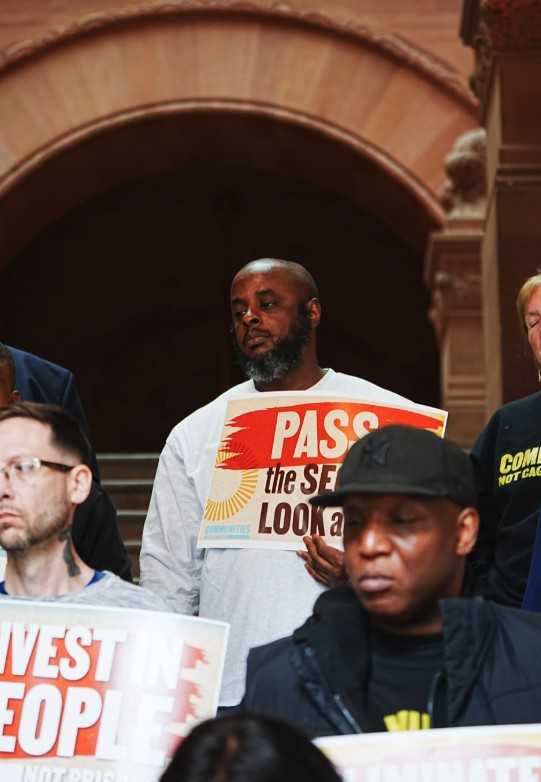
A criminal justice reform coalition is making a major push for a trio of laws that would reform sentencing practices across New York state.
Legislators and criminal justice advocates will hold rallies in eight areas of New York state Nov. 17 to demand the passage of a legislative package that includes the Second Look Act, Earned Time Act, and Marvin Mayfield Act. Proponents of the package are hoping to seize on the political energy created by the electoral shift toward Democratic governance in the midterms to pass some long-proposed criminal justice reforms at the state level.
“For decades, New York has relied on extreme punishment, mandatory sentences, and mass incarceration, with devastating consequences for Black and Brown New Yorkers. Progressive victories across the country in the midterm elections have given us renewed momentum heading into the 2027 legislative session,” said Thomas Gant, an organizer at the Center for Community Alternatives. “Here in New York, we have an opportunity to turn that energy into real change for families who have waited far too long.”
Rallies will take place at noon in New York City, Rochester, Syracuse, Buffalo, Long Island, Westchester, Albany, and Ithaca. Advocates noted widespread support from many different sides of the criminal legal system for the changes.
New York Chief Judge Rowan Wilson and Chief Administrative Judge Joseph Zayas, corrections leaders including a former prison commissioner of the Department of Corrections and Community Supervision (DOCCS) and the American Bar Association have all come out in favor of sentencing reforms.
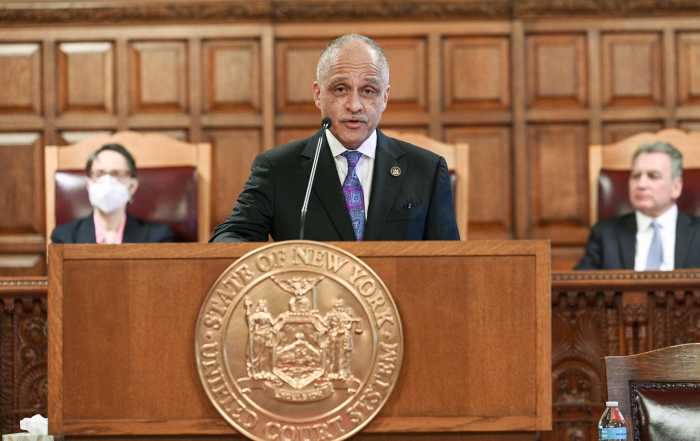 New York Chief Judge of the Court of Appeals Rowan Wilson delivered his State of the Judiciary speech on Feb. 10, 2025.
One of the pieces of legislation, known as The Second Look Act, would provide a process for judges to consider shortening sentences of 10 years or longer. Another, named The Marvin Mayfield Act, would eliminate mandatory minimum sentences in New York state. The third piece, the Earned Time Act, expands on time credit systems for incarcerated people — programs that reduce sentences through participation in education, vocational training and work assignments.
The political momentum in the state Senate behind the Second Look Act began to build this past year as the legislation passed out of the Senate Codes Committee, which reviews criminal and civil justice legislation. In the Assembly, the bill has stalled in the Corrections Committee since 2025.
State Senator Julia Salazar (D-Brooklyn), the lead Senate sponsor of the Second Look Act, has said that New York’s laws have not meaningfully changed to allow for incarcerated people to show their progress in areas like education and community service.
“Our laws too often refuse to recognize their transformation or the fact that their sentence was excessively harsh to begin with,” Salazar said. “The Second Look Act would finally give people serving such long sentences the opportunity to demonstrate their rehabilitation before a judge and have their sentence re-considered… There is no reason to delay.”
The costs of mass incarceration
In the state of the Judiciary two years ago, Wilson echoed points that criminal justice advocates have long made: mass incarceration is costly and does not meaningfully contribute to public safety. In New York, it costs roughly $70,000 per year to incarcerate a person in state prison.
In the 1970s, New York enacted a set of strict mandatory minimum sentences for drug offenses, which stripped judges of discretion and introduced severe life sentences for drug-related crimes.
In 2009, New York repealed some of its mandatory minimums for low level drug offenses and some forms of burglary. The reforms gave judges more flexibility on minor offenses, there are still felony drug offenses that can still carry severe prison sentences. Advocates argue that mandatory minimums give prosecutors an unfair advantage in forcing defendants to take plea deals.
As of 2019, 33% of arrests and 50% of convictions still involved mandatory minimum sentences, according to the New York City Bar Association.
Peggy Herrera, a member of the Center for Community Alternatives, came to advocacy after she was arrested in response to a 911 call she made to ask for help for her son, Justin Baerga, who was experiencing a mental health crisis. Herrera has been pushing for criminal justice reform ever since. Four years ago, Baerga died in a shooting on his birthday.
“I don’t want another mother to experience the pain of losing her child, whether to violence or to decades of incarceration. We have to find ways to heal our communities and prevent more families from suffering. That’s why I support the Second Look Act. Giving someone a chance to demonstrate that they’ve changed doesn’t erase the harm they’ve caused,” Herrera said.
 Photo via Getty Images