
A pedestrian walking through Bayside, Queens, might not think they were in New York City at all. Tall oak trees line streets dotted with mailboxes. Instead of bodegas and subway stops, it’s mostly residential with mostly single-family homes with front lawns.
Barbara Gertel has lived here for 24 years. She wants the neighborhood to stay exactly how it is.
“They’re trying to stick a building in our part of the world,” she said while standing before her community board on Oct. 6. “Well, I think we need to fight it.”
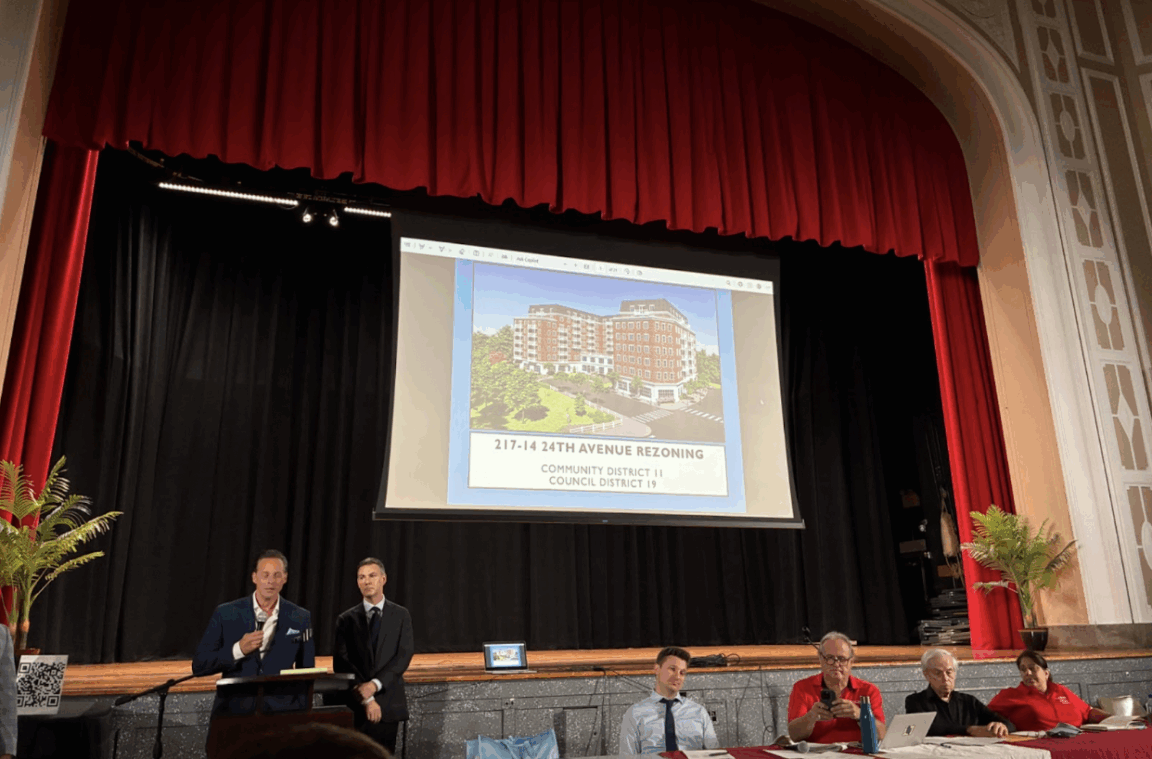
Gertel isn’t alone. She was among more than 450 residents filling Bayside High School’s auditorium that night to overwhelmingly oppose an eight-story apartment complex proposed for 24th Avenue and Little Neck Boulevard. The project’s developers — Barrone Management and Apex Development — presented their case at the nearly three-hour meeting filled with heckling and invocations of the Constitution from the listening Queens Community District 11 residents. Their most frequently voiced concern was that accepting the development would set a dangerous precedent that could forever change the neighborhood’s aesthetic.
When the board chair called Gertel to speak, she walked up to the microphone and stoically introduced herself.
“These people are going to take a small area and build a huge structure,” she said. “It’s too much in one little area. Where are people going to park? There’s barely parking now.”
Murmurs of agreement spread throughout the crowd. One man thrust into the air a large sign emblazoned with the words, “Where’s the parking?”
“Traffic will be so much worse,” Gertel continued. “We’re zoned for one- to two-family houses for a reason, and we shouldn’t change it.”
The audience broke into a cheer. “I agree with you!” yelled an elderly woman.
All 18 residents who spoke that night said they staunchly opposed the 183-unit complex, including 128 market-rate, 55 rent-controlled and 65 senior-assisted-living units. One speaker even invoked the Constitution.
“We the people,” — the applause was enthusiastic — “have the right to stand up to this!”
Residents cited many reasons for their opposition, such as the location — in a federally-designated flood zone — limited parking, aesthetic concerns and fear of too much construction. The district includes Bayside, Douglaston, Little Neck, Auburndale, Oakland Gardens and Hollis Hills, and it’s zoned mostly for single-family homes. As a result, the project would require a major zoning change.
“These developers don’t understand that we just want to live in our suburb,” said Paul Graziano, an urban planner and lifelong Little Neck resident. He criticized attempts to rezone District 11 and saw them as part of a wider wave of citywide changes ever since Mayor Eric Adams initiated his City of Yes for Housing Opportunity plan.
“It’s important to maintain our high level of homeownership and quality of life,” he added. Residents in the district own over 65% of occupied housing units, whereas only 29.8% of occupied units in the city as a whole are owned instead of rented.
“We’re not against all new things,” Graziano said. “But if we say yes to this complex, which clearly doesn’t fit the community, it’ll open a floodgate for overdevelopment.”
During the meeting, developer Scott Barone emphasized that he is from Queens and is pursuing this project so that older residents like his mom can retain a place in the neighborhood as they age. Community District 11 has one of the oldest populations in the city, with more than 20% of residents over 65. But as Barone presented his plan, residents yelled, “absolutely awful” and “we like things the way they are.”
Their resistance has stayed consistent. On Sept. 30, the East Flushing/North Bayside Zoning Committee rejected the zoning amendment that would allow the complex to be built. When the Queens borough president held a hearing about the zoning amendment on Oct. 16, Community Board 11 Chair Paul DiBenedetto reported that the community board unanimously voted down the amendment and complex.
But that’s not entirely true. On Oct. 6, board member after board member rejected the project, until it was Rosemarie Guidice’s turn. “I vote yes,” she said on Zoom. Immediately, the crowd booed her.
“New York does need housing,” she told Along the 7. “Sure, this complex is not deeply affordable, but someone will want to live there.”
“I think a lot of people are afraid of what this all means for their way of life,” she added. Residents say they are used to looking out their windows and seeing uninterrupted sky, not walls. They don’t want to deal with construction noise or more cars on the road or the possibility of renters wanting more public transportation in the community.
“They say an eight-story building is out of character with the neighborhood,” Guidice said. “Honestly, I agree. But change isn’t the enemy. Stubbornness is. Fear is.”
For right now, Guidice seemingly stands alone. She suggests that perhaps during a time of immense change people are at their capacity for adapting to new things. Maybe the fear of the unknown simply weighs more heavily than an openness to the unfamiliar. This is, after all, a community where many residents stay their whole lives.
Graziano, DiBenedetto, and other attendees at the board meeting vowed to fight the apartment complex every chance they get, all the way until the proposal goes to city council.
“Time will tell who triumphs,” Guidice said.