
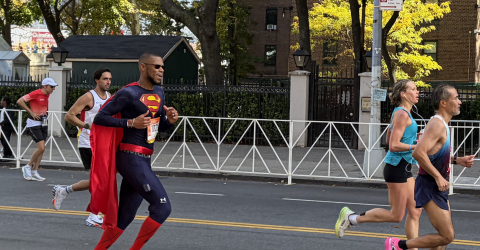
More than 60,000 runners hoofed it 26.2 miles, from Staten Island to Central Park, at speeds ranging from a startling gallop to a grueling trudge in the TCS New York City marathon on Nov. 1. An estimated 2 million spectators also lined the streets at one point or another. Tracy Morgan was the race’s Grand Marshal.
Breaking the tape first in the women’s race was the event’s 2024 winner, 35-year-old Kenyan Sheila Chepkirui in 2:24:36 (5:31 mile pace), besting 34-year-old American Jess McClain by six seconds. In the race’s most dramatic moment, McClain stalked last year’s winner, 36-year-old Kenyan Hellen Obiri, smartly taking the tangents in Central Park before sprinting past Obiri in the race’s last meters.
The men’s race was won by 31-year-old Swede Andreas Almgren in 2:06:01 (4:54 mile pace), besting the Ethiopia-born Italian Yemaneberhan Crippa by 13 seconds. It was Almgren’s debut marathon, following years as an elite, if not world-beating, middle-distance runner.
Weather for the event was very good, sunny, with little wind and temperatures in the 50s. If this was a little too warm for many runners’ optimum performance, it was excellent for most spectators. One exception to this is anyone who happened to be within earshot of one of this year’s race innovations, an infinitely looped warning message blasted over loudspeakers at Fifth Avenue and 130th Street in Harlem:
“Attention runners: Due to warm temperatures course conditions may be dangerous. Please listen to your body. Slow down if necessary and stop at a medical tent if you feel feint. Don’t try to beat the heat.”
The course is difficult, with dragging hills and bridges. Indeed, many people have had their races later go cockeyed because they got overexcited running down the Verrazzano-Narrows Bridge into Brooklyn. The subsequent spans are the Pulaski, from Greenpoint to Long Island City; the 59th Street Bridge into Manhattan; the Willis Avenue Bridge from East Harlem into Mott Haven, and Madison Avenue Bridge back into Harlem.
It was on the Manhattan side of this last span—a four-lane swing bridge over the Harlem River—where this reporter made his base camp: Fifth Avenue and East 138th Street. This location was chosen because it offers the best combination of access and drama. It’s far enough into the race—just past the 21-mile mark—that there’s great suffering but still early enough that the front-runners are closely packed.
What the Bronx lacks in miles, it makes up for in intensity, including the bridge itself, whose pedestrian walkway is a favored spot of knowing spectators who bring mordant signs with them such as “Last Damn Bridge” and “F**k it up Buttercup.”
Despite these playful attempts at encouragement, many runners did f**k it up, paying the price here for prior over enthusiasm, coming off the bridge only to start walking or nearly collapse. With water, food and a race medical tent nearby, there were no major emergencies but the worries were real.
Cheers and Perseverance
Watching all this unfold on the southeast corner of Fifth Avenue and 138th Street was a tall, lean, dapper-looking black gentleman in a hip-length black leather jacket, green corduroys and clean, crisp brown felt Homburg hat. His name is Ernest Connor and he returns to this spot every year.
In 1980, Connor set a world record for running the New York City Marathon… backwards, in 5 hours 11 minutes. Connor, now 82, was living in the Bronx then, which was in a very bad place. Running the marathon backwards, he explained, would prove how one can triumph over adversity. Connor lives in Atlantic City now, and drove up the day before.
Seeing a couple of NYPD Harbor unit officers standing next to Connor unaware of who he was, after asking where they parked the boat, introductions were made. The cops were genuinely inquisitive about Connor, who was happy to explain his astounding journey, again.
Running forward, the first female New Yorker—and the first Manhattanite—was Lily Murphy, 22, who finished in 2:30:06, 5:44 mile pace. Murphy ran track and cross country at the University of Pennsylvania and is presently an investment banking analyst for Barclay’s.
Second among the local women was Alosha Southern, 31, of Brooklyn, who finished in 2:41:29, 6:10 mile pace. A former runner at Grinnell College in Iowa, Southern is a paralegal at Rottenburg, Lippman, Rich law firm.
On the men’s side, the first Manhattanite was Jacob Shiohira, 30, who ran 2:16:15, 5:12 mile pace. Remarkably, Shioria ran in high school in Bentonville, Arkanas, but not in college at the University of Nebraska, and he didn’t start training seriously until he began his career as a software engineer.
Taking second for the local men was Brooklynite Ryan Cutter, 27, who ran 2:17:42, 5:16 pace. Cutter ran track and cross country at the University of Chicago as an undergrad and at Villanova as a grad student. Today he’s a sustainability consultant for the architecture and urban planning firm, AECOM.
“She Was Always on the Go”
“You’re killing it!” is a frequent shout of excited spectators to strangers, reading the name on their bib, like Rie Kauwuchi, of Japan, who finished 19th in the women’s race, or former Stuy Town resident Ruairi Kelly, who ran for FDNY.
These exhortations had an unintendly tragic reflection later in the day, however, with the news that 24-year-old Rachel Apa had died during the race, after collapsing near the 24-mile mark.
A former Division 1 field hockey player at Bucknell University, Apa was in excellent health and having a joyous first time marathon when she was felled but rhabdomyolysis also known as rhabdo. This rare condition, triggered by extreme exertion or trauma, causes rapid muscle breakdown which can result in an equally quick death as muscle fibers breakdown and sent harmful proteins into the bloodstream. Because the symptoms can be similar to the marathon pains many people push through, immediate lifesaving treatment can be missed.
“She was always on the go, always go, and it doesn’t matter if it’s school or sports or whatever it is. She was go,” said her bereft father from the Apa family home in Lewisberry, Pennsylvania. Countless tributes to Apa would be posted by runners in the hours and days following the race.
There was a similar online outpouring of first support, then anger and mourning for Katie Suarez, 28, of Bensonhurst, Brooklyn, who’d been viciously stabbed in the neck while running on the Shore Parkway on Thursday evening of October 30. Because Suarez was listed in critical condition as of Sunday, there was hope that she’d pull through.
When Suarez was pronounced dead on Monday after the marathon—which she was reportedly training to run in 2027—while the killer was still on the loose, the framing of many runners marathon memories, especially women, changed amid tributes to Rachel Apa and Katie Suarez online, including photos of the Apa ecstatically waving mid-race. The quieter Suarez was pictured smiling gently in a Frozen Bonsai 5K race T-shirt in Brooklyn.
At least one male runner who was clocking along at sub 3:00 hour pace was also felled by rhabdo around mile 18, but a neurologist from New York-Presbyterian Weill Cornell spotted him suddenly struggling and summoned EMS which whisked him to the hospital. He was released after several days and is expected to make a full recovery but has no memory of the incident that nearly killed him.
At press time, a 28-year-old Brooklyn man named Sayed Mohassib had been arrested for Suarez’s murder. Briefly an NYPD cop and a US Marine, before a discharge for psychological reasons, he had most recently been working as a teacher’s aide PS 200 elementary school in Bensonhurst.