
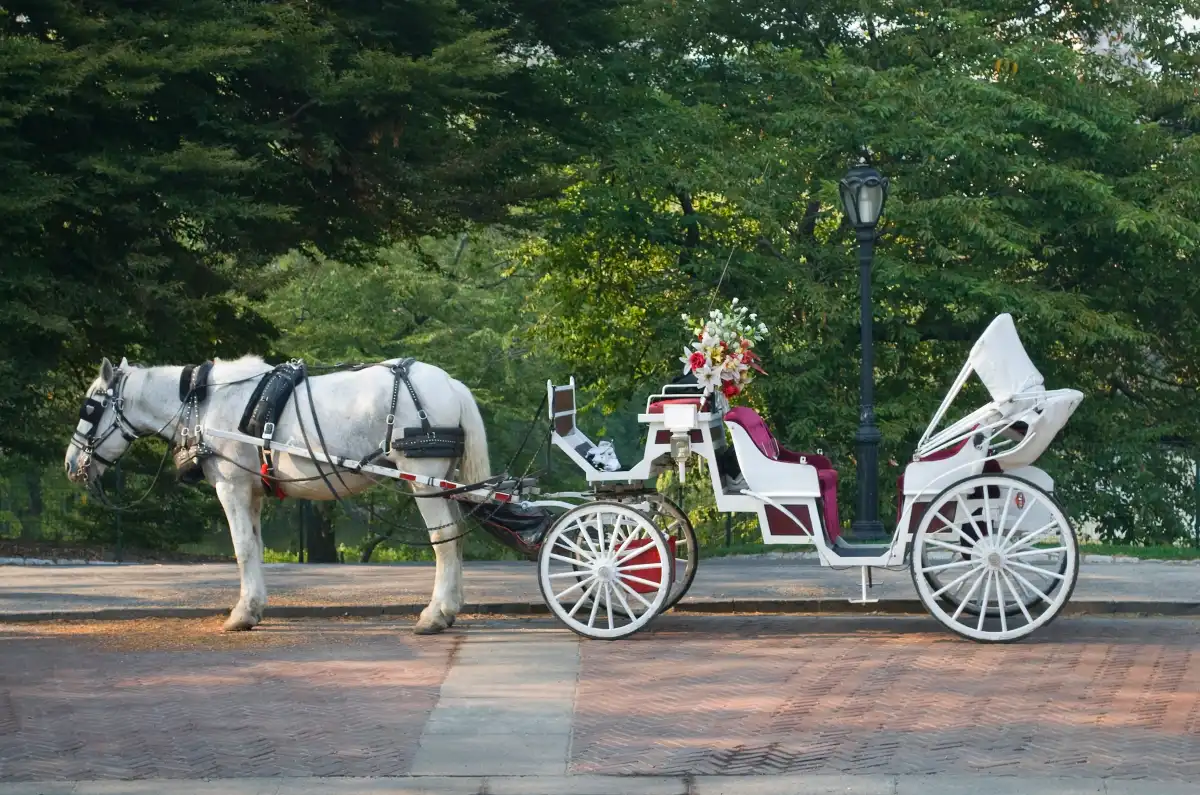
A bill to phase out New York City’s horse-drawn carriage industry stalled Friday after the City Council’s Committee on Health voted against sending the measure to the full Council.
The bill, known as Ryder’s Law (Intro. 967) and sponsored by Council Member Robert Holden, failed in committee by a vote of 1–4, with two abstentions.
The vote comes amid heightened public scrutiny of the carriage industry following the collapse of Ryder, the horse whose 2022 death inspired the bill, and several incidents since, including he recent death of a horse named Lady near Times Square.
The contentious November 14 meeting, which was not a public hearing under Council Rule 7.110, the provision Holden invoked to force a vote, opened with the Queens council member quoting Mahatma Gandhi and arguing that the city had failed to protect vulnerable animals.
“The greatness of a nation can be judged by the way its animals are treated, and that compassion should extend to all living beings, especially in the most helpless,” said Holden. “The greatness of a city council should also be measured by that, and the greatness of a council member should be measured by that.”
He accused colleagues of discrimination and claimed the committee had avoided holding a public hearing on the issue for four years. He also referenced cities around the world that have banned carriages and held up an example of an electric-powered carriage meant to replace horses as part of his earlier legislative proposal.
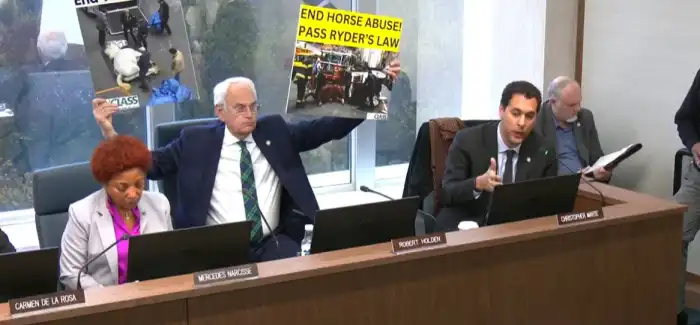 Council Member Robert Holden holds up signage during the Committee on Health meeting on Nov. 14 to advocate for Ryder’s LawPhoto by City Council YouTube
Holden attempted to place a motion on the floor to schedule a public hearing, but Schulman ruled that his motion could not take precedence because he is not a member of the committee.
Council Member James Gennaro pushed back strongly, calling Holden’s remarks inaccurate and asserting that the carriage industry has operated for 150 years with no criminal convictions for animal cruelty. He described Holden’s bill as “ill-conceived and silly,” and defended past reforms the city has enacted to protect horses.
Council Member Carmen De La Rosa, who chairs the Council’s labor committee, said opening Holden’s remarks spurred her to speak, emphasizing the need to respect the livelihoods of carriage drivers, many of whom are immigrant workers.
“I wish this energy was present when we talk about undocumented people in the city of New York, homeless people in the city of New York, those people who are not able to fend for themselves,” she said to Holden.
“Those children [of carriage drivers] deserve a future too,” De La Rosa said, noting the families in attendance at Friday’s meeting. She voted down the motion to move the bill forward.
Council Member Mercedes Narcisse echoed the same sentiment on the need to balance animal welfare with drivers’ financial realities, drawing parallels between the carriage medallion system and the struggles of taxi medallion owners, noting that many purchased medallions expecting stable, long-term work.
“This needs to be addressed one way or the other. I want to strike a balance with this process,” said Narcisse, who abstained.
Council Member Justin Brannan, who noted his own background as an animal-rights activist by referencing his own “meat is murder” tattoo, said that while he cares deeply about animal welfare, the bill was mishandled and lacked meaningful dialogue. He criticized Holden for never approaching him to discuss the legislation despite his leadership role in the Council. “This is not how you do business in the City Council,” he said, before voting no.
He claimed that in recent months the debate surrounding Central Park horse carriages had been “poisoned and hijacked by bad actors and desperate people” who are not motivated by animal welfare but by money, making “everybody look bad.” He argued that hypocrisy within certain segments of the animal-rights movement undermines public credibility and makes progress more difficult.
Brannan stated that his primary concern has long been the safety of transporting horses to and from the stables, rather than the horses working inside Central Park itself. He believes a compromise is possible, but that compromise is not the bill known as Ryder’s Law.
In response, Holden accused Brannan of reneging on past promises to support a carriage ban and again asserted that political forces were blocking reform.
“It gets blocked because of discrimination,” Holden said of the bill. “It gets blocked because of people who are actually in lockstep with special interests, not the interests of New Yorkers, not the interests of animals, not the interests of the city of New York.”
‘The issue will never completely go away’
Mayor Eric Adams recently endorsed Ryder’s Law and issued an executive order directing agencies to prepare for a 2026 phaseout, though the City Council must pass the legislation for that transition to occur.
At Friday’s hearing, Brannan further questioned Mayor Adams’ recent interest in the issue, saying the mayor had “suddenly woke up a month ago and started caring about the horses,” despite never engaging with the issue before. Brannan suggested that motivations for that shift would “come out in the wash.”
Council Member Christopher Marte spoke in support of the bill, praising Holden and citing the mayor’s proposed transition plan, which he said would increase driver wages if they accepted city employment under a restructured system.
“Currently, on average, workers make less than $40,000 a year. What the city is offering in total can be more than 70,000 a year,” said Marte. “This is a plan that not only takes into account the amount of work you put in, but also the additional benefits that you can get as a city worker that everyone here cherishes, because we know the value of working for the city and being protected by the city.”
“If it was an individual, if it was a human pushing a horse carriage, we will call that inhumane. If it was any other living animal, whether it’s dogs or cats pushing the carriage, we will call that inhumane,” he added. “Why do we have to put horses at a different level? And that’s why I’ve been supportive of this bill.”
During the roll-call vote, Council Member Simcha Felder cast the sole vote in favor of advancing the bill. With a final tally of 1–4, the measure fell far short of the six votes needed to proceed.
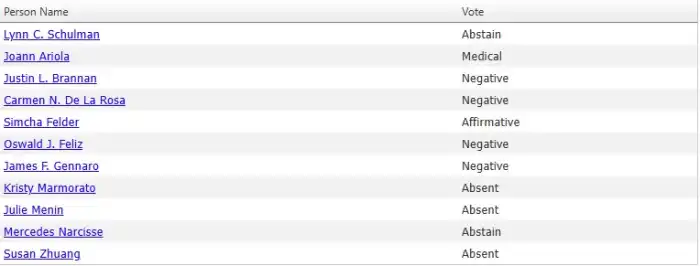 Roll-call vote from the NYC Council Committee on Health showing the results of Ryder’s Law (Intro. 967), which failed to advance to the full council.Phot via NYC City Council
Following the vote, Committee Chair Schulman said in a statement that she is eager to play a constructive role in bringing the two conflicting sides together “to achieve a resolution in a way that reduces conflict.”
“All bills, and particularly those related to challenging issues like this, require that we bridge the divide between stakeholders through legislative work that engages all parties to reach a potential solution,” she said.
Outside the chamber discussion, animal-rights groups and industry advocates reacted swiftly.
“More than 75% of New Yorkers want horse-drawn carriages off city streets,” PETA Director Ashley Byrne said, calling the industry “a dying trade” and expressing confidence the bill will return next term.
Recent polling has also been sharply divided. A Zogby Analytics poll commissioned by NYCLASS found that 78% of voters support ending the industry, while a poll backed by the Transport Workers Union found that 59% of frequent Central Park visitors support keeping the carriages.
TWU International President John Samuelsen praised council members who opposed advancing Ryder’s Law and for standing with the workers and their families today to defend their livelihoods, but acknowledged that the fight for the industry will continue.
“They are hardworking immigrants who take good care of their horses, and have consistently been attacked and slandered by monied interests who care nothing about animal welfare,” said Samuelsen. “As long as the stables occupy valuable Manhattan real estate, the issue will never completely go away. A stable in Central Park would be the best route forward for the workers and the horses. That should appease a significant number of critics who don’t like the fact the horses now walk short distances from their stables to the park on city streets.”
While the battle between horse-drawn carriage drivers and animal rights activists has come to a halt at the City Council level, the fight is set to continue in court after TWU announced on Monday that it filed a lawsuit against NYCLASS, alleging the animal advocacy group slandered horse-drawn carriage drivers as “evil animal abusers” through years of “malicious lies and misinformation.”