
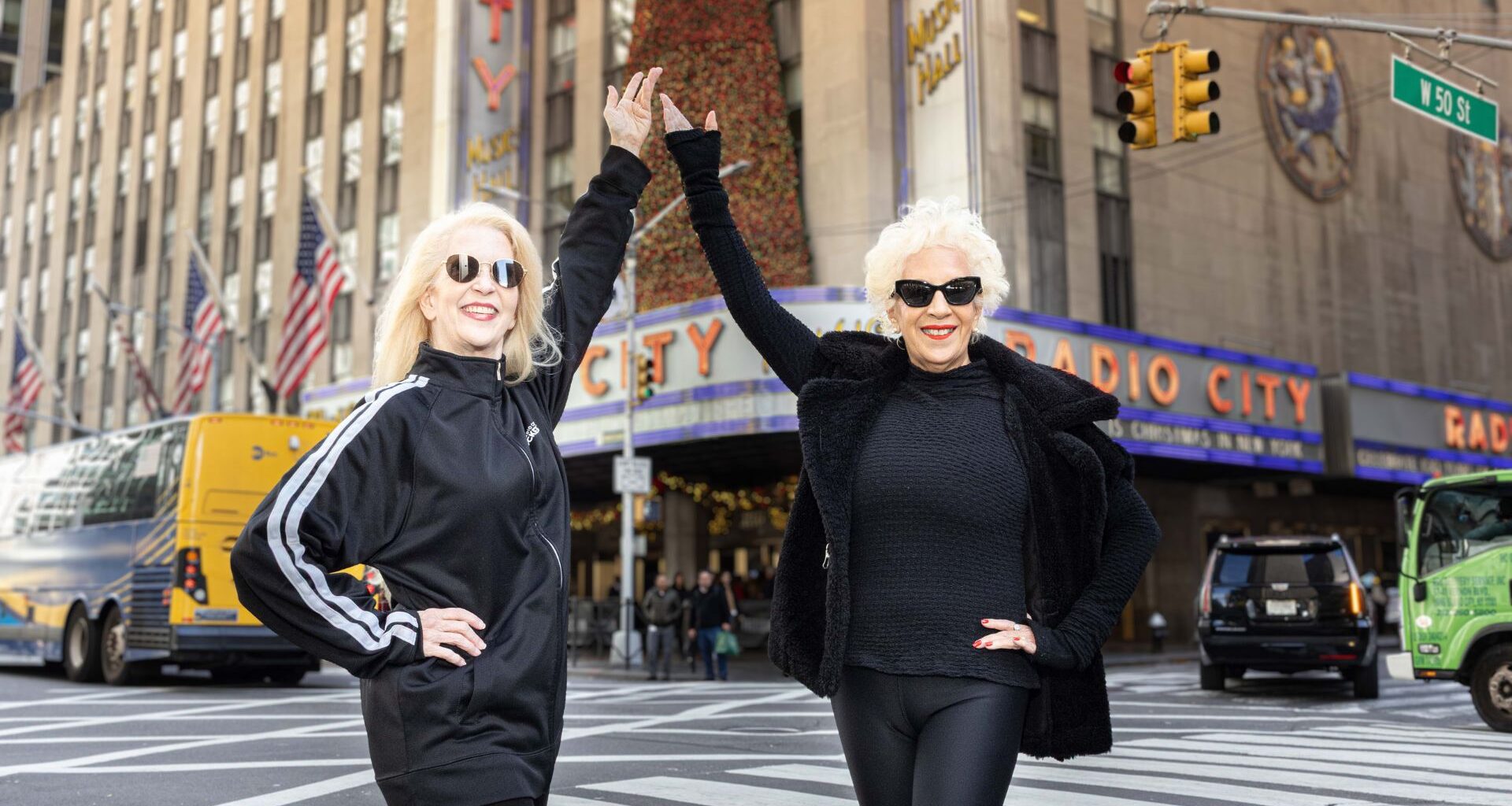
After a century of razor-sharp precision dance, the Radio City Rockettes are still kicking — with plans to celebrate their milestone birthday at a gala celebration November 21 held in Midtown’s Edison Ballroom. Ahead of the next week’s gathering — which will bring together generations of former and current Rockettes for an evening of reminiscing and what’s certain to be a killer dance floor — W42ST caught up with a few Hell’s Kitchen alumni to hear how their years on the line have kept them on their toes.
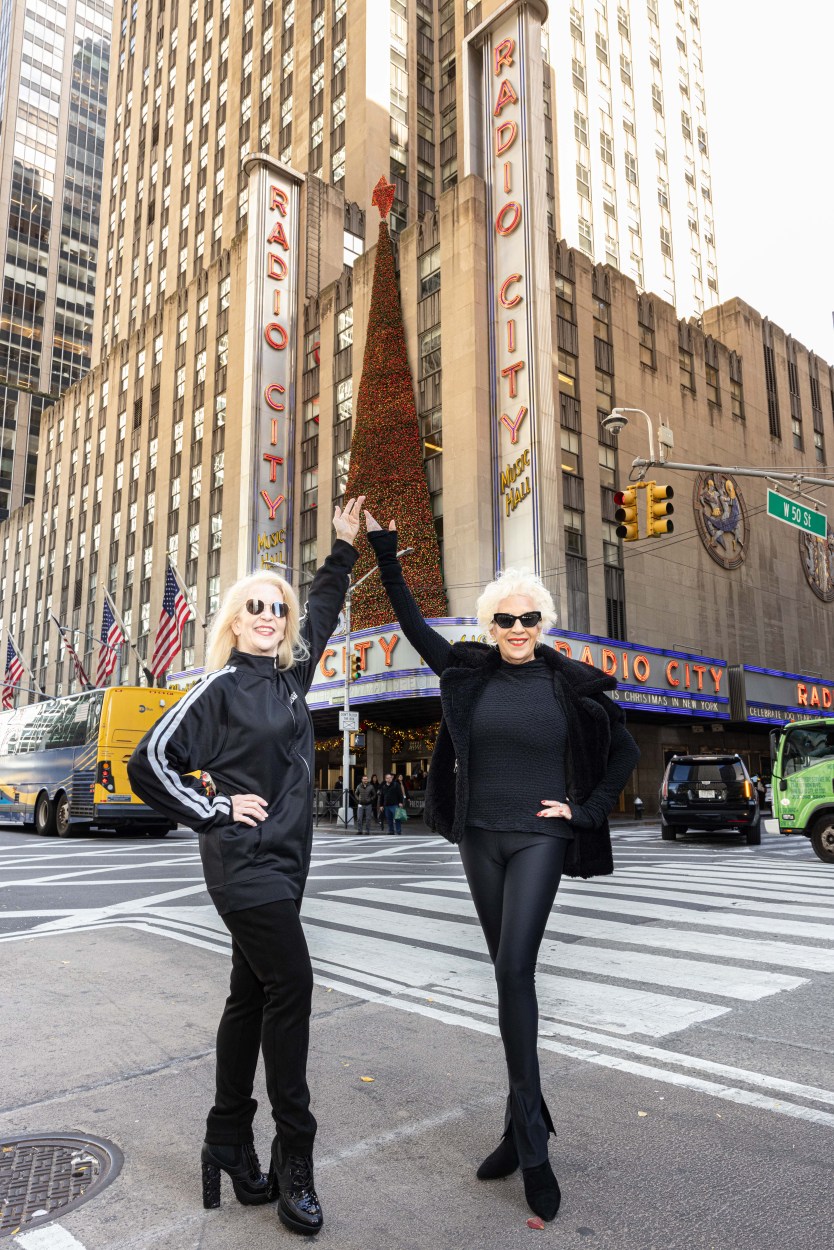 Former Rockettes and current Hell’s Kitchen residents Leslie Riddle and Lillian Colón outside Radio City Music Hall. Photo: Michael Hull
For Jean Young, the organization’s oldest alumna at 86, joining the Rockettes was a happy accident. Longing to escape her small town upbringing, Jean left Ohio at 22 and found herself working at famed department store Gimbels for Matthews, “wigmaker to the stars.” Auditioning was “an afterthought,” said Jean, and while she didn’t have a big dance background, she soon found herself working a one-year contract for Radio City.
A lifetime spent dancing is what led her fellow alumna Leslie Riddle to the Rockettes. A Texas native, Leslie spent her youth studying dance and entering pageants — “all that stuff you gotta do in Texas” she told W42ST — before graduating with a degree in dance and business from Texas Christian University. “I wanted to come here and dance with Martha Brown Company, but after dancing in classical work, I realized there’s no money in that,” she laughed. After deciding to go back to her tap and jazz roots, Leslie pored over the Backstage newspaper in hopes of finding a notice for the Rockettes, to no avail — so she took matters into her own hands.


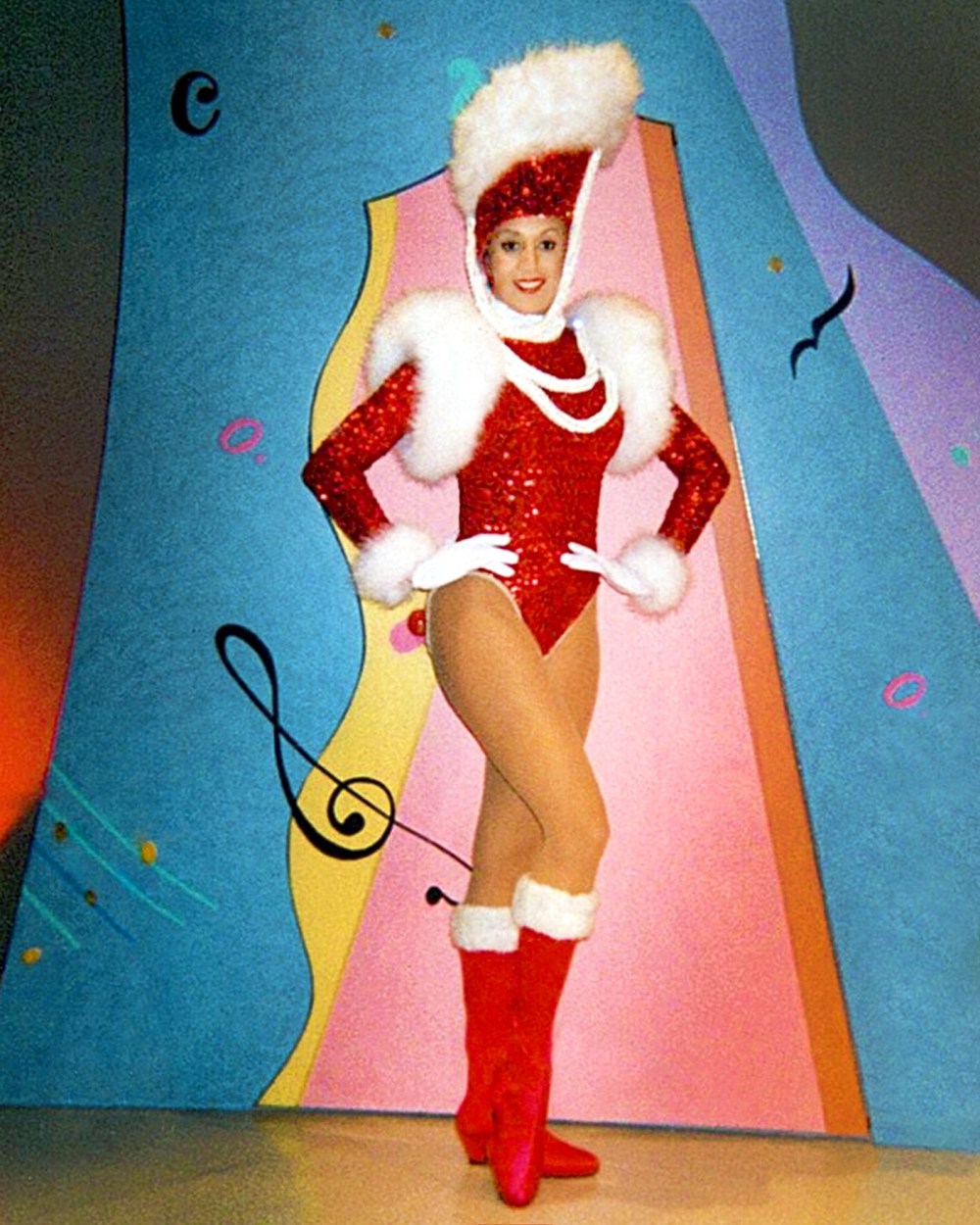
Leslie was most excited to wear the Bob Mackie designed costume seen in the top right and bottom images. Photos supplied.
“I left ballet one day. I had my little dance bag and my ballet bun, and I walked over to Radio City and I knocked on the backstage door — nobody has ever done that, right?” said Leslie. Finding herself face-to-face with “a big, burly man,” Leslie inquired where she could audition for the troupe, and in a moment of serendipity, he said, “Wait a minute, the choreographer happens to be here today.”
That choreographer turned out to be legendary Rockettes leader Violet Holmes, who agreed to take a copy of Leslie’s resume and inform her of the next audition. While out of town working on a show in Las Vegas, Leslie received the fateful call and flew back to attend “the longest audition I’ve ever been to in my life,” and was put through her paces. After hours and rounds of cuts, Leslie was eventually hired, and it was “really, really an honor,” she said.
For Lillian Colón, the first-ever Latina Rockette and current president of its alumnae association, the long and winding journey to become a Rockette was so memoir-worthy, she captured it in her book, Lilly: The First Latina Rockette. She was raised in the Lieutenant Joseph P Kennedy Home for Children in the Bronx. “They brought in a dance teacher once a month — it was just a little class, it wasn’t in a dance studio or anything like that, and that’s when I got my first taste of it,” Lillian recalled. “Once I had that first class, I was done.”
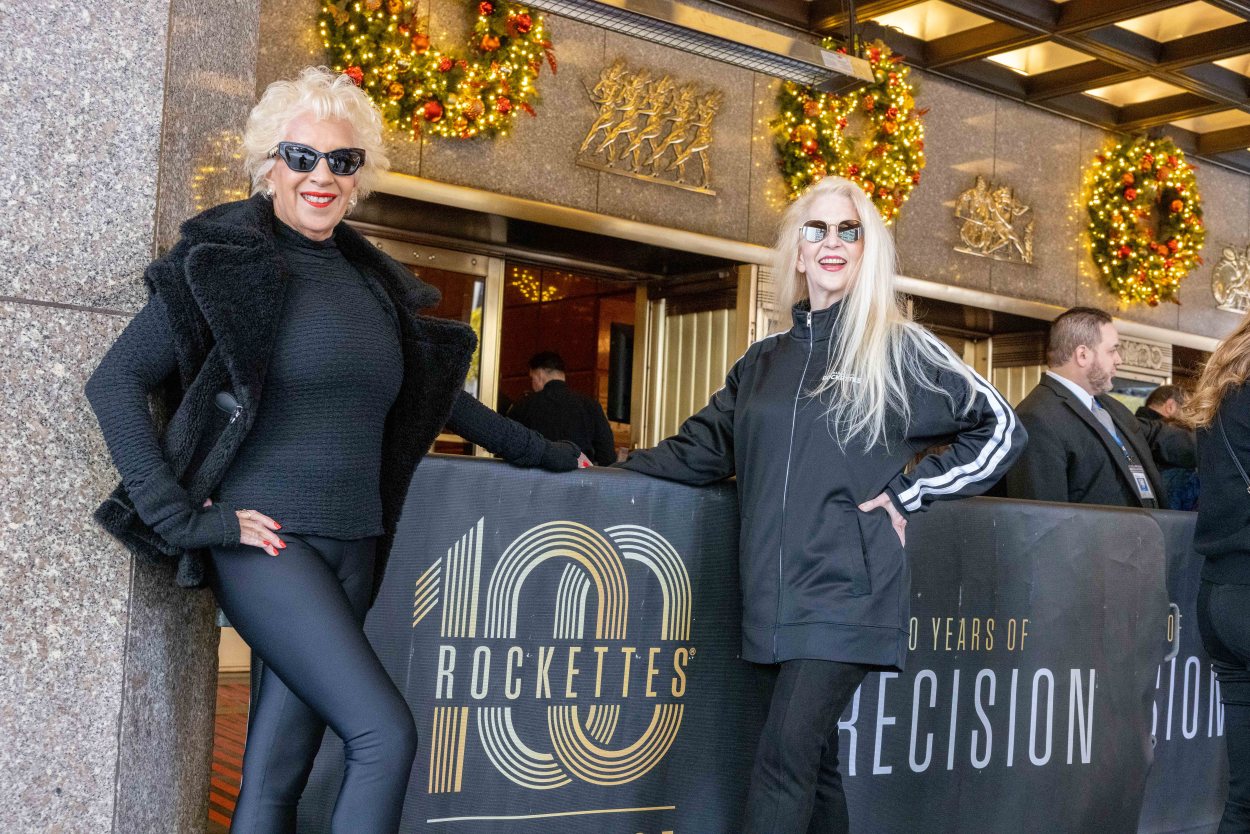 The Rockettes officially kick off their 100th season on November 19. Photo: Michael Hull
She was determined to audition and attend the famed LaGuardia High School for the Performing Arts, “I didn’t really have the training or the dance clothes, but I went anyway,” said Lillian. She got in — despite the reluctance of her nun caretakers. “I was dead-set on going,” said Lillian. The nuns, disappointed that she wouldn’t be attending a Catholic high school, let Lillian go to LaGuardia on the condition that she be back on the grounds of the orphanage within 45 minutes of the last bell.
“So as soon as that school bell rang, I ran out of there to catch the first train back, because I didn’t want them to ever tell me I couldn’t go back,” said Lillian. After graduating, “I wanted to get out of that orphanage,” said Lillian, who got married at 18 to avoid living in the home until 21. The relationship was abusive, and she ran away “to the big lights of Broadway,” even finding herself homeless until she could find her way.
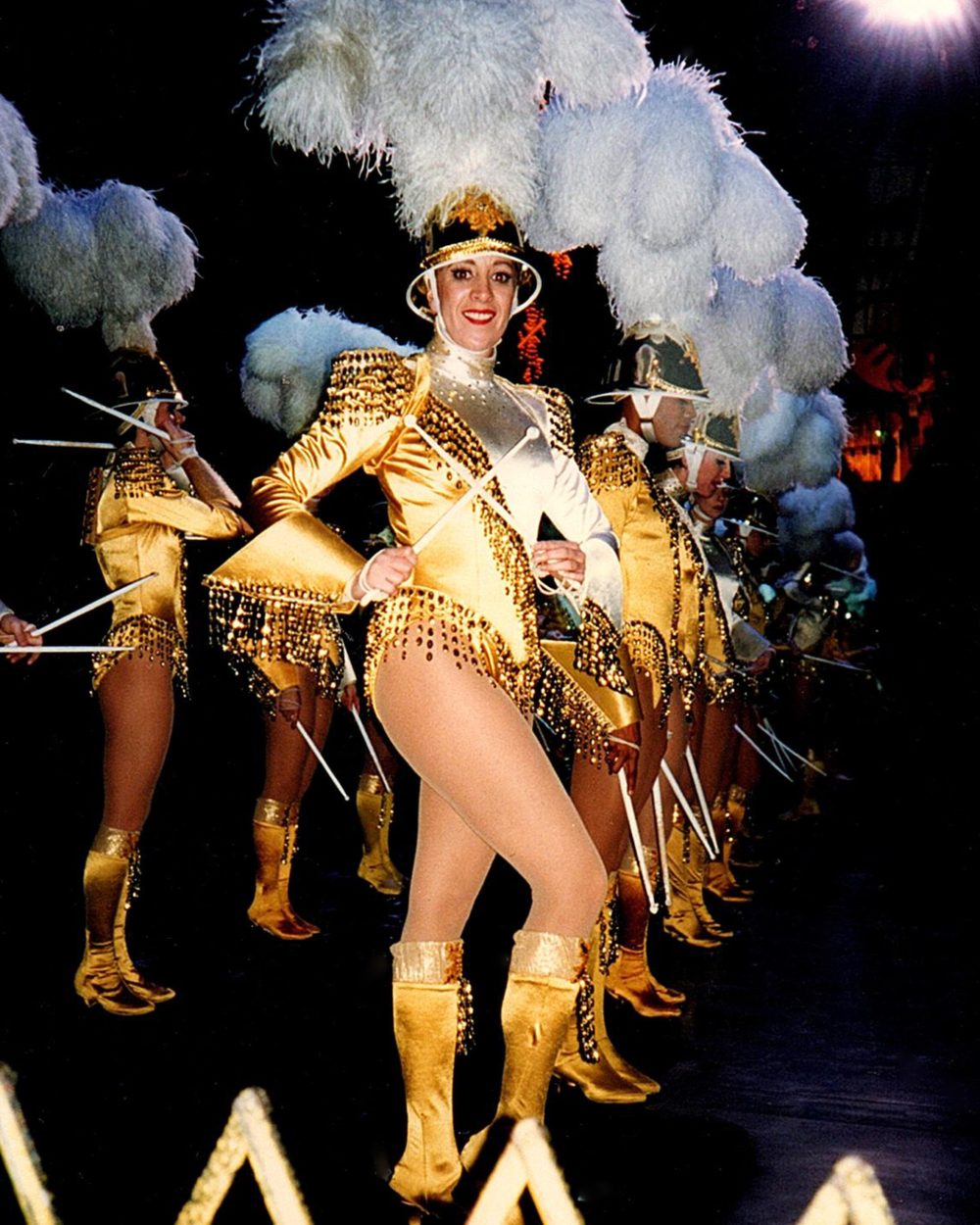
An audition for a production of Can-Can with legendary dancer Chita Rivera and the Rockettes that led to Lillian’s eventual tenure with Radio City. Photos supplied.
An audition notice in The Daily News led to an opportunity to dance for the producers of No, No, Nanette, and despite having to complete a tap combination without tap shoes — “They said, ‘you’re going to have to work a little hard [to be heard] and I said, ‘I’ll work as hard as you want me to’,” added Lillian. “I got the job, and I wasn’t homeless anymore — I was going to be able to make money and support myself.”
Lillian toured with the show and returned to New York, auditioning tirelessly and working on Broadway, on TV gigs, at theaters around the country and even headlining her own show in Mexico City. “I had done everything I could possibly do, and I wanted to see where I stood as a dancer,” said Lillian.
She moved back to New York, booking the gala performance of A Chorus Line, a job as the choreographer of the Ricky Martin-led boy band Menudo, and the musical Sugar Babies. But it was an audition for a production of Can-Can with legendary dancer Chita Rivera and the Rockettes that led to her eventual tenure with Radio City. After touring with the Rockettes on the road, Lillian joined the troupe, and spent 16 years at Radio City both dancing and working backstage in wardrobe. “It was unheard of to have a pension for dancers,” she said, “but I was able to accomplish that.”
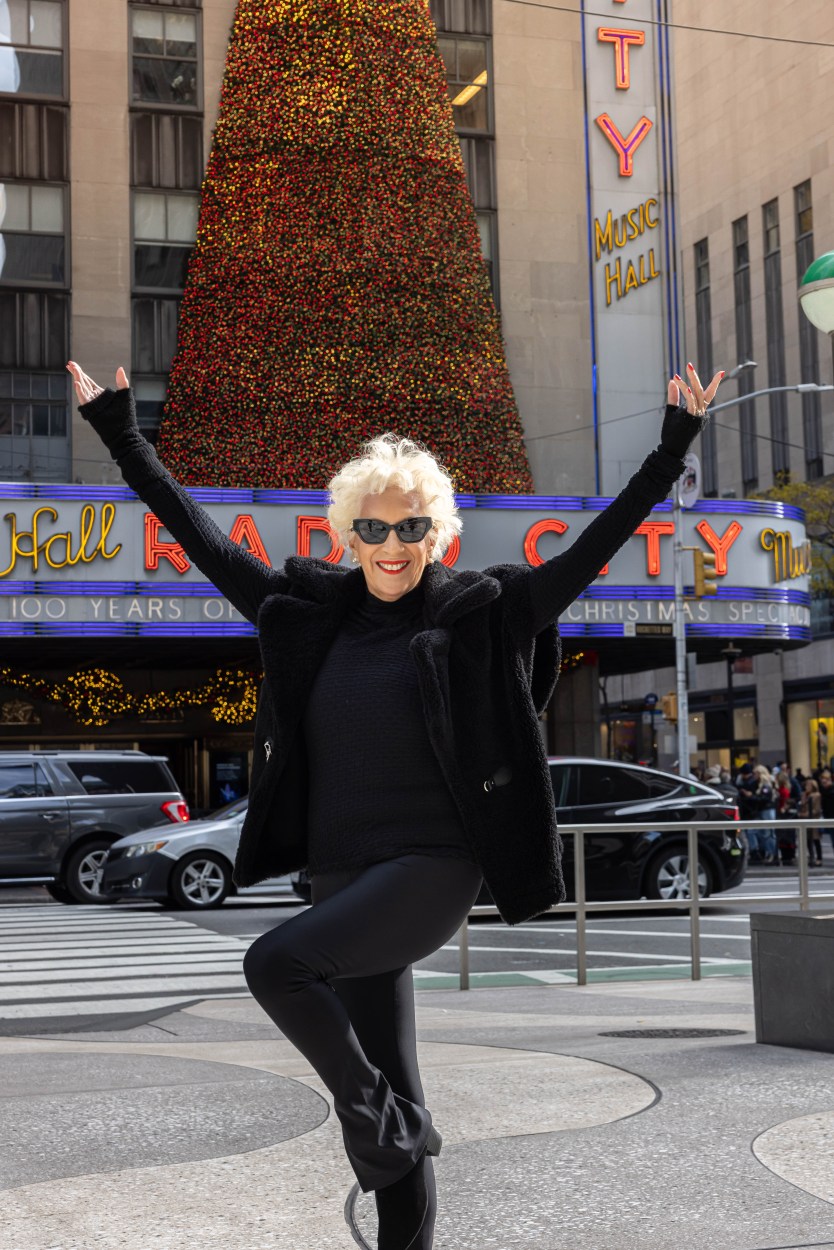 Lillian Colón is the first Latina Rockette and current president of the alumnae association. Photo: Michael Hull
Being a Rockette was a weighty responsibility, the women agreed, with most expressing a mixture of exhilaration and excitement at being a part of the longtime legacy. “All I can remember is practice, practice, practice — I had to put everything else aside,” said Jean, who added that performing at a venue like Radio City could be “really scary.”
Leslie learned to navigate life as a Rockette through the kindness of a seasoned mentor, and through the classic first performance rite of passage. “My very first show, we were doing a pinwheel, and I went the wrong direction,” she said. “My mentor grabbed me, turned me in the right direction, and everyone was cracking up — and I never made a mistake after that.”
“It’s really hard to be perfect in everything you do — the perfection, the professionalism, doing six shows a day,” said Lillian. “What doesn’t break you makes you stronger, you know? But when you love something, you don’t even feel it — your muscles do, but you don’t feel it mentally.”
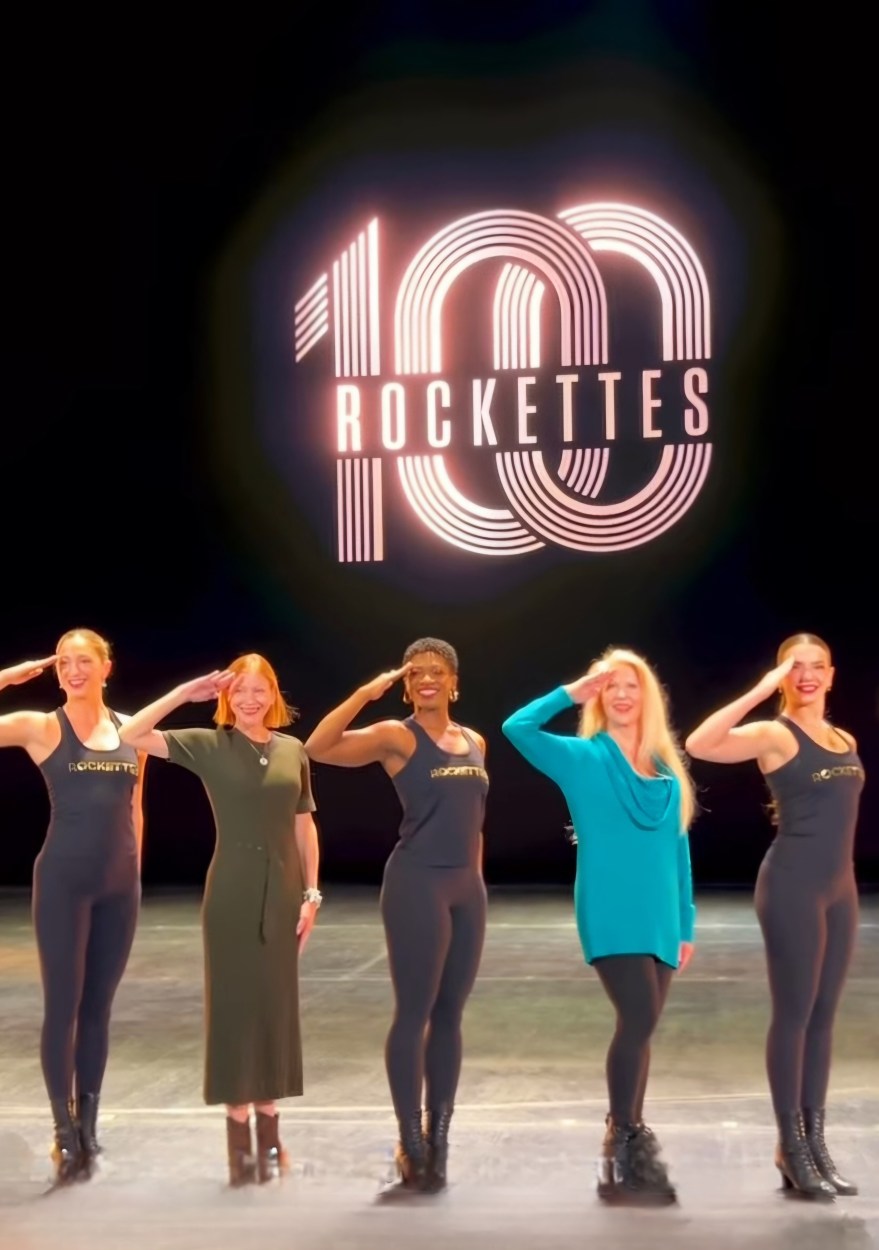 Leslie joined current and former dancers for a Rockettes 100 promotional event in March 2025. Photo supplied.
As an orphan, Lillian also took heart in having a newfound show family — especially around the holidays, she added. “One thing that I loved about it, is that I was able to have someplace to go on Thanksgiving, someplace to be on Christmas Day, that I knew I was spreading my love and my talents for people, 6,000 people in the audience that were watching us — I had purpose. I was somebody. I never had to worry where I was going to be, if I was going to be invited somewhere for Thanksgiving, if I was going to be invited for Christmas — I knew where I was gonna be, and I knew I was going to be fine.”
Years after performing, the dancers still find themselves inexorably tied to Radio City. Jean, who moved to Manhattan Plaza and became the associate comptroller for New York University as well as a visual artist, post-Rockettes, used to take her son and mother to see the Spectacular for years after her stint at Radio City. Lillian, who finds it a “pleasure and responsibility” to represent the organization as the first Latina Rockette and current alumnae association president, is deep in the midst of planning the company’s centennial gala.
Leslie has enjoyed getting to know Rockettes across generations through the alumnae network, and has taken on the gargantuan task of creating the group’s alumni directory from piles upon piles of discordant paperwork. Perhaps it’s why she’s recognized so often. “We run into a lot of other alumnae in the neighborhood and around town,” she said. “I was walking by the United Nations one day and ran into one of the girls who yelled my name — it’s fun to see each other.”
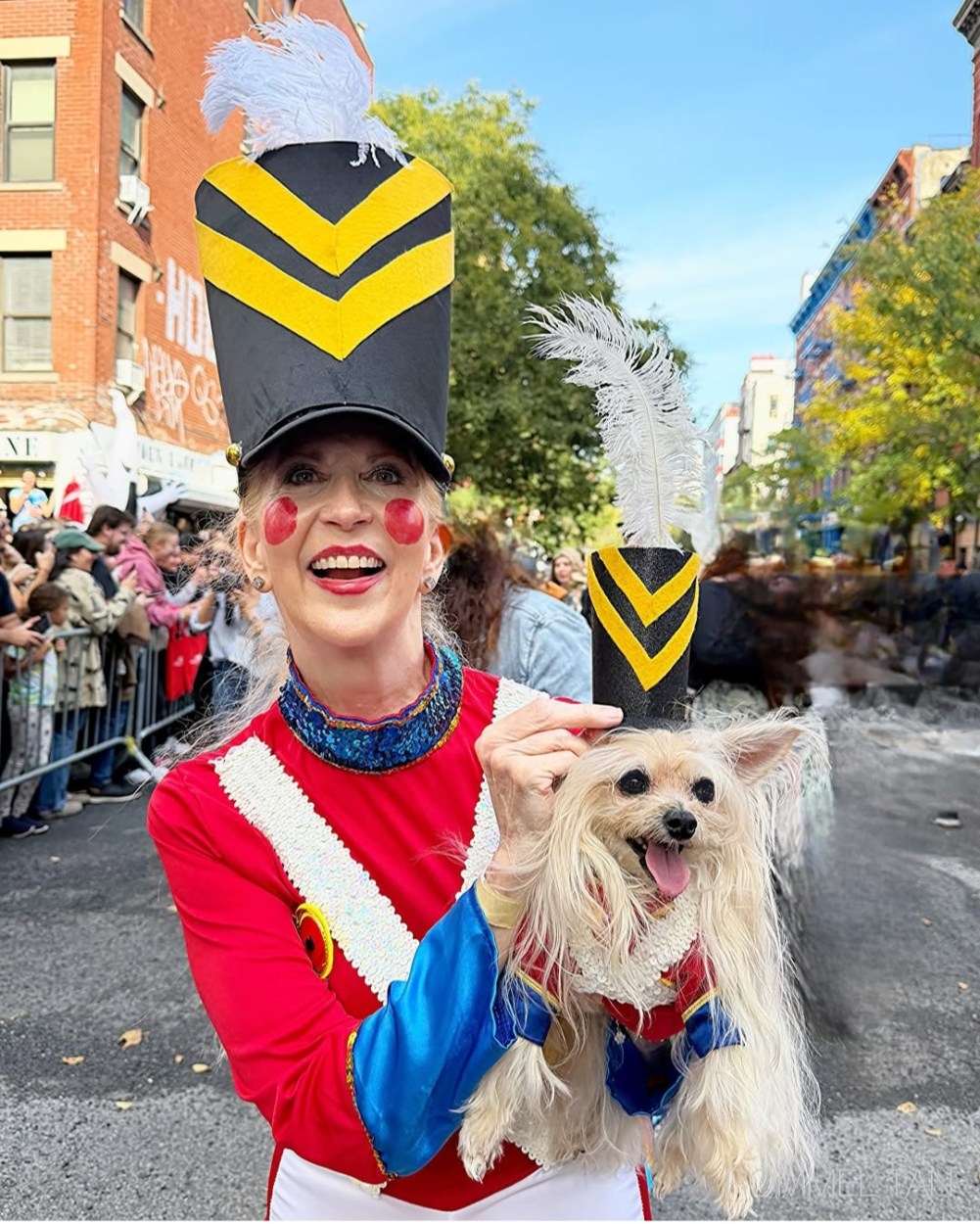
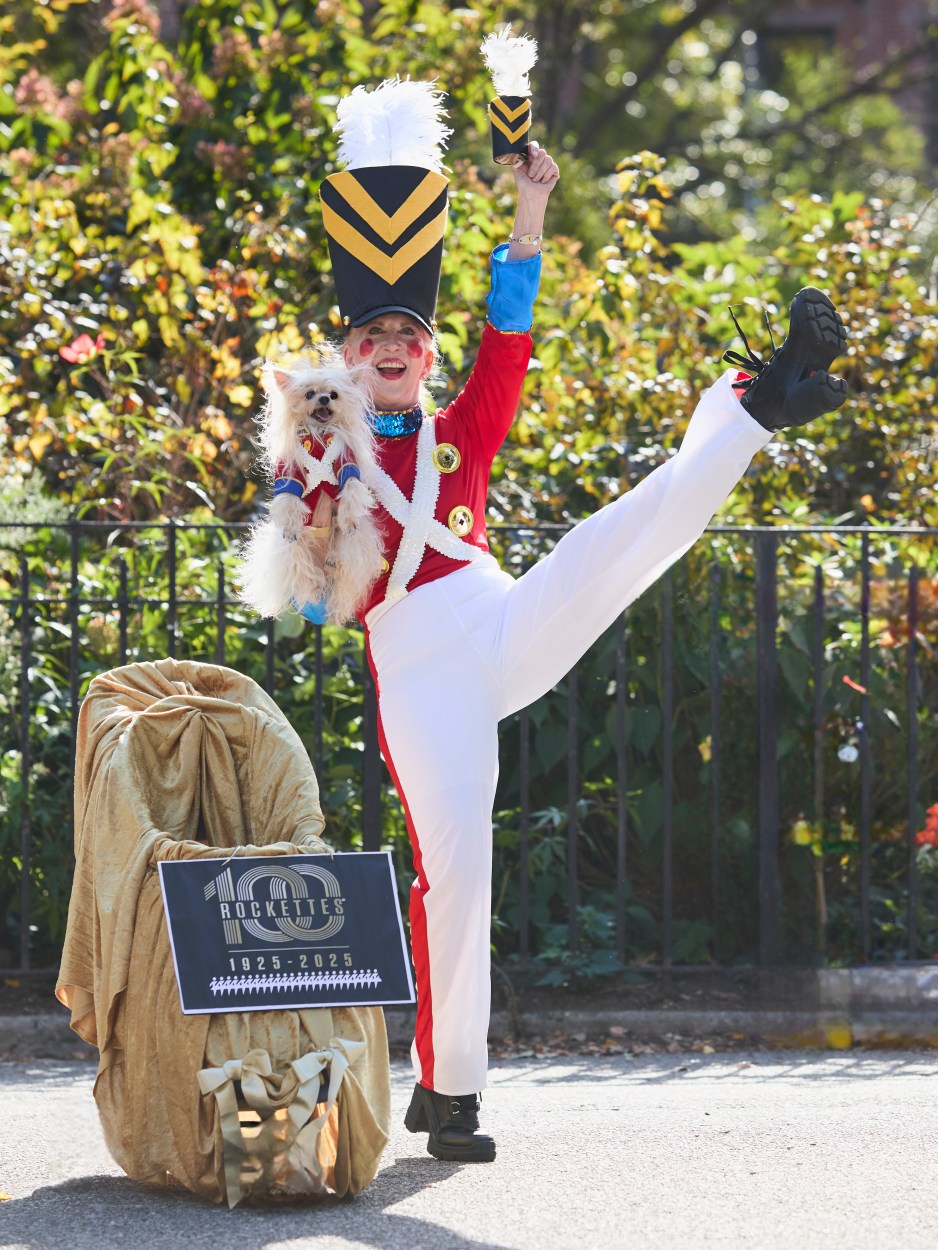
Leslie and her dog Puccini dressed as the iconic wooden soldiers from the Christmas Spectacular for Halloween. Photos supplied.
“The fact that we have so many generations now is really pretty unbelievable,” added Lillian, noting that the group has grown more representative of all dancers in recent years. “The most important thing [that’s changed] is the diversity on the line,” she said. “I have gotten to know every girl, and it’s so wonderful to know the entire troupe individually as well as collectively.” Looking ahead to the gala, “We will make it as close to an opening night of Radio City Music Hall as we possibly can — and I hope that every single Rockette will be there,” she added.
And for all the former Rockettes, a key part of honoring the group’s legacy is going back to see the next generation of dancers tackle the notoriously difficult choreography amid the lights and sparkle of Radio City. “When I come in and that curtain goes up, that orchestra starts, the butterflies hit my stomach just like they did the moment that I walked onto that stage,” said Lillian.”Just the fact that I was part of that, I am part of that, oh my gosh, and if it leaves a legacy for my daughter and for other Latinas — I hope that [other] Latinas will have the opportunity.”
While the Rockettes may seem as quintessentially New York as the Yankees or Saturday Night Live, the precision dance troupe was founded as the “Missouri Rockettes” in St Louis by choreographer and Broadway veteran Russell Markert. A few years into their tenure, the troupe, performing in Manhattan, caught the eye of theater owner SL “Roxy” Rothafel, who subsequently booked them at the Times Square Roxy Theater and renamed the group “The Roxyettes.”
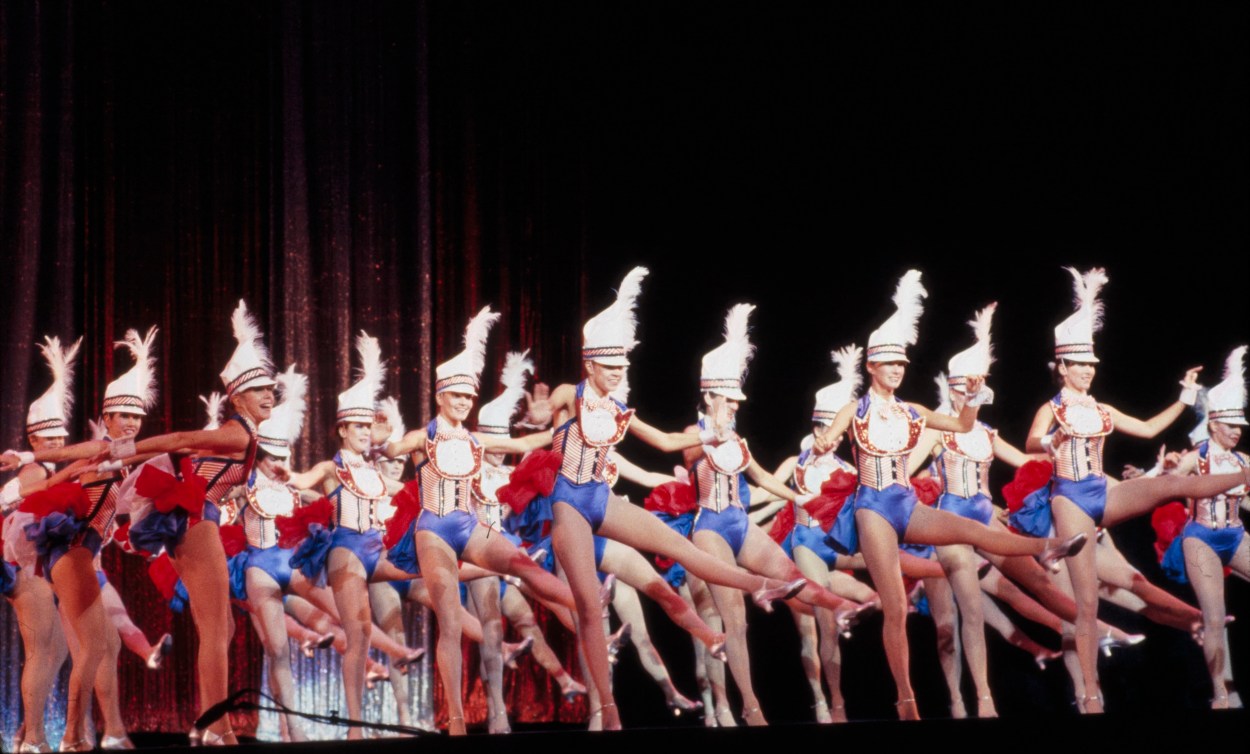 The Radio City Rockettes performing on stage between 1970-1990. Photo: Bernard Gotfryd/Library of Congress
In 1932, Rothafel, along with Markert, moved the company to his newly opened Radio City Music Hall, christening them “The Rockettes.” The first Christmas Spectacular debuted in 1933, with the Rockettes kicking off what would become a beloved holiday staple for years to come.
Over the next few decades, the troupe would continue to grow in popularity and visibility, performing with the USO during World War II, making their Thanksgiving Day Parade debut in 1957 and even protesting outside city hall to save Radio City amid the financial troubles of the 1970s. The venue was eventually determined to be a landmark by the Landmarks Preservation Commission, added to the National Register of Historic Places and reopened through a non-profit subsidiary of the Urban Development Corporation in 1978.
Through the years, the Rockettes and the Christmas Spectacular have continued to make their mark as the annual must-see for tourists and ornery New Yorkers alike, with the troupe’s choreographers continually refreshing the beloved holiday production to include modern touches like the addition of a double decker tour bus in the popular New York at Christmas number, while still retaining time-honored audience favorites like the iconic Parade of the Wooden Soldiers.