
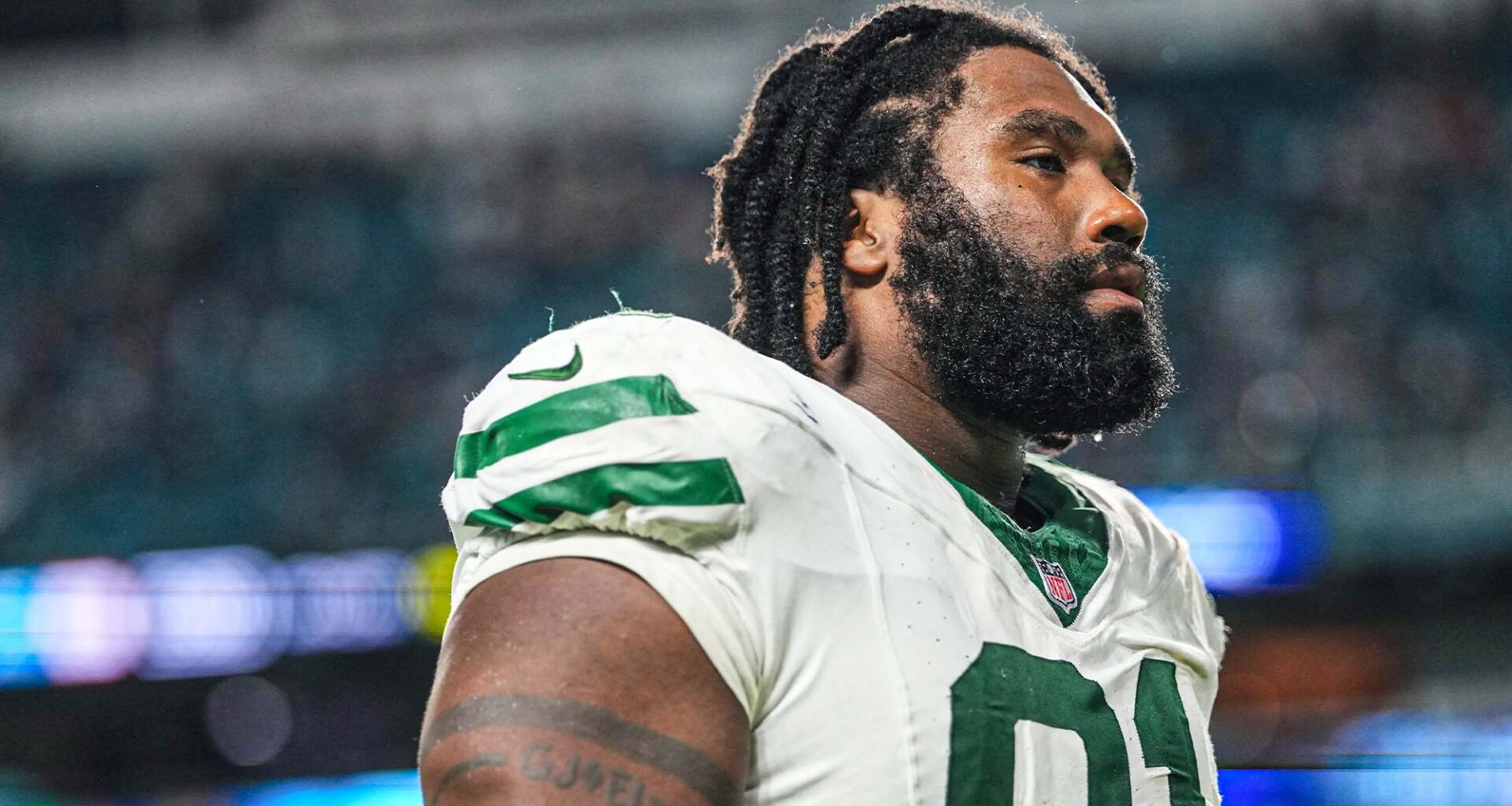
A Quinnen Williams-sized hole has opened in the middle of the New York Jets’ defense.
That’s no easy hole to fill—certainly not overnight. It could take multiple offseasons for the Jets’ interior defensive line to replicate the production it lost with the former first-team All-Pro.
However, the hole allows for less heralded players to gain more opportunities than they had before. It’s a chance for the rebuilding Jets to evaluate some young pieces who could be a part of the long-term plan to replace Williams.
Through two games, no player has seized his newfound opportunities more than the Jets’ greatest young find under first-year general manager Darren Mougey: Jowon Briggs.
Acquired by Mougey in a late-August trade, the 24-year-old had established himself as a solid rotational piece over his first eight games in green. Briggs was already known as one of Mougey’s best pickups in his short Jets tenure.
Since Williams’ exit, though, Briggs has ascended to a level that even New York probably didn’t imagine was possible.
Suddenly, the Cincinnati native looks like he could be much more than just a nice backup. Comparisons to Williams would be much too early, but Jets fans might be shocked by the numbers Briggs has quietly accumulated over the last two games.
READ MORE: Jets accomplished a critical big-picture goal despite TNF loss
Jowon Briggs is ascending into more than just a run-stuffer for the Jets
In late-August, needing run-stuffing help on the interior after losing Byron Cowart for the season, Mougey swapped a 2026 sixth-round pick for a 2026 seventh-round pick to acquire Briggs, who was a seventh-round pick of the Browns in 2024.
Starting his rookie year on the practice squad, Briggs did not get onto the field until Cleveland’s final six games. Once active, he displayed efficient run-stopping production with his limited opportunities.
There wasn’t much pass-rush production to speak of, as Briggs had no sacks and only four total pressures (via Pro Football Focus), but he racked up 13 tackles in just 133 defensive snaps, showing his knack for finding the ball in the run game. Briggs also had a dominant pair of run-stopping games in the 2025 preseason.
This does not seem like the type of player who teams would typically look to trade. However, the Browns have one of the deepest defensive lines in the NFL, so they deemed Briggs expendable. The Jets jumped on the opportunity to land an intriguing second-year player for pennies.
Through the first eight games of 2025, Briggs thrived in his role. He was productive with his playing time, making 12 tackles on 189 defensive snaps.
Quietly, though, Briggs was showing the potential to be more than just a run stuffer.
On 100 pass-rush snaps, Briggs had racked up nine total pressures, including two sacks. Not only was it surprising to get two sacks out of him in just half the season, but his 9% pressure rate was comfortably above the 2025 league average for defensive tackles (7.7%), suggesting Briggs’ pass-rushing improvement might be sustainable.
Williams’ exit has presented an opportunity for the Jets to find that out. So far, the results have been staggering.
In his first game without Williams, Briggs racked up a career-high of six pressures on just 16 pass-rush snaps against the Browns, a whopping 37.5% pressure rate, helping New York earn a 27-20 victory.
Briggs’ snap count actually didn’t increase much in the Jets’ first game without Williams; he played 41% of the snaps against Cleveland, just his fourth-highest mark of the year. But as a reward for his breakout game, the Jets pumped him up to a season-high 60% snap count against New England, 12% above his previous high.
Handling a season-high snap count on a short week against an elite offensive team, this was the perfect opportunity for Briggs to prove that his pass-rush progress is legitimate.
Boy, did he seize the moment.
Briggs backed up his six-pressure game with another five pressures against the Patriots, coming on 25 pass-rush snaps for a 20% pressure rate.
While Briggs’ impact may have been hard to notice live, it pops off the film.
Going against Mike Onwenu, the NFL’s fourth-richest right guard ($19 million salary), Briggs quickly bull rushes Onwenu into Drake Maye’s lap, forcing a short throw on third-and-5 that New York halts short of the sticks.
On third-and-15, Briggs takes Patriots center Garrett Bradbury for a ride into the backfield, hurrying Maye into a leaping checkdown that New York stops to force a field goal attempt. Briggs finishes with a crushing hit on the young quarterback.
This rep doesn’t even count among his five pressures, yet it’s just as valuable. Later in the fourth quarter, after beating Bradbury for the hit on Maye, Briggs exploits Bradbury once again. Tasked with opening up room for Jermaine Johnson to loop inside on the stunt, Briggs successfully carries Bradbury far enough inside for Johnson to loop through and get to Maye.
The pressure forces Maye to hang his deep shot a little more than he’d prefer, buying time for Brandon Stephens to recover from getting beat and make the deflection. It’s a chain reaction of complementary football, all started by Briggs doing his job on the stunt. And since Briggs beat Bradbury for a hit earlier in the quarter, Bradbury probably viewed Briggs as a greater threat moving forward, causing him to hold onto Briggs longer than he should have on this play, thus making him late to get back to Johnson.
Jowon Briggs is making his case for a 2026 starting spot
Across two games since the Williams trade, Briggs has collected 11 pressures on 41 pass-rush snaps, a downright absurd pressure rate of 26.8%. His production over those five days now has him looking like one of the most efficient pass-rushing defensive tackles in the NFL this season.
Briggs’ pressure rate for the 2025 season has skyrocketed to 14.2% (20 pressures on 141 pass-rush snaps). It ranks second-best among the 91 defensive tackles with at least 120 pass-rush snaps this season.
Best pressure rates among DT (via PFF) through Week 11 TNF, minimum 120 pass-rush snaps:
Moro Ojomo, PHI (14.3%) — 34 pressures on 238 pass-rush snaps
Jowon Briggs, NYJ (14.2%) — 20 on 141
Jeffery Simmons, TEN (13.7%) — 27 on 197
Zach Allen, DEN (12.9%) — 41 on 317
Milton Williams, PHI (12.7%) — 35 on 276
Javon Hargrave, MIN (12.2%) — 21 on 172
Christian Barmore, NE (12.0%) — 34 on 284
Jalen Redmond, MIN (11.8%) — 22 on 187
DeForest Buckner, IND (11.3%) — 33 on 291
Osa Odighizuwa, DAL (11.2%) — 25 on 224
The Jets already knew Briggs provides value as a run stuffer, so any semblance of value he brought in the passing game would be gravy, let alone this degree of success.
From here, the next step for Briggs is to continue thriving on a weekly basis. For now, his elite efficiency stands out as a possible small-sample outlier.
What Briggs has already accomplished, though, is showing the Jets that he has a much higher ceiling than initially thought. Whether he fulfills it remains to be seen, but through his two-game pressure explosion since the Williams trade, Briggs proved that he offers two-way potential on the interior, which is what made Williams such a unique player.
Defensive tackles who can thrive in both phases are hard to come by. If Briggs can continue doing this consistently, he could earn a long-term starting role in New York. Perhaps he could even become a core leader of the Jets’ defense.
Before seriously engaging in those conversations, we need to see Briggs sustain his production in a featured role for more than just a couple of games. Still, he has vaulted himself into the spotlight as one of the Jets’ most fascinating players to watch over the final stretch of the season. Suddenly, he is one of the Jets’ highest-ceiling players, especially on defense.