
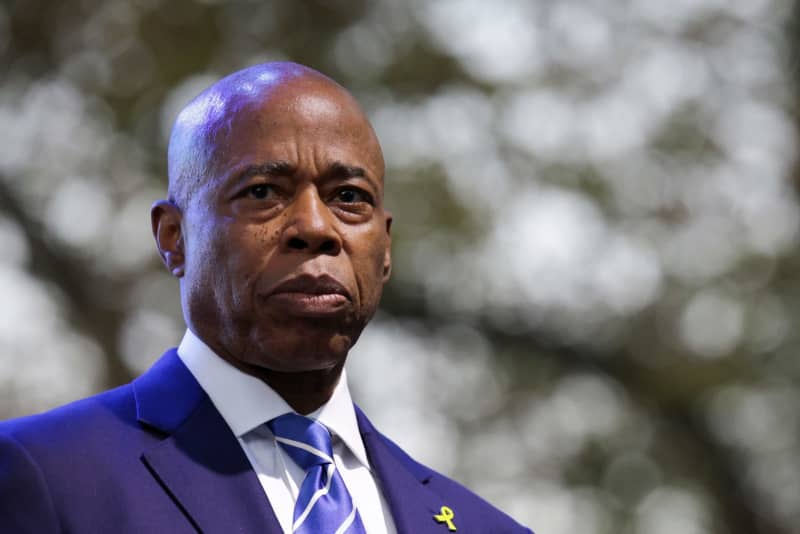
Adams came not only to reaffirm the deep ties between New York and the Jewish state, but also to warn – sometimes bluntly – about what he believes lies ahead for the city’s Jews.
Here’s a sight we won’t be seeing for quite some time: A New York City mayor praying at the Western Wall.
With less than two months left in office, New York’s outgoing Mayor, Eric Adams, stood at the Western Wall on Sunday, eyes closed, palm pressed against the stones, during his farewell visit to Israel as mayor.
Adams came not only to reaffirm the deep ties between New York and the Jewish state, but also to warn – sometimes bluntly – about what he believes lies ahead for the city’s Jews.
Visits to Israel by New York’s mayors have long been a staple of the city’s political culture. Since 1948, every New York mayor has visited Israel during or shortly after their term.
Liberal or conservative, Jewish or Catholic, Democrat or Republican – it never mattered. Showing up in Israel was simply something they did. It signaled solidarity, respect, and the recognition that the city with the world’s largest Jewish population could not treat Israel as foreign. This notion was woven into the city’s political DNA.
 The closing chapter
Adams’s visit appears to be the closing chapter of that tradition, because incoming Mayor Zohran Mamdani has promised something entirely different.
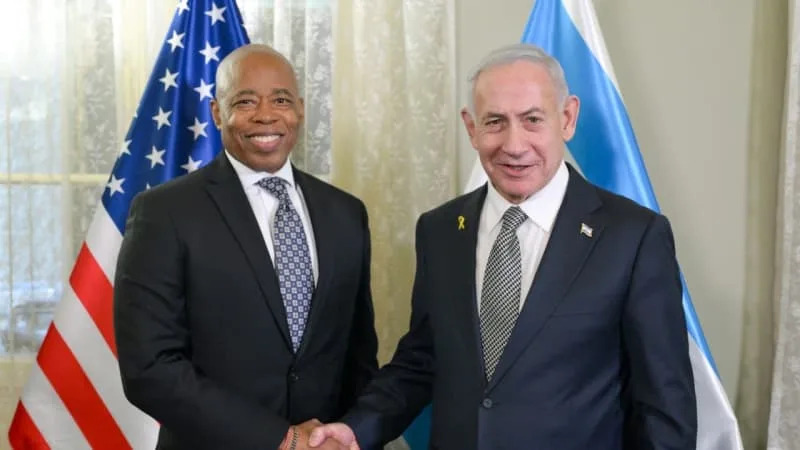
Just hours before Adams met with Prime Minister Benjamin Netanyahu on Monday, during which the prime minister thanked him for his support, Mamdani again told an interviewer that he hoped to arrest Netanyahu if he came to New York.
He would “exhaust every single legal option” to do so, Mamdani continued, adding that, however, “I’m not going to create my own set of laws.”
New York has had liberal and progressive mayors before, even mayors who sharply criticized Israeli policies. But it never had one whose worldview is so deeply anti-Israel.
This is not a tonal shift; it is a rupture.
The rupture becomes clear when set against the long arc of New York’s mayoral relationship with Israel – a tradition that began almost immediately after the state’s establishment.
William O’Dwyer, New York’s mayor at the time of Israel’s independence, traveled to the country in 1951 shortly after leaving office, spending several weeks there on behalf of his Jewish constituents. His successor, Vincent Impellitteri, also visited that same year, meeting with Prime Minister David Ben-Gurion and receiving an official welcome in Jerusalem.
Robert Wagner continued the pattern through the 1960s, helping stitch together the post-war bond between the two communities. John Lindsay followed suit, visiting Israel during his mayoralty in 1971 and engaging in outreach to New York’s Jewish community, which viewed such a visit as an important gesture of solidarity.
Abraham Beame, New York’s first Jewish mayor, visited Israel in 1976 as part of a US mayors’ delegation, meeting Israeli officials during a period of growing ties between American cities and Israel.
Each mayor who followed found his own vocabulary for the relationship.
Ed Koch was unabashedly Zionist, wearing his affection for Israel openly. David Dinkins traveled to Israel during the Gulf War in 1991 and again in 1993, meeting immigrant families and declaring that Jerusalem must remain united. Rudy Giuliani made headlines when he expelled Yasser Arafat from a Lincoln Center concert.
Moreover, Michael Bloomberg built deep business ties, visiting during conflicts and never hiding his personal attachment to the country. And Bill de Blasio, despite his progressive instincts, rejected the Boycott, Divestment, and Sanctions movement outright and repeatedly affirmed Israel’s right to defend itself.
Then came Adams, who made fighting antisemitism a central pillar of his mayoralty and stood unabashedly with Israel as anti-Israel protests multiplied in his city after Hamas’s October 7 massacre. He cultivated close relationships across the Israeli political spectrum, has now visited the country twice as mayor, and spoke frequently of the need to confront rising anti-Jewish hate at home.
Netanyahu, during their meeting, thanked him “for his great support for Israel and for being a true friend of the Jewish people.” It was a parting gesture, and likely the last such exchange between an Israeli leader and a New York mayor for the foreseeable future.
Part legacy burnishing, part warning sign.
For Adams, the trip was part legacy burnishing, part warning sign.
“If I were a Jewish New Yorker, I’d be concerned about my children,” he said during an event in his honor put on by the Combat Antisemitism Movement in Tel Aviv. He argued that antisemitism has become “cool and hip,” that a generation has been raised on social media distortions, and that the city’s Jewish community “must prepare itself” for what is coming.
Characteristically, even predictably, The New York Times wrote in a news story that he “stoked fears.”
In an interview with Israel Hayom, Adams said that Mamdani will be “mayor, not emperor,” and that he does not have the power to unilaterally sever diplomatic ties with Israel, divest pension funds, or dictate foreign policy. Nor does he have the legal authority or any grounds to arrest Netanyahu.
But symbolism and atmosphere matter. And New York’s atmosphere carries outsized weight.
For decades, Israel relied on the city’s leadership not just for business ties but for the symbolic reassurance that came from the mayor of what is one of the world’s most important cities standing publicly and unapologetically with the Jewish state.
A mayor who accuses Israel of genocide, questions its right to exist as a Jewish state, and states repeatedly that he wants to arrest its prime minister sends a very different message – not legally decisive, but politically potent.
Adams’s prayer at the Western Wall on Sunday, therefore, was more than a photo op; it was a bookend. It closed a 75-year chapter in which New York mayors – liberal and conservative, reformers and machine politicians alike – saw showing up in Israel and standing with the Jewish state as part of their responsibility, as just part of what they do.
With Mamdani, that assumption is now a thing of the past, and the era in which support for Israel was a natural reflex of New York’s leadership has ended.
What comes next will depend not only on Mamdani, but on how New York’s Jews choose to respond – whether they retreat, or, as Adams urged during his visit, stand their ground and fight to preserve the place Israel has long held in the public and political life of the city.