
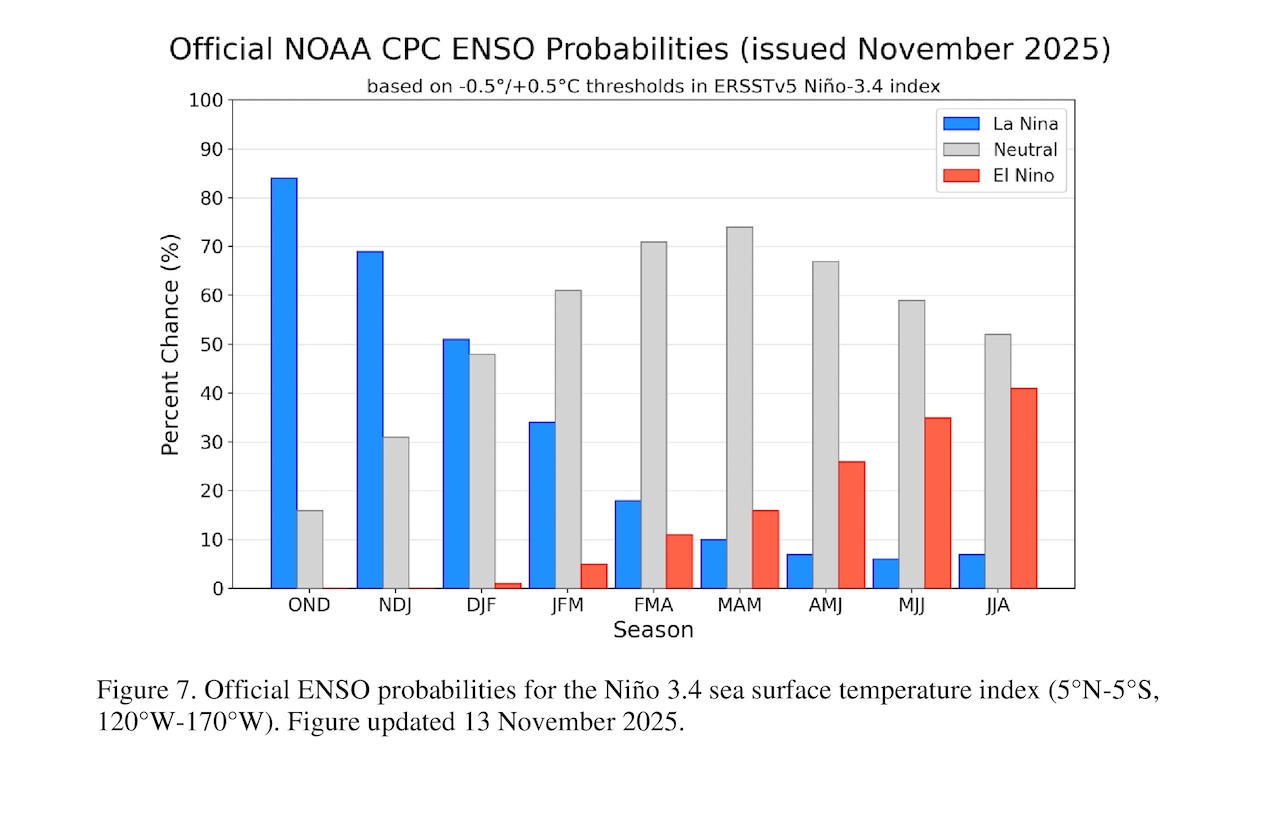
La Niña is forecast to extend into the winter months before potentially giving way to the return of ENSO-neutral conditions. But just what does any of that mean for New York residents?
The El Niño-Southern Oscillation cycle, otherwise known as the ENSO cycle, is a recurring climate pattern pertaining to changes in the water temperatures in the central and eastern tropical Pacific Ocean, according to the National Weather Service.
Over time, the sea surface temperatures tend to either warm up or cool down. This is what the weather service refers to as the ENSO cycle.
Cycle-neutral conditions are present when water temperatures are normal, neither below nor above-average. In this stage, residents typically experience seasonal conditions and the phenomenon is generally not a driving force in determining weather conditions.
La Niña is the cold phase of this cycle while El Niño is the warm phase. During La Niña, cold water conditions are prevalent and trade winds enhanced, directing warm water toward Asia, ultimately cooling waters off the West Coast, as detailed by the National Oceanic and Atmospheric Administration.
As previously reported, in October, the cycle entered a La Niña phase.
During a La Niña winter, the U.S. and Canada typically experience a wave-like jet stream flow, usually resulting in colder and stormier conditions in the north, and warmer and less stormy conditions across the south, as noted by the weather service.
A Nov. 13 update by the weather service’s Climate Prediction Center explained that while La Niña is favored to persist from December through February, it will likely remain weak. As such, it was clarified that a weak La Niña “would be less likely to result in conventional winter impacts.”
Still, that does not mean La Niña will play no role whatsoever. In citing a National Oceanic and Atmospheric Administration study, The Weather Channel shared that historically, weaker La Niñas typically produce above-average snowfall across much of the northern tier of the U.S. and below-average snowfall in the southern Rockies and parts of the Ohio Valley.
Previous winter forecasts largely suggested that it will not be an incredibly cold or stormy winter in New York.
The odds of a transition in the El Niño-Southern Oscillation cycle shift in the middle of winter. According to the Climate Prediction Center, cycle-neutral conditions have a 61% chance of replacing La Niña at some point between January and March 2026.
If you purchase a product or register for an account through a link on our site, we may receive compensation. By using this site, you consent to our User Agreement and agree that your clicks, interactions, and personal information may be collected, recorded, and/or stored by us and social media and other third-party partners in accordance with our Privacy Policy.