
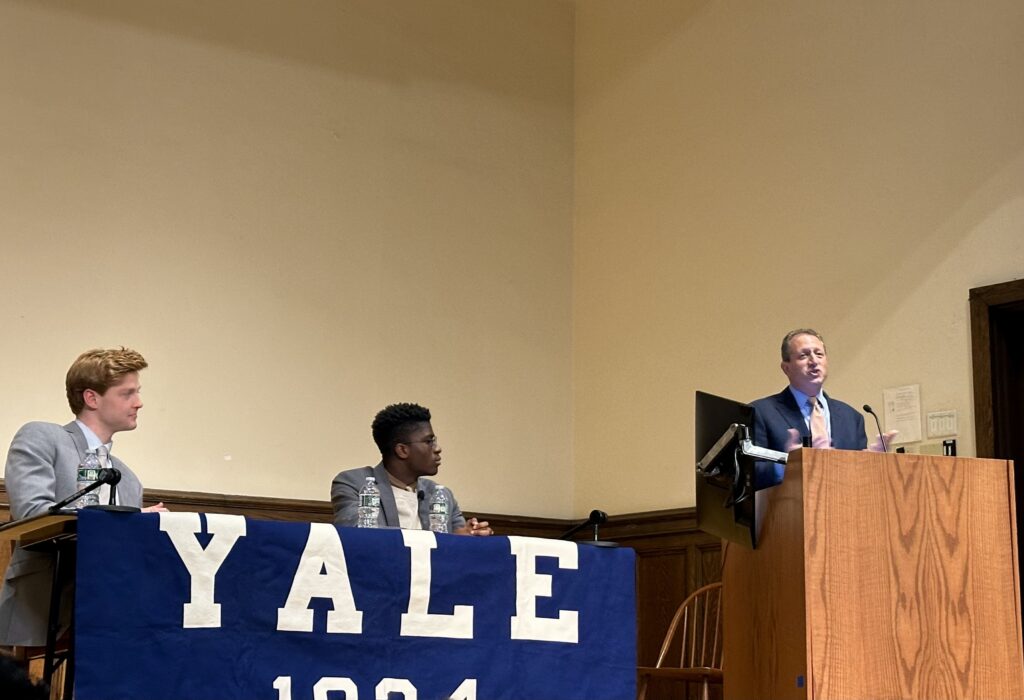
At a Yale Political Union debate on Tuesday, New York City Comptroller Brad Lander argued for the resolution,“Save the Sanctuary City,” which members of the YPU approved in a 95-16 vote.
4:19 am, Nov 19, 2025
Contributing Reporter
Sasha Cabral, Contributing Photographer
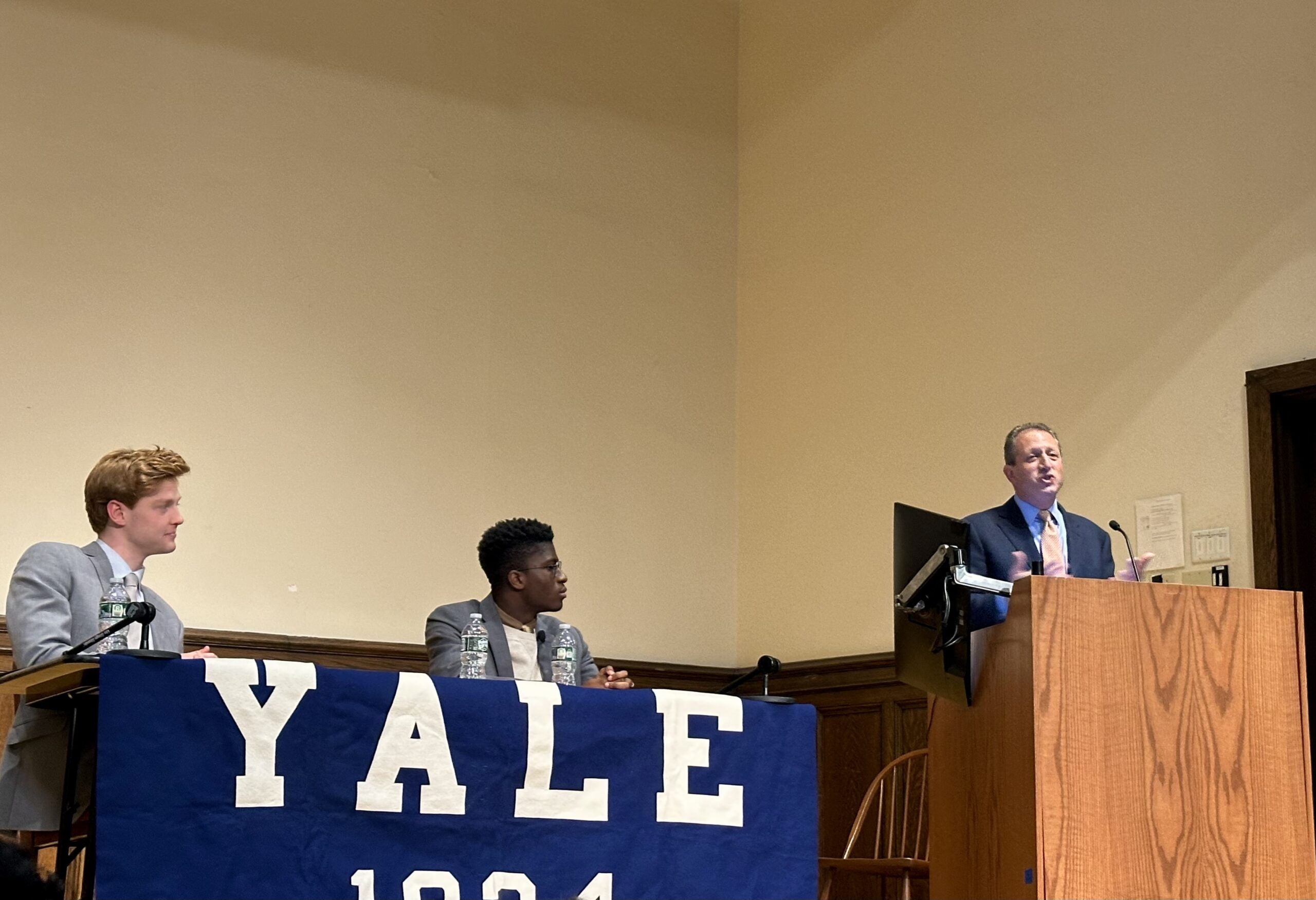
Attendees filed into the 53 Wall St. auditorium on Tuesday for the Yale Political Union’s penultimate debate of the semester, in which New York City Comptroller Brad Lander spoke in favor of the resolution “Save the Sanctuary City,” which passed 95-16.
The YPU hosted Lander, who finished third in the June Democratic primary for New York City mayor. Now soon to be out of a job, the comptroller is considering running for Congress, according to reporting by the New York Times.
Lander is voluntarily facing trial for his arrest at 26 Federal Plaza after reportedly linking arms with a person Immigrations and Customs Enforcement officers were attempting to apprehend.
“At the state and local level, we don’t set border policy. We don’t decide who can become a citizen or legal permanent resident. We don’t set protective status. We don’t do any of those things. That is, in fact, the prerogative of the federal government. But once people are in our jurisdictions, they are our residents,” Lander said at the union debate, speaking in defense of the legality of sanctuary cities.
At the debate, students sparred about the moral and legal reasons to support or oppose the resolution. Most of the student speeches condemned the way ICE has treated immigrants under the Trump administration.
“No matter one’s personal policy position on immigration, I think the manner of immigration enforcement has been pretty horrific, pretty sickening,” Avi Rao ’27, the chairman of the Independent Party, said in his speech opposing the resolution.
Rao, who described himself as “strongly in favor of immigration,” posited that the support of immigration and rejection of ICE does not have to equate to automatic support for sanctuary cities.
“Sanctuary city policies do work until the federal government wants immigration enforcement to be uniform. At that point, the same policies that are meant to protect immigrants actually create more violence and fear,” Rao continued.
Elizabeth Shvarts ’27 posed a rhetorical question to the audience, asking if “mass deportation is the economically savvy option,” while also positioning morality at the forefront of their speech. They elaborated on how legality and morality have historically been at odds, particularly citing Nazi officers’ “just following orders” defense.
“This is not just a moral question. This is a blatant violation of existing federal law,” Shvarts, who spoke in favor of the resolution, said. “And in terms of a time to break the law, a time to break the law is when people’s human rights and dignity are being violated. Even if it means being arrested, not cooperating with ICE is the thing to do. You should break the law in that instance.”
Lander recognized the divide between students regarding sanctuary cities while also acknowledging the general consensus in opinion on ICE’s recent actions.
“One thing I’m delighted to see is how broad the revulsion at ICE’s policies broadly are,” Lander said. “Regardless of how you feel about sanctuary cities tonight, I feel hopeful that the set of people here have a good sense of right from wrong, what’s lawful from what’s lawless.”
While there was a general denouncement of ICE’s activities, not all audience members were in agreement. In an interview, Garrett Warner ’27 expressed his dissatisfaction at the resolution’s passage. Warner, who is from North Carolina, expressed support for Trump’s actions in Charlotte, N.C.
“What’s happening in Charlotte needed to happen, right? American citizens have been suffering for a long time, and our laws have not been enforced in this country for my entire lifetime,” he said. “This is the first time in my 21 years of life that American immigration laws have been enforced, and I think that’s a wonderful thing, and it’s very sad to see almost the entirety of the political union disagree with that.”
Warner also recounted his discontent at what he characterized as a lack of representation for people with his viewpoint on the stage.
Brad Lander previously represented a Brooklyn neighborhood on the New York City Council.