
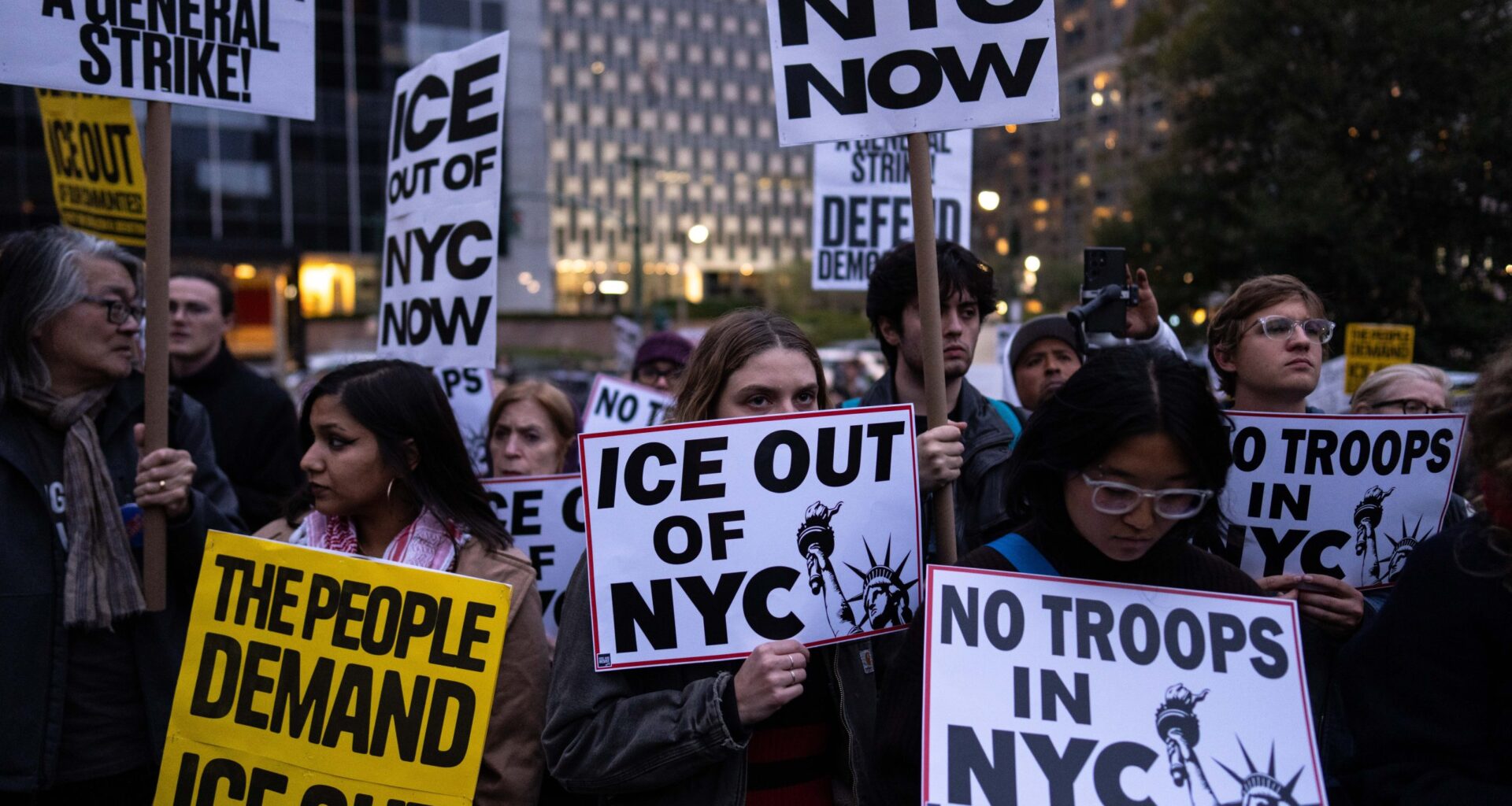
Scores of volunteers are training to protect their noncitizen neighbors from the potential deployment of military troops in New York City. Organizers said they are building on what they’ve learned from the experience of resistance in Los Angeles, Portland, and Chicago, where masked and unidentified agents have often used excessive force and broken federal laws to carry out the Trump administration’s devastating campaign against immigrants.
“We need to exercise repeatedly with our peers so that we know exactly how to step up, how to be courageous, and how to respond,” said Jose Lopez, the co-executive director of Make the Road New York, a grassroots organization with 29,000 members across the state. The goal, he added, is to train “tens of thousands of people across New York City.”
To ensure readiness, more than 100 unions, faith groups, and community organizations have formed Hands Off NYC. The coalition, which emphasizes nonviolence, trains volunteers not to open their home’s door if agents fail to show a judicial arrest warrant, to video record arrests without interfering, and to blow a whistle and share the immigration agents’ location with the community to alert vulnerable noncitizens.
On Nov. 15, Hands Off NYC organized a “Day of Community Action,” featuring over 40 events to build solidarity with neighbors and local businesses across the five boroughs. About 10,000 whistles were distributed for people to alert their neighbors of the presence of federal agents, a tactic learned from Chicago activists.
The wave of mobilization came after President Donald Trump threatened to withhold funds and deploy federal troops to New York City if Democratic candidate Zohran Mamdani was elected mayor, which he was on Nov. 4. “We’re not going to ruin one of our great cities, because we’ll make that great,” Trump said on Oct. 14. “We will clean up the crime in about 30 days. It took 12 days to do Washington, D.C. So New York is bigger.”
Tricia McLaughlin, the assistant secretary of the Department of Homeland Security, wrote in an email to Prism, “We do not discuss future or potential operations.”
Trump border czar Tom Homan, however, told Fox News this week that Immigration and Customs Enforcement (ICE) is ramping up in New York City.
“I plan on being in New York City in the near future. We’re going to do operations in New York City,” Homan said, adding that the City Council shut down ICE’s agreement with outgoing Mayor Eric Adams to detain immigrants at Rikers Island prison complex. “Teams are there now. But we are increasing enforcement presence in New York City, again because they’re a sanctuary city.”
Several other signs have led advocates to believe that a large-scale immigration enforcement campaign might be imminent in New York.
In the last few weeks, an inordinate number of detained immigrants have been transferred out of Delaney Hall, the largest immigration detention center in the New York metropolitan area, capable of holding over 1,000 people. Advocates fear the federal administration is making room for new detainees.
Families of many of the detainees in Delaney Hall report that their loved ones were moved to either Michigan, Ohio, Texas, or Arizona, a spokesperson of Movimiento Cosecha New Jersey, a community organization that helps friends and families of immigrant detainees across New Jersey, told Prism in an email.
Located in Newark, New Jersey, approximately 35 minutes from Manhattan, Delaney Hall has been the primary facility for detaining immigrants in the area since its reopening in May, as New York City has not had a detention center since 2010.
ICE is also actively increasing its detention capacity in New York. The agency negotiated agreements to hold over 100 detainees at the Metropolitan Detention Center, a federal prison in Brooklyn, and up to 50 individuals for up to 72 hours at the Nassau County jail on Long Island. ICE has also recruited at least six county jails in upstate New York to detain immigrants.
The Trump administration has also explored whether to use a Coast Guard facility on Staten Island to house detained immigrants, The New York Times reported on Nov. 14.
“We’re seeing more and more law enforcement show up at doors, at car washes, stopping people on the street,” Lopez said. “We expect that more could come, but we don’t want to wait until that happens before we start talking to people, organizing and training folks.”
An authoritarian project
In an unprecedented decision, the Trump administration has deployed not only officers from ICE but also Customs and Border Protection agents, who are usually assigned to the border, as well as military troops and the National Guard to arrest noncitizens in several Democratic-led cities. The move seems tied not only to immigration enforcement, but also to the broader authoritarian project at the core of the government’s agenda.
New York had a taste of that project in October when a military-style raid in the middle of the day on the most important commercial street of Manhattan’s Chinatown resulted in nine noncitizens and four U.S. citizens being arrested. The latter were released nearly 24 hours later without any federal charges. The incident accelerated efforts to prepare New Yorkers for what might come.
Although not as intense as the actions in Chicago, which have involved tear gas and even agents rappelling down a high-rise building into private apartments, sightings of federal agents seem to be increasing across the city. These have included arrests in Washington Heights in Manhattan and raids in Jackson Heights, Queens, and Sunset Park, Brooklyn, all of them neighborhoods with large immigrant populations. More of these actions are expected.
An upcoming operation in the city would be implemented despite the opposition of New York Gov. Kathy Hochul and the state’s Attorney General Letitia James. “Every New Yorker deserves to live free from fear or intimidation,” James has said publicly. In October, her office launched a webpage for people to upload videos, photos, and reports of federal actions in the state.
Members of the City Council also oppose the potential deployment of militarized teams, arguing that this would undermine public safety and the city’s economy. Some council members are directly involved in organizing the community response.
“We want people to have the knowledge and skills to feel comfortable and ready when something happens,” Sandy Nurse, a City Council member from Brooklyn, told Prism. A former organizer, Nurse, led a training in Bushwick on Nov. 15, which included simultaneous interpretation into Spanish. Other council members, she said, are doing similar trainings in their districts.
Participants were encouraged to subscribe to WhatsApp or Signal message groups to share resources and information about the potential presence of agents in the community.
“What we’re going up against is so violent and dangerous that it scares people,” Nurse said. “And the only way to get through that fear is to put your body in motion, get your brain together, and be with other people so you don’t feel alone.”
Editorial Team:
Sahar Fatima, Lead Editor
Carolyn Copeland, Top Editor
Stephanie Harris, Copy Editor
Related