
Manhattan Regional Airport is working to give its main taxiway a facelift. The Manhattan City Commission on Tuesday unanimously authorized project plans and financing for Taxiway Alpha’s reconstruction project.
That approval also included a professional services agreement with Olsson Inc. The total cost of the project is $1,213,800.
Previously, Federal Aviation Administration grant funding was provided at a 90/10 split, with the city responsible for 10% of the cost. However, under recent FAA reauthorization, that cost share improved to 95/5, reducing the local share.
Following the commission’s approval, Olsson can proceed with design work, which is anticipated to complete by spring 2026. Once the design is finalized, a grant application will be submitted to the FAA to cover the cost of both design and construction. The resulting grant offer and construction contract will be brought back to the city commission next year.
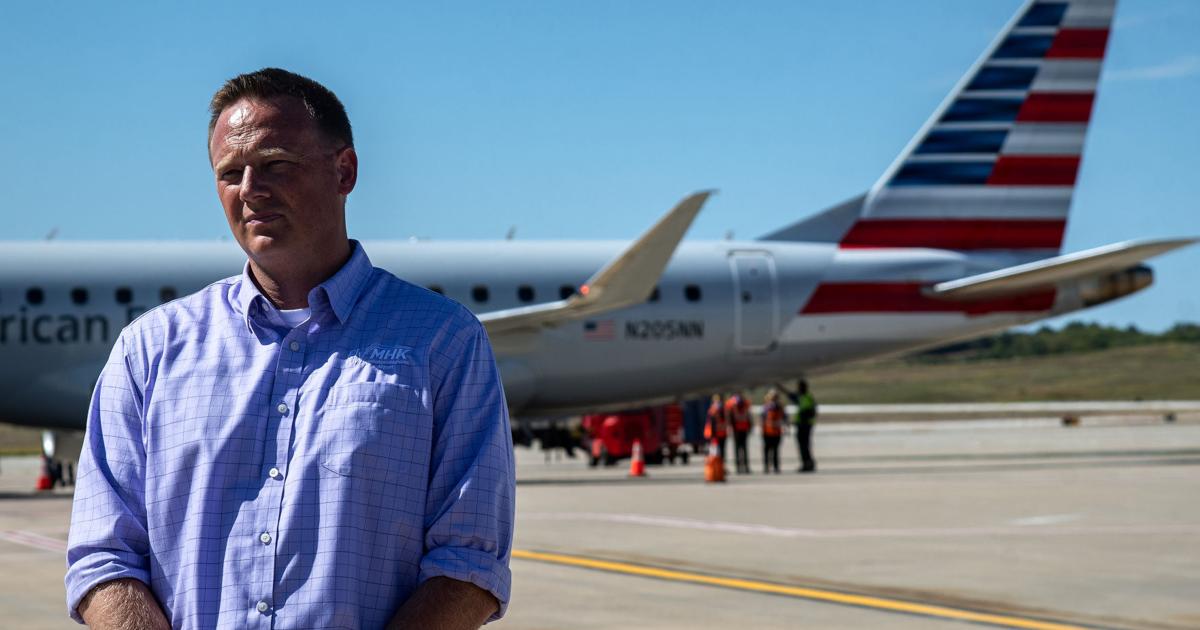
Airport Director Brandon Keazer said updating the taxiway is vital.
“If you’re not familiar with what a taxiway does, it’s a route which an aircraft can taxi when moving to or from a runway,” he said. “They’re also known as a pathway on an airport that connects the runway with ramps. It’s a very critical component for airport airfield operations. And if you’ve flown out of really big airports, it’s traditionally where airplanes will stage before they get clearance onto the primary runways.”
Keazer said the three sections of Taxiway Alpha were constructed in 1982, 1994 and 2002, and have varying pavement conditions. He said new opportunities have necessitated a tighter timeline for the project.
“Prior to mid-October, the FAA was basically putting enough grant funding out there available to us to just replace the middle and the north section, and we’d have to come back at some point and do the south section at another point, with another grant,” Keazer said. “We were going to design in ‘26, take a lot of time, spend some time on the design, and then look to construct in ‘27 and ‘28.”
Then, additional funding became available during the government shutdown.
“We got notified that we had an opportunity to complete all three sections with our entitlement and now discretionary funds,” Keazer said. “The discretionary part is the big piece. That is going to allow us to be able to do all of it. The challenge that we run into is that we have to move incredibly quick.”
Keazer said that while the city will provide the project’s funding at the start, the grant will cover 95% of the cost after the fact.
“We do not have the grant yet,” he said. “With airports, we build everything out first, and then we go back and get the grant. So we do all of that work first. So right now, the city will cover this $1.2 million until we get the grant offer. When I get the grant offer, it’ll have everything in it. It’ll have the reimbursement for this $1.2 million and then it’ll also have the construction.”
He said he also has a plan to cover the remaining 5% cost.
“If you go back to April of this year, we did a commission-approved passenger facility application, or passive facility charge, where we can utilize our $4.50 that we get to pay for the local share on eligible FAA projects,” Keazer said. “And so that is my intention of once we build this out, to eventually put this, that 5% that we owe, onto that application. So the more people that fly in and out of Manhattan, the more money we make, the quicker we pay off our debt.”
Keazer said the design must be completed by the end of April, followed by construction in 2026 and 2027. He said taxiway construction will be done incrementally to not affect airline operations.
Keazer plans to return to the city commission toward the end of summer 2026 to seek approval of the construction contract to move forward with the project.