
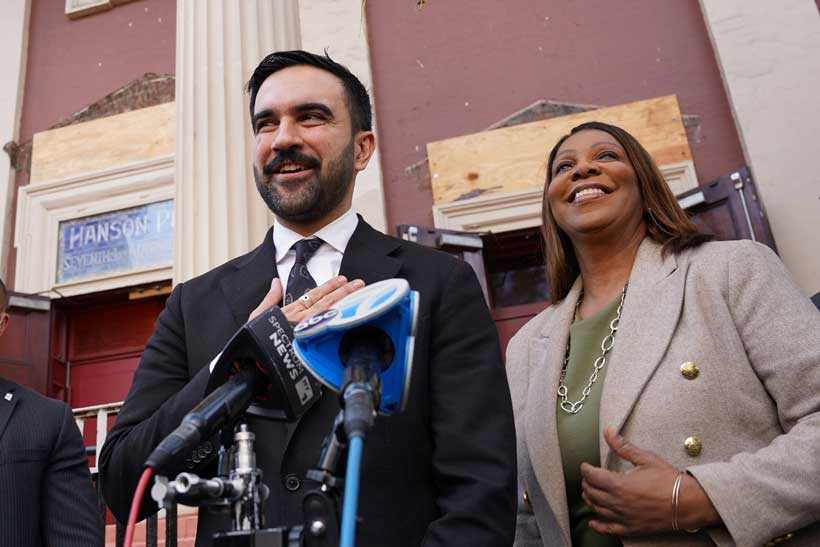
New York has always been a testing ground for bold ideas, and on Nov. 4, the city’s voters made a very global leap of faith: give the young, loud, and marginalised a chance, and see what unfolds. Zohran Mamdani’s victory, the city’s first Muslim and one of its youngest mayors in recent memory, is more than a symbolic upset. It’s a political earthquake that hits at the core issues of affordability, identity, and global influence.
The backdrop makes the gamble clear. Manhattan’s office towers no longer hum like they did; vacancy rates that affected markets a year ago remain stubborn and structural, and the churn has hollowed out business corridors while housing supply has not kept pace with demand across the metropolitan area. In simple terms: jobs have come back, but the cost of living has not lowered, and a chronic housing shortage, as hundreds of thousands of units short by conservative regional estimates, is holding back the city’s future. The numbers are not theoretical; they are the mortgage notices, the eviction hearings, the parents juggling two jobs to pay for childcare.
Mamdani campaigned as a response to that lived reality. His promises: a rent freeze for covered units, free city buses in a trial, universal childcare and tougher taxes on the ultra-rich, are unapologetically redistributive and designed to resonate with New Yorkers: in their wallets and their daily lives. This is not empty populism. It is a deliberate effort to change incentives, treating urban governance as social infrastructure rather than just a consequence of market goodwill. Whether viewed as necessary medicine or risky surgery depends on political perspective, yet the diagnosis—unaffordable housing, broken care systems, and congested streets—is almost universally acknowledged.
Estimates vary, but independent planners put New York’s gap in stark terms: studies from the Regional Plan Association and planning firms have suggested anywhere from roughly 560,000 to more than 800,000 units needed to meet demand over the coming decade, a scale that makes this more than a policy problem; it is a structural emergency. Bold ideas need fiscal architecture: costed pilots and transparent revenue plans, phased pilots, a mix of targeted taxes and municipal bonds, and independent fiscal oversight are the difference between promise and policy.
There is a flavour of theatre here, an erstwhile state legislator taking on billionaires and the financial sector, and Wall Street is watching nervously. Investors and business groups warn that higher taxes and expansive regulation could chill competitiveness; progressives reply that long-term productivity gains come from stable housing and reliable care, and that a city that works for ordinary people is a city with more buyers, workers and vibrancy. The tussle will be fought in courtrooms and budget offices, not billboards. Expect legal challenges, congressional grandstanding, and headline-grabbing debates about whether a city can spend big without breaking its budget.
Expect headlines and headlines of worry: when Seattle’s council passed a head tax in 2018, major employers and business groups publicly warned of consequences, a reminder that corporate pushback is concrete, not rhetorical. Moreover, expect constitutional takings arguments, state preemption fights and procedural challenges as recent litigation over New York rent rules shows, and a timetable measured in appeals that can stretch for years unless carefully designed upfront.
But Mamdani’s win is not just domestic economics dressed up as politics. It is city diplomacy in action. A mayor of New York is also a global brand manager: mayors sell ports and pensions, tourism and tech partnerships, cultural festivals and film shoots. Mamdani’s identity: an immigrant, a Muslim, a South Asian with roots that span continents, is being wielded as soft power. By speaking directly to diasporas, courting cultural linkages and opening trade and investment channels, the new mayor can leverage social networks that are peculiarly suited to 21st-century globalisation: trust circuits that run on kinship, faith and shared memory as much as on spreadsheets. The scholarship is clear: diasporas move capital, ideas and credibility in ways nation-states sometimes cannot. Mamdani is well placed to thread that needle.
Think of London under Sadiq Khan or Toronto under mayors who pitched their cities as cosmopolitan hubs: cultural diplomacy and diaspora outreach yield real money, visitors and projects. Mamdani’s team has already signalled interest in those avenues — meeting business envoys and pitching a resilient, pluralistic New York as a safe harbour for investment that also has a conscience. If he plays it smart — building predictable, transparent channels for diaspora capital and pairing them with social returns — New York could attract stable, willing partners rather than speculative hot money.
Diaspora networks are not magic money: they are convertible capital only when packaged into credible instruments (diaspora bonds, municipal diaspora funds, co-investment vehicles) with transparent governance, legal registration and measurable social returns — a lesson borne out by decades of diaspora bond experiments and the careful policy guidance of multilateral agencies.
Yet there is a sober counterweight to the romance. Cities have limited levers: zoning, taxation, local services and moral suasion. They cannot magic away structural inequality overnight, nor can they fully insulate themselves from federal policy swings or national politics. New York’s experiment will therefore be both local policy test-bed and international theatre: a place where the policies that make life bearable for a nurse, a schoolteacher, or a bus driver are also a message to the world about what a modern American city values.
Moreover, implementation should proceed through a graduated pathway of experimentation, fiscal consolidation, and strategic expansion rather than abrupt transformation. The initial phase would focus on demonstration corridors and districts—targeted localities where integrated interventions such as adaptive housing reuse, childcare accessibility, or zero-fare transit can be tested and evaluated under real urban conditions. These initiatives would be financed through a diversified resource framework combining reallocation of underutilised municipal funds, catalytic contributions from state and federal grants, and the issuance of social or green municipal bonds designed to attract ethical investors and diaspora capital under a transparent ‘City Impact Partnership’ platform.
Fiscal prudence would be safeguarded through independent budgetary oversight and the use of performance-based indicators measuring economic inclusion, service uptake, and environmental efficiency. Once institutional confidence and empirical credibility are established, the model would advance into progressive scaling, supported by blended finance mechanisms and private–public co-investment vehicles. This phased, evidence-anchored strategy ensures that ambition is matched with accountability, political trust, and durable financial sustainability—hallmarks of responsible metropolitan governance.
The world should watch this with more than casual interest. Cities everywhere, from Sydney to São Paulo, Nairobi to New York are engines of culture and contradiction, and what binds them is not geography but a fragile, shared promise: a global compact to protect dignity, fairness and opportunity in the face of rising inequality. Mamdani’s brand of municipal politics speaks to that compact. When national politics grow brittle or are captured by extremes, cities become laboratories of repair. Led with courage and competence, they can re-stitch social contracts at street level, turn everyday services into acts of solidarity, and project a living story of openness and responsibility to the world.
The first year will be critical: daycare rollouts, transit experiments, and housing initiatives, as well as prudent fiscal management, will demonstrate whether campaign rhetoric translates into dependable services. Success will necessitate daring combined with rigorous implementation and the ability to guide capital into long-term relationships rather than headline-grabbing acquisitions; failure will result in swift backlash. Whatever the conclusion, Mamdani’s mayoralty sends a global message that cities may still lead democratic transformation and reestablish international confidence.