
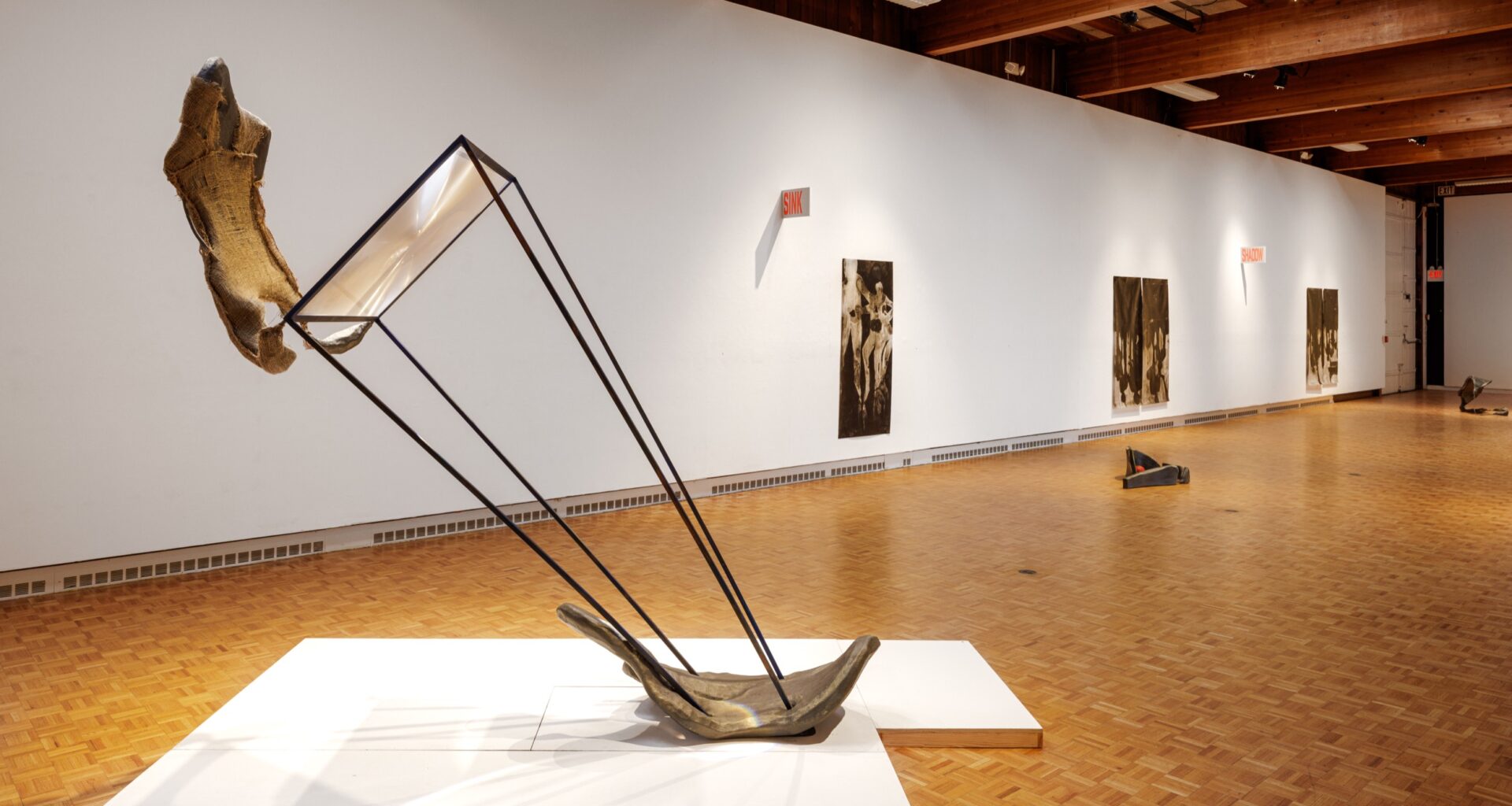
Several “slumps”—sculptural shapes that resemble moribund bodies from another universe—are fabricated using steel, foam, fiberglass, Aquaresin, burlap, and encaustic. Painted in a gray inspired by Japanese post-war architect Kisho Kurokawa’s implementation of “Rikyu Grey” (produced by mixing all colors together), engenders not only a feeling of mortality but also provides an ethos of hope. The “slumps,” much like Butoh’s radical dance, are twisted and turned in unwieldy shapes and balances that can be interpreted as a revolt against the status quo.
These pieces unmistakably touch on the idea of immigrants as aliens rather than members of our common humanity. Their shapes inspired the title of the exhibition, Overbody, and act as a metaphor for the invisible pressure exerted on immigrants to conform and comply.
Passage 1 (2024), a wall piece created using twine and mulberry paper, simulates a chainlink fence with rips and tears, some tiny, some large enough for a person to crawl through. From a distance it resembles an exquisite, fragile, lace-like tapestry suffering the crumbling insults of rotting linen; close-up, it is the quintessential barrier to imagined freedom, a symbol commonly erected on borders to keep out those not needed nor welcomed.
Four new “sign paintings,” Under/See, Sink/Soul, Shadow/Fold, and Over/Body (all 2025), were all created on maple panels, 10 by 12 by 1 inches, and painted using acrylic and Flashe. Designed to mimic exit signage, they mirror the concept of exiting one place as a means of entering another environment.
Inspired by Butoh, Premnath collaborated with Butoh practitioners and Bennington dance faculty, Mina Nishimura and Kota Yamazaki who created movement scores that responded to Premnath’s sculptures and presented alongside his preparatory drawings in the exhibition catalogue. This partnership was conceived to offer a prompt for viewers to respond to works physically as they move through the exhibition.
Sreshta Rit Premnath’s Overbody is a deep visual response and investigation into the irrational and unrealistic concept of borders. Contemporary borders were established by imperialist countries specifically after World War II that rewarded colonialists. These demarcations are only secure as long as they serve those who maintain them. In a shrinking world that is rapidly changing due to climate change and the immediacy of contemporary international travel, this draconian system serves no one but a few oligarchs.
Born in Bangalore, India, the artist came as a student to the United States and has since become a US citizen. Anyone who has trekked through this experience knows firsthand the constant burden of the pressure to behave in a superimposed manner. This includes but is not limited to language, cuisine, culture, and even one’s clothing and posture. Premnath’s exhibition not only denotes the trials of immigration but also depicts the inner strength and stalwart determination of everyday people. It further speaks to the resiliency and human decency of those who make this journey.