
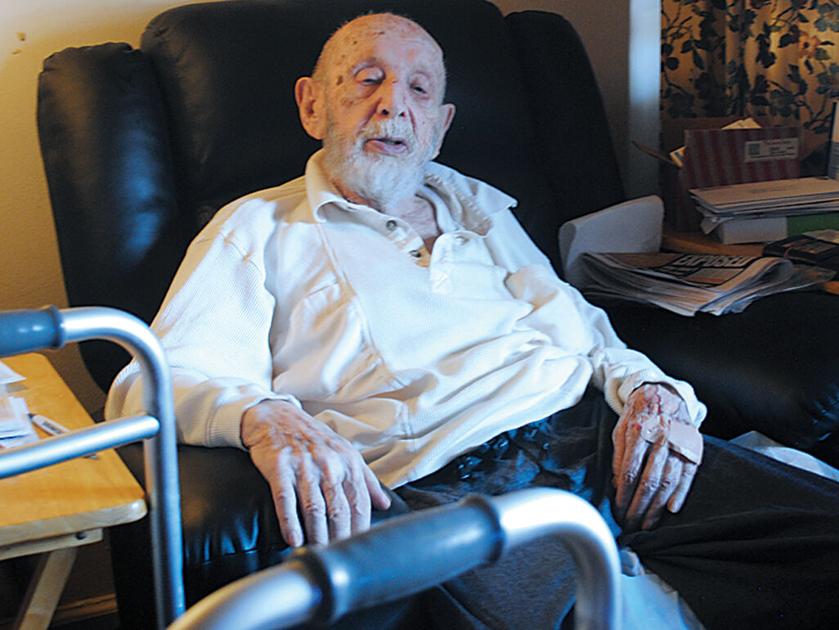
Andrew Spitz of Kew Gardens Hills will turn 95 on Nov. 22.
Although he has built a life in Queens with his wife, Ruth, Spitz can never forget what his days were like 80 years ago, when he was taken from his hometown in Hungary to the Nazis’ largest concentration camp.
“Sometimes, you turn to God and you say, how do you allow this to happen to me?” he told the Chronicle during a home visit Monday.
Spitz was separated from his family when he was brought to Auschwitz at 14. His sister also was in the camp, but men and women stayed in separate quarters, and his mother was with her own age group. His father had been in an army unit after being drafted.
He spoke of the Nazis’ “inhumanity” only in vague terms, and got choked up when thinking back to the cruelty he endured.
He said many people in the camp started to revolt and question God’s authority, and the experience changed his thoughts about his religion for good.
“In my childhood before the Holocaust, I was very much into it,” Spitz said. “But everything changed after.” He does not subscribe to Hasidic Jewish beliefs or even adhere to a strict kosher diet.
“It’s funny, no matter how many years go by … you get very emotional at times,” Spitz said. “In one respect, it’s good to remember some of the past to make sure you do not repeat it.” But, he said, he would prefer not to remember all that he went through, and the survivors whose memory now fails them “may be better off.”
After his time in Auschwitz, Spitz was transferred to the Strasshof camp in Austria, where he was liberated in 1945 by the Russian army. He fondly recalled drinking with his liberators and learning songs in their language, which he sang Monday in a baritone as strong as ever.
Spitz next traveled to Vienna, followed by Eggenfelden, Germany, where the United Nations Relief and Rehabilitation Administration sent him and other survivors. He said there was an open market there, and he did well for himself riding his bike to sell basic items to people in nearby towns.
And though the people he met there were “very pleasant,” he said he knew he could not stay in Germany. He eventually returned to Hungary, but soon applied for a visa to come to the United States, where he already had some relatives.
Spitz was about 17 when he came to New York and spent some “good years” in the city, especially with his uncle Zoltan, a custom tailor based in Manhattan. He even met famed Royal Canadians band leader Guy Lombardo, a client of his uncle’s.
His successful trade ventures in Germany continued in the United States. He was staying at a Manhattan commune when he learned of an open busboy position at a small hotel. He earned $650 in that role in 1950, which he said was “a lot of money then.”
He nearly doubled his earnings as a waiter the next summer, and the money he saved later helped him open his first business in lower Manhattan.
“After this, I opened another dozen stores,” Spitz said. “I was fortunate to go into the food business when every store we opened was very successful.” One such undertaking was a bagel shop near Madison Square Garden.
“I printed up menus and fliers, but we didn’t have to give them out,” he said. “The door opened, there was a long line.”
Spitz met Ruth in 1949 and married her shortly thereafter. They have two daughters, Judith and Sharon.
Ruth Spitz’s birthday also is coming up — she will turn 93 Nov. 28. The family plans to get together to mark both their birthdays this Sunday.
While his wife was born in the city, Spitz said their coming to Queens was “an accident,” guided by groups that help newcomers find housing. They have lived in the borough since the ’60s, and he said there is a community of survivors in the area.
“It’s not something that I would like to remember, but sometimes, it does come back into mind,” Spitz said. “I’m grateful that I escaped, and I’m grateful that my mind is still intact.”