
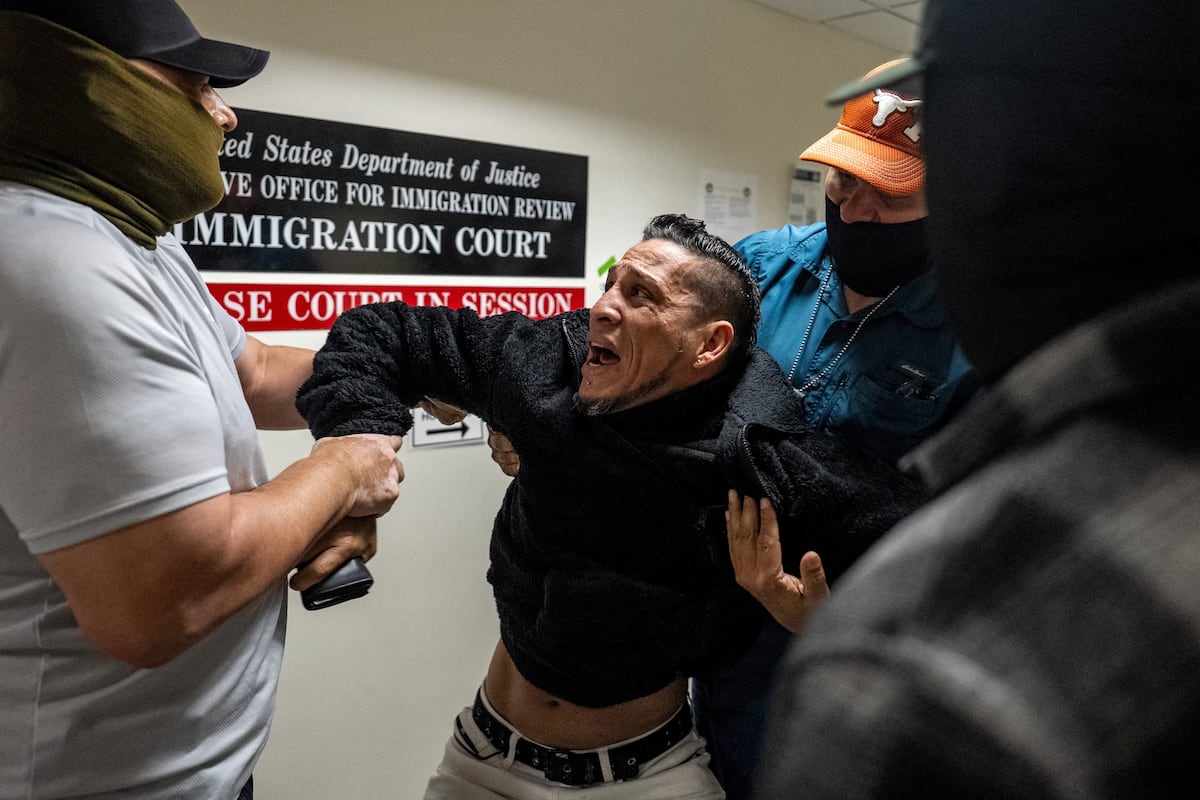
Zohran Mamdani is still six weeks away from taking office as the next mayor of New York City. But even before his historic victory on November 4, city and state officials had been preparing for the possibility that U.S President Donald Trump will send more federal agents to enforce his immigration offensive and deploy the National Guard to the city, as he has already done in other Democratic strongholds. These preparations have intensified since the socialist politician was elected, while the Republican administration has doubled down on its threats.
“I plan on being in New York City in the near future. We’re going to do operations in New York City,” Border Czar Tom Homan told Fox News on Tuesday. The top official added that immigration agents are already in the city and that he plans to send more: “We’re going to flood the zone.”
It’s a warning the Trump administration has been repeating for months, but it takes on special significance now that Mamdani will be the mayor of New York City. The young socialist Democrat won the mayoral race in the most populous city in the United States with a strongly anti-Trump and pro-immigrant message. After a campaign in which he constantly promised to stand up to the president, as mayor-elect Mamdani has remained steadfast in that commitment, openly challenging the Republican in his first speech after his victory. “New York will continue to be a city of immigrants,” he declared that night.
However, there have also been signs that Mamdani is willing to extend an olive branch, or at least try. His team announced this week that it had contacted the White House to arrange a meeting with Trump. Mamdani has said that the hypothetical meeting would focus on the city’s affordability crisis, the cornerstone of his campaign. The announcement came after the president stated on Sunday that he is willing to meet with Mamdani, after months of calling him a “communist lunatic.”
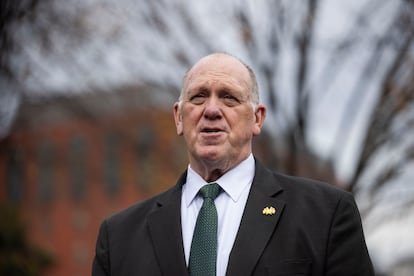 Tom Homan in Washington, November 14.JIM LO SCALZO (EFE)
The move comes at a time when both the city and the state are preparing for a potential confrontation with the federal government if Trump decides to replicate in New York what he has already done in cities like Los Angeles, Chicago, Portland (Oregon), Washington, D.C., and Charlotte (North Carolina). In recent months, federal agents have arrived in these cities, all governed by the Democratic Party, and have carried out large-scale immigration operations resulting in hundreds of arrests. Some have also received National Guard troops, while others have managed to halt these deployments in the courts.
The presence of agents and troops has been met with citizen protests that have turned violent, with federal authorities responding by launching tear gas and firing rubber bullets, pepper balls and chemical weapons at the protesters.
So far, such scenes have not been seen in New York. Although there have been raids, such as the one in October on Canal Street in Lower Manhattan, immigration enforcement activity has been concentrated in a single building: 26 Federal Plaza, a federal skyscraper housing several immigration courts, also located in Manhattan. Half of the more than 3,000 migrant arrests that have taken place in the city in recent months have occurred there.
However, that raid on October 21st served as a warning to the city. The dramatic, military-style operation, with more than 50 officers and armored trucks descending on a tourist area known for its street vendors, most of them migrants, offered a glimpse of what might be coming in the months ahead.
Harmful to the economy
Preparations to address this possibility have been led by the office of the state’s governor, Democrat Kathy Hochul. For weeks, her team has held meetings with various sectors of society to develop a strategy. These discussions have included business and real estate leaders, many of whom have ties to or are close to the president. The expectation is that they could intervene to prevent Trump from ordering a federal deployment to the city by signaling that such an action in New York, the country’s financial capital, would be detrimental to the national economy.
“I’ve had conversations with a lot of business leaders saying, ‘When the time comes, make sure that you also convey your concerns about what this would do to destabilize New York City and the outsize impact that this would have across America,’” Hochul said on Monday. “It would have an effect that other cities do not have because we are the financial center. And you cannot disturb that without consequences.”
It is a strategy that has already been fruitful in San Francisco, where Trump was going to send troops last month, but decided not to after executives from several of the large technology companies that have headquarters in the Californian city argued against it.
Meanwhile, Hochul’s office has been in contact with officials in cities like Chicago and Los Angeles to gather feedback on their response. Members of her team have asked their counterparts in these cities how they have dealt with Trump’s federalization of the National Guard, which effectively takes over a force that is legally under the command of each state’s governor. It is likely that New York, if necessary, will follow the lead of states like Illinois and California, which responded with lawsuits challenging the deployments.
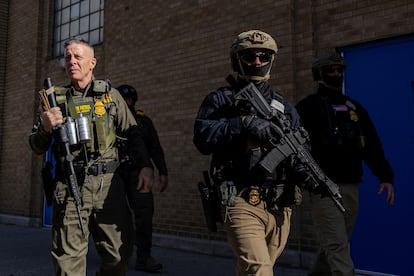 Border Patrol agents in Chicago on November 6.Jim Vondruska (REUTERS)
New York officials have also investigated how local police in different cities have handled the increased presence of federal agents on the streets, and how they have dealt with the resulting citizen protests. Like Los Angeles and Chicago, New York is a sanctuary city, meaning local law enforcement does not cooperate with federal immigration authorities. This is why the Trump administration has targeted these cities, accusing them not only of failing to cooperate with his agenda of mass arrests and deportations, but also of allowing crime to run rampant.
Crime has been the primary justification the government has used for ordering these deployments. However, data shows that crime is declining in all the cities involved. In New York City alone, shootings and murders have reached historic lows in 2025. Other serious crimes, such as burglaries and shoplifting, have also decreased.
Even so, the Trump administration is convinced that New York will be one of its next targets: “We are increasing enforcement present in New York City — again, because they’re a sanctuary city, and we know we have an issue there with public safety threats in the street every day,” Tom Homan said on Fox News this week. The border czar added that, like Trump, he would be willing to meet with members of Mamdani’s incoming government to “work on this together.” But if they don’t want to cooperate and continue to resist and impede efforts, “then we will simply send more teams there,” he concluded.
In addition to state and local officials, migrant advocacy groups and community organizations and activists are also preparing to counter the Trump administration’s plans for the city. Taking a cue from a strategy already employed in Chicago, thousands of whistles are being distributed in areas that have already been targeted by immigration agents or that could be targeted due to their large immigrant populations.
New operations in the south of the country
While New York awaits its turn, the Republican administration has set its sights on the South, on cities that, although Democratic, lack sanctuary policies because their respective states have laws prohibiting them. This is the case in Charlotte, North Carolina, where a migrant detention operation has been underway since last Saturday, resulting in more than 250 arrests. The government plans to expand the operation beyond the state’s largest city to Raleigh, where federal agents have already arrived in recent days.
The next target will be New Orleans, Louisiana. Around 250 Border Patrol agents are expected to arrive in the jazz city in the coming weeks for a two-month immigration offensive that could begin on December 1.
Sign up for our weekly newsletter to get more English-language news coverage from EL PAÍS USA Edition