
I don’t have a lot of regrets about how I raised my kids when they were little.
I did all the things: I strapped them to my body for “attachment,” joined Mommy and Me classes to find our “village,” and signed them up for Little League, dance, STEM programs and soccer. We played chess and board games, built obstacle courses around the house, and wrote letters (and songs) to grandparents who lived far away.
And every night, I read to them — stories that taught kindness, inclusion, and the importance of seeing beyond our little bubble.
But … somehow, in all those DIY lessons and bedtime stories, I never taught them another language.
All the books we read together were in English. Not a single bilingual book in the bunch.
Manhattan Beach mom Maritere Rodriguez Bellas, however, wants to make sure other parents don’t miss that boat.
Sixty-eight-year-old Bellas — who was born and raised in Puerto Rico but raised her (now adult) son and daughter in the South Bay — has made it her mission to help other parents raise bilingual children.
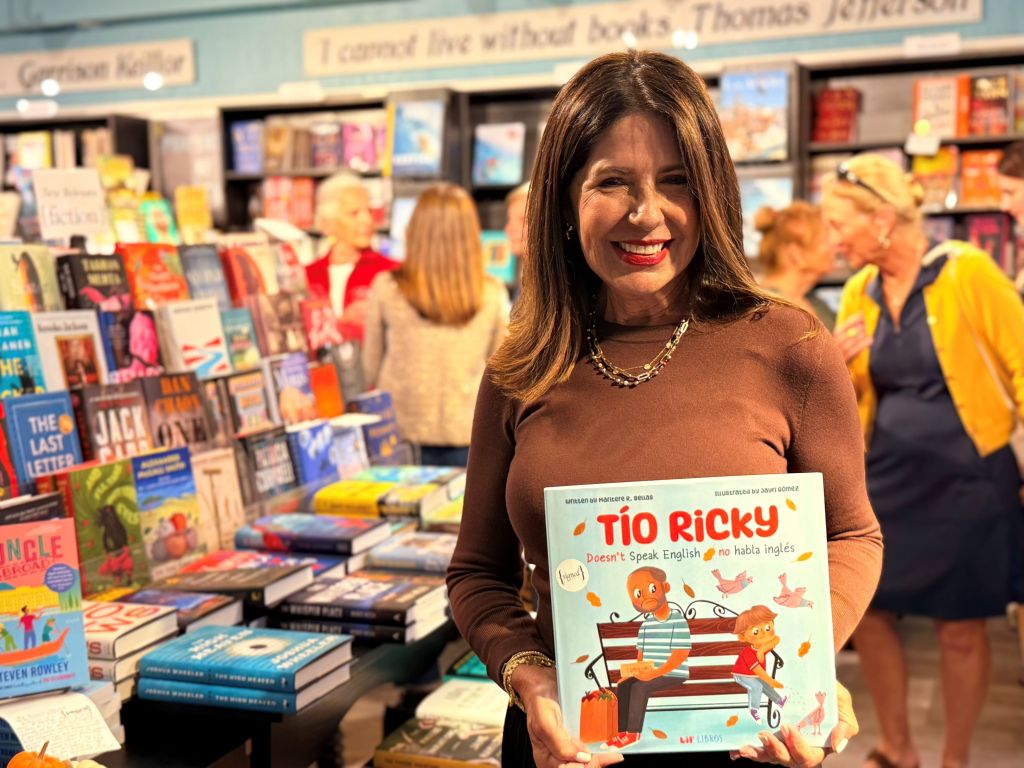
Maritere R. Bellas and her bilingual children’s picture book ‘Tío Ricky Doesn’t Speak English / no habla inglés.’ (Photo courtesy of Melissa Heckscher)
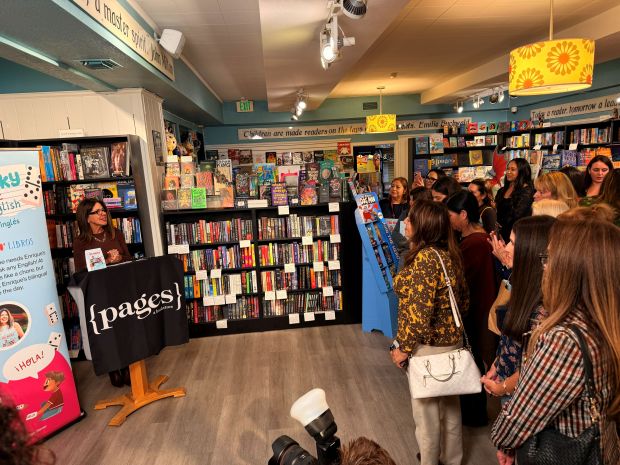
Maritere R. Bellas speaking about her bilingual children’s picture book ‘Tío Ricky Doesn’t Speak English / no habla inglés’ to a crowd at Pages bookstore in Manhattan Beach. (Photo courtesy of Melissa Heckscher)
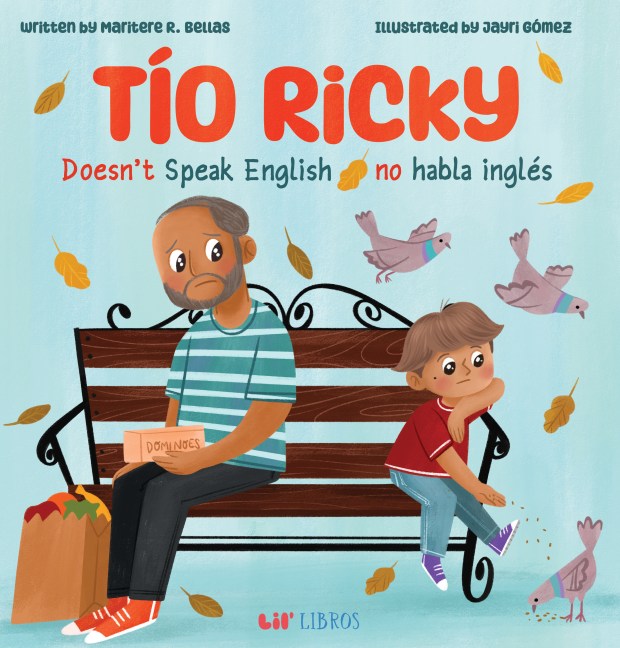
Book cover for Maritere R. Bellas bilingual children’s picture book ‘Tío Ricky Doesn’t Speak English / no habla inglés,’ and illustrated by Jayri Gómez. (Photo courtesy of Maritere R. Bellas / Lil’ Libros)
Show Caption
1 of 3
Maritere R. Bellas and her bilingual children’s picture book ‘Tío Ricky Doesn’t Speak English / no habla inglés.’ (Photo courtesy of Melissa Heckscher)
A longtime writer, she’s bringing that mission to life in her third bilingual children’s picture book (and fifth overall), released this week through the Los Angeles publisher Lil’ Libros.
“Tío Ricky Doesn’t Speak English/no habla inglés” is a brightly illustrated story about a boy who must translate for his Spanish-speaking uncle, a task he resists until it leads to heroic consequences.
The book is written in English, with Spanish translations just below.
“This is a story that touched my heart because I used to translate for my grandmother all the time,” Bellas said. “We need this story.”
Bellas has become somewhat of a guru when it comes to bilingual parenting. She co-created and hosts “Mamás 411,” a podcast heard in 27 countries, and co-hosts the Instagram Live series “The Hablemos Bilingual.” Both are resources for parents raising bilingual kids.
For 12 years, she wrote a weekly parenting column for La Opinión, one of the nation’s largest Spanish-language newspapers.
She was also instrumental in launching the Spanish-language program at American Martyrs School, which her two children attended.
“My dream is to see Spanish in every single school in the whole country,” she said.
She’s since written two more bilingual picture books, including “I Have a Secret/¡Tengo un Secreto!,” which received an honorable mention for Best Children’s Fiction Picture Book at the 2022 International Latino Book Awards.
That story follows a child embarrassed to admit to his classmates that he speaks Spanish — a struggle many immigrant families share.
“Many (immigrant) parents struggled with kids who didn’t want to speak Spanish anymore when they started school, and often parents would give up,” Bellas said. “Kids were afraid of speaking Spanish because they would get criticized.”
For Bellas, bilingualism and multiculturalism are simply part of who she is. She grew up in Puerto Rico speaking Spanish and English, then studied in Switzerland — where she learned French, Portuguese and Italian before coming to California to earn her master’s degree in communications from Pepperdine University.
In Southern California, she found herself surrounded by even more languages and cultures: friends from Argentina, Peru, Mexico and Puerto Rico, and her husband, Peter Bellas, a Greek American who worked for the Spanish-language television network Univision.
With her background, you’d think raising bilingual kids would come naturally. But when Bellas became a mother, she discovered there weren’t many resources to help her.
So she created them herself.
“I’m trying to empower parents,” Bellas said. “My whole life here has been in English. Keeping the Spanish has been super important.”
The benefits of learning another language — especially for children — are well documented, with research showing it strengthens the brain’s ability to focus, solve problems and understand others.
A 2024 study published in the journal “Nature,” for instance, found that bilingual children develop stronger connections between brain regions tied to focus and problem-solving, while research from the National Institutes of Health found they consistently outperform monolingual peers on attention and cognitive flexibility tests.
“Just learning language and literacy, your brain becomes more flexible,” said Irma Vazquez, a Redondo Beach bilingual educator and founder of My Escuelita, which offers Spanish language summer camps and teacher trainings. “Even if your child is not fluent — even if you are not fluent — the benefits are things like empathy, global citizenship, andunderstanding that we’re part of a global citizenry, that we’re connected to many people around the world.”
Bilingual books are booming. According to Publishers Weekly, the children’s nonfiction “diversity and multicultural” category has grown nearly tenfold in recent years — up 993% from 2020 to 2021, and another 861% from 2021 to 2022.
That surge reflects a growing audience: U.S. census data shows that roughly 44% of households speak a language other than English at home, often in multigenerational families, where parents or grandparents use one language and the kids another.
Of course, not every parent is ready to enroll their child in a dual-immersion program or a Spanish summer camp.
But even a bedtime story can help.
“If you create a positive memory around learning another language, it will help when it comes to your child choosing a language in middle school,” Vazquez said. “You have your globe, your map — you point to a country and connect them to other children across another continent — and suddenly, your world becomes smaller.
“Your child’s world becomes smaller,” she added. “And they can see that there are other people out there just like them who may speak a different language.”
“Tio Ricky Doesn’t Speak English/no habla inglés” is available to order at Pages Bookstore in Manhattan Beach or wherever else books are sold.