
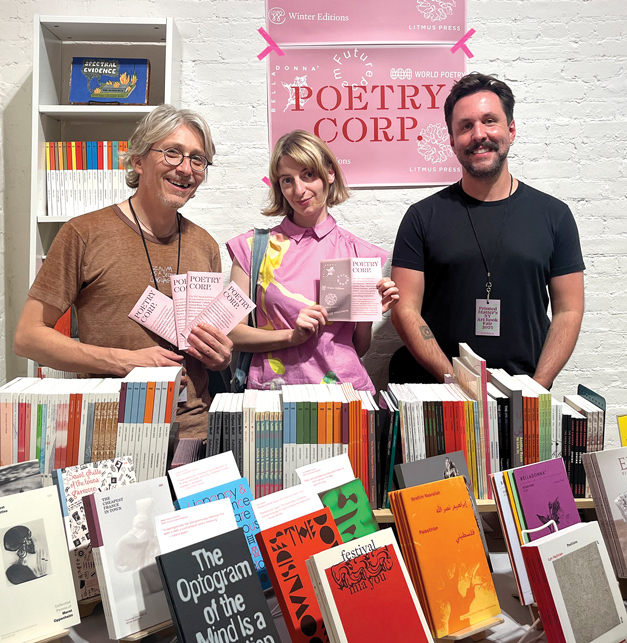
Behind a table on the second floor of September’s New York Art Book Fair, four pink posters with big block letters announced the presence of the newest entrant to the city’s independent
publishing community: “POETRY CORP.”
Poetry Corp. was at the fair, which is run annually by the nonprofit bookstore, publisher, and distributor Printed Matter and features more than 250 exhibitors, to make its official debut. Calling itself an “informal mutual-aid publishing cooperative,” Poetry Corp. comprises five New York City small presses—Belladonna* Collaborative, Futurepoem, Litmus Press, Winter Editions, and World Poetry—and sees its mission as “investing in the future of experimental publishing.” (All but Winter Editions are also incorporated as nonprofits.)
Miriam Atkin, an editor at Litmus as well as its main grant writer, says she hopes that the resource sharing enabled by the collaboration—from joint press lists to shared staff to streamlined printing—can sustain the presses for the long run. “These more underground markets can’t survive unless the different purveyors of this work are doing it all together, side by side,” Atkin says.
On this count, Poetry Corp. reflects the prevailing ethos, and practices, of its corner of the publishing world. In the open-plan studio in Crown Heights, Brooklyn, where they share a single book-lined space, boundaries between the presses are thin.
The impulse to collaborate is strong in the studio, says E. Tracy Grinnell, cofounder and publisher of Litmus, whose list includes avant-garde heavyweights Etel Adnan and Lyn Hejinian. This spirit manifests in day-to-day cooperation and in more concrete ways: Litmus and Belladonna*, for instance, have a history of copublication. Some of Poetry Corp.’s presses also share a staffer, Theadora Walsh, as well as an intern.
“We’re taking cues from how labor is already functioning in this space,” says James Loop, publicity director at World Poetry and a Belladonna* alum, who came up with the name Poetry Corp. as a tongue-in-cheek joke.
As the presses develop a collective identity in the public eye—what World Poetry and Winter Editions publisher Matvei Yankelevich describes as “an extended family of publications”—Poetry Corp. hopes to open up more possibilities for small and nonprofit publishing.
“There’s so much overlap in terms of authors and editors and translators, and there’s so much we can do working together,” Grinnell says. “We’re not in competition with each other—we need each other, actually.”
Poetry Corp. joins a growing cadre of cooperatives, including the recently formed Stable Book Group, that are looking to share resources and leverage buying power at a challenging time for indie presses, which are still reeling from the abrupt closure, last spring, of Small Press Distribution. What’s more, the cooperation comes at a moment of anxiety for nonprofit presses, when funds from the National Endowment for the Arts have dried up and the future of state and city arts councils, which provide many such presses with the bulk of their funding, is in doubt. So it made sense, Atkin says, to think about alternative models of sustaining the literature that has a tight-knit community surrounding it but little market power: poetry, translation, and experimental works.
“There isn’t a very strong philanthropy culture around small press publishing and poetry publishing,” Yankelevich adds. “With family foundations, it’s very difficult for small presses to break in.” He hopes Poetry Corp.’s “consortium” model—which gives donors the option “to support a whole ecosystem”—can help them tap into new wells of support.
Loop locates Poetry Corp.’s conceptual origins in the free-spirited poetry scene of New York in the 1960s and ’70s, when what’s known as the mimeograph revolution allowed for an profusion of small-scale, noncommercial publishing. “I hope Poetry Corp. can reconnect with that anarchic, improvisatory spirit,” he says. “My hope would be that the strange and slightly ramshackle world of poetry publishing can be part of the appeal of poetry. The labor of poetry, in a sense, is poetic.”
A version of this article appeared in the 11/24/2025 issue of Publishers Weekly under the headline: poetic justice