
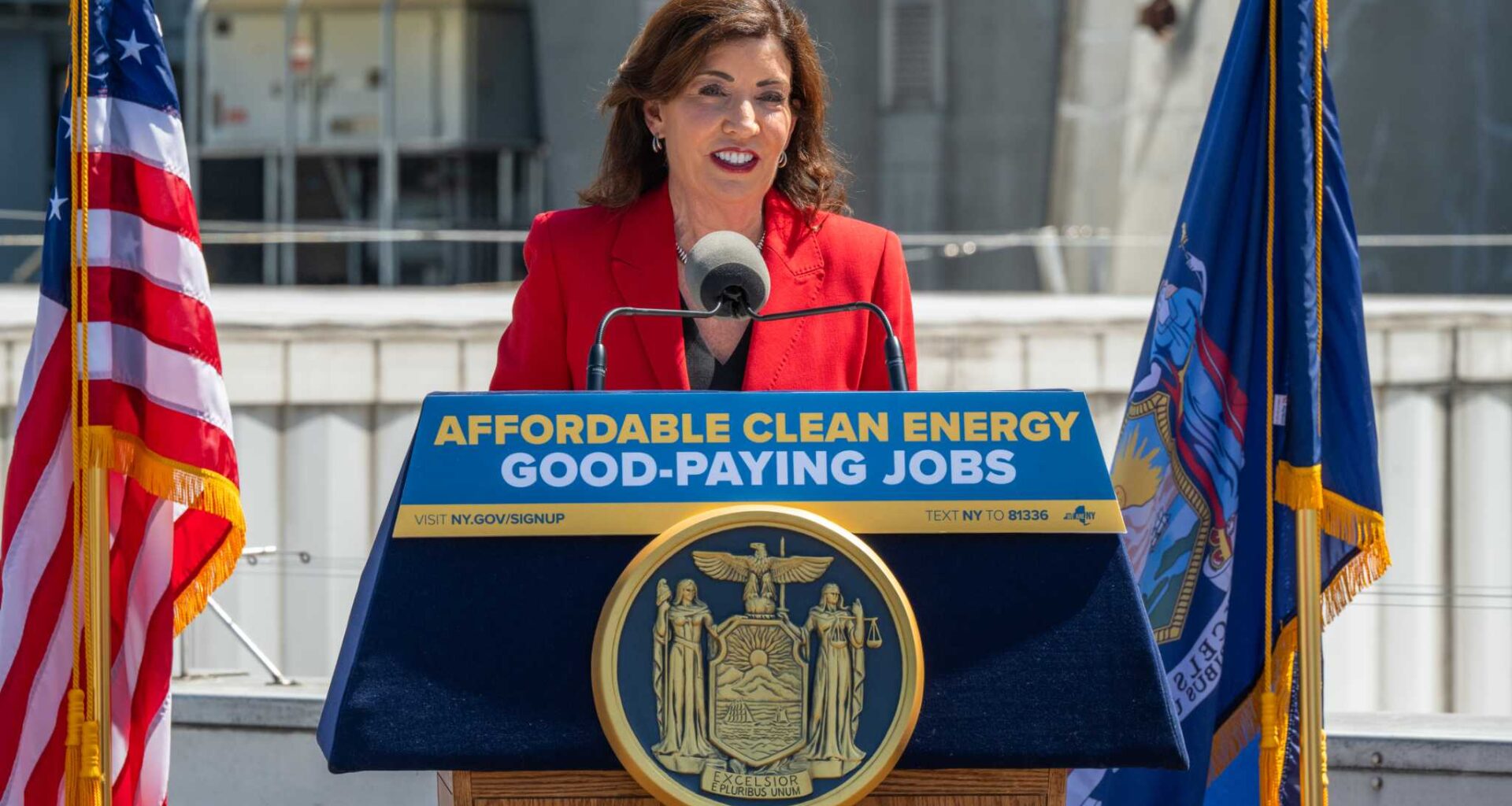
Gov. Kathy Hochul is delaying some elements of her clean energy agenda after a group of mostly western New York Democrats expressed concerns.
Darren McGee/Darren McGee/ Office of Governor Kathy Hochul
Gov. Kathy Hochul temporarily halted implementation of New York City’s congestion pricing program in the summer of 2024, then moved ahead after that year’s general election.
Will Waldron/Times Union
Several home builders say they are planning to leave the state in anticipation of mandates requiring new construction to use all-electric appliances.
Will Waldron/Times Union
Some Western New York Democrats — including Assemblyman Jeremy Cooney, shown at a February news conference at the Capitol — are concerned about grid reliability as new data centers and manufacturing facilities are poised to consume huge amounts of electricity.
Will Waldron/Times Union
Several Republicans in the state Legislature anticipate the governor will spring some clean energy policies onto the state after next year’s elections.
Will Waldron/Times Union
ALBANY — After championing clean energy policies as a means to lower costs for New Yorkers, Gov. Kathy Hochul in recent months has been using the same affordability message as a justification to slow their implementation.

Hochul proposed a ban on fossil fuel-burning heating equipment in existing single-family homes in her 2023 budget proposal. The final spending plan prohibited gas appliances in new single-family construction starting in 2026 and expanding to all new buildings in 2029, with limited exceptions.
Article continues below this ad
Also in 2023, she directed state agencies to draft a “cap-and-invest” that would, among its provisions, require large carbon emitters such as natural gas plants and manufacturing facilities to pay to emit greenhouse gases.
“What’s great about cap-and-invest is that it offers us flexibility, so we can focus our efforts on the biggest polluters and ensure families, farms and small businesses aren’t crushed by costs,” Hochul said in her State of the State address almost three years ago.
Two years later, those measures were close to taking effect — and this time, the cost savings Hochul is touting are the result of tapping the brakes.
“I also have to moderate and make sure I’m not doing something that’s going to drive up costs for consumers right now,” Hochul said in August about the cap-and-invest plan. “And the data shows that at this time, it would.”
Article continues below this ad
Last month, she made the same point in relation for the electric building mandate: “I’m going to look at this with a very realistic approach and do what I can — because my number one focus is affordability right now, because New Yorkers are suffering too much,” Hochul said.
Some, including western New York Democrats concerned over the impacts of the electric building mandate, say the governor is deftly responding to emerging concerns about the viability of the electric grid and specter of inflation.
In October, 19 Assembly Democrats signed a petition asking the governor to pause the electric building mandate. “We have to address the present crisis in front of us before adding a new one,” said Assemblyman William Conrad III, a Buffalo-area Democrat who led the petition effort.
He compared the proposed slowdown to Hochul’s June 2024 decision to delay congestion pricing — another environmental mandate with pocketbook implications — on the eve of its implementation in Manhattan. She moved ahead with the tolling plan shortly after the 2024 elections; the timing drew the ire of Republicans.
Article continues below this ad
Earlier this month, the state reached an agreement in a lawsuit brought by home builders, labor unions and the gas industry that said it would temporarily block implementation of the new electric building rules.
It was a striking reversal because the state had been successful in rebutting the plaintiffs’ challenge. Industry groups had relied on a U.S. Court of Appeals for the Ninth Circuit decision striking down a similar gas appliance ban in Berkeley, Calif. But U.S. District Judge Glenn T. Suddaby agreed with the dissenting view in the Berkeley case, and said in a July ruling that the argument against the mandate “has no merit.”
After Suddaby’s ruling, the groups opposing the mandate argued implementation of the electric building mandate should be delayed while they appealed. The state disagreed in an early October filing. But after Hochul’s “number one focus is affordability” comments, the state agreed to delay implementation until an appellate court rules.
‘Trump’s bidding’
Kim Diana Connolly, a law professor at the state University at Buffalo, said that pausing the mandate while challenges move through the courts “preserves administrative resources and avoids costly adjustments if the rules were to later be altered or struck down.” It also “avoids confusion for stakeholders like builders and local governments while preventing potential compliance confusion,” she added.
Article continues below this ad
The delay will strengthen the policy “as well as reduce regulatory uncertainty for developers during this period of litigation,” said Ken Lovett, a spokesman for Hochul. “Gov. Hochul remains resolved to providing more affordable, reliable and sustainable energy for New Yorkers.”
Affordability is emerging as the most durable political mantra of 2024, with political observers citing it as the winning theme in Zohran Mamdani’s maverick campaign for New York City mayor. New Jersey Gov.-elect Mikie Sherrill stayed relentlessly focused on lowering high utility bills in her dominant campaign. James Blair, the political director for President Donald J. Trump’s affordability-driven 2024 campaign, recently told Politico Republican candidates “didn’t address those key issues of affordability very effectively,” and that the focus going forward should be on that issue.
In New York, the Executive Chamber’s concession prompted outrage from environmental advocates and progressive lawmakers who warn that the building mandate and cap-and-invest are critical to meeting the state’s clean energy mandates and — you guessed it — driving down costs for New Yorkers.
“It’s a way for the governor to delay the (electric building mandate) without taking responsibility for delaying it,” said Michael Hernandez, New York policy director at Rewiring America, an advocacy group focused on promoting electrification and reducing fossil fuel usage.
Article continues below this ad
Assemblywoman Emily Gallagher, a Brooklyn Democrat, was more harsh, accusing Hochul of “doing President Trump’s bidding and selling out New Yorkers’ futures to oil and gas executives.”
With Hochul’s 2024 congestion pricing actions clearly in mind, Republicans see this new temporary legal retreat as a ploy to implement the regulations after the next year’s all-important elections.
“This is a cynical political ‘pause’ so she can screw New Yorkers with higher prices after the election,” said U.S. Rep. Elise Stefanik, the North Country Republican who is challenging Hochul in the 2026 governor’s race.
Hochul “has been all over the place,” Senate Minority Leader Robert G. Ortt said. “She’s against congestion pricing, then she’s for congestion pricing. She’s for the electric buildings act, now she’s walking it back.”
Article continues below this ad
Michael Fazio, executive director of the New York State Builders Association, said the governor is “being very pragmatic.”
The mandate, he said, goes against Hochul’s desire to build more housing and will only raise costs. The new rules could add $5,000 to the cost of an average-sized Albany County home, according to data from a study commissioned by the New York State Energy Research and Development Authority. It would take 11 years of efficiency savings from electric appliances to cover that cost, the same study concluded.
Conrad, the western New York Democrat behind the petition effort, said Hochul was making a sober response to an increasingly strained power grid, not a political calculation.
The New York Independent System Operator issued a dire warning last month that New York City could face power deficits starting next summer. But if several aging natural gas plants currently seeking to close are kept online and renewable energy projects far along in construction are completed, the deficits are pushed out to the end of the decade, according to the same Independent System Operator report.
Article continues below this ad
Grid planners are contending with a broad set of imminent challenges. One of the most significant is the fact that the electrification of home heating — a requirement for new construction under the incoming rules — is one of the factors that will push the state to use more power in winter than in summer over the next decade.
Traditionally, power demand is far higher in the summer as people use electric air conditioners. The state is reliant on natural gas, which is less accessible in the winter, potentially leading to shortfalls, the Independent System Operator wrote last year.
Rooftop and small-scale solar installations proved critical to ensuring grid reliability during summer peaks in New York this year. Those resources have less output in the winter, lessening their impact during those months.
“Moving toward a winter peak is going to be quite a bit of a challenge,” said Matthew Antonio, director of National Grid’s transmission control center.
More solar projects than wind projects are in development right now, a factor that’s beneficial during the summer but needs to be balanced with wind and battery storage to prepare for winter peaks, Antonio said.
Article continues below this ad
More wind and battery storage power needs to be brought online over the coming years to meet winter peaks, Antonio said.
Another challenge: Large electricity users, including Micron’s proposed chip fab near Syracuse, will consume enough power to supply more than 4 million homes, according to a Times Union review of New York Independent System Operator data. The majority of those proposed projects are between Syracuse and Buffalo, areas represented by many of the lawmakers who signed Conrad’s petition.
“The grid’s got to be fixed before the (electric building) mandate is imposed,” Conrad said.
The New York Independent System Operator sounded the alarm on shrinking margins for grid reliability before the all-electric building mandate was passed two years ago: “Fossil-fueled resources are retiring, primarily due to emissions concerns, at a faster pace than clean energy resources are entering,” the operator wrote in a 2022 report.
Article continues below this ad
Natural gas power plants going offline faster than renewable energy sources are coming online is a concern the state has neglected, said Chris Casey, utility regulatory director at the Natural Resources Defense Council, an environmental advocacy group. But that shouldn’t be used as an excuse to delay the all-electric buildings mandate, he continued.
Delaying the mandate does “nothing to address the reliability needs that are being discussed” because data centers and transportation electrification are the predominant reasons for increased demand, Casey said. “Most of the new electric load from buildings comes from heating electrification, which primarily increases demand in the winter when New York’s grid is expected to have spare capacity for many years,” he added.
Winter decencies could arise in 2029 if fuel becomes scarce, the Independent System Operator wrote earlier this year.
New electric construction is responsible for 7% of projected winter electricity demand growth, according to a recent analysis from the clean energy think tank Switchbox.
Article continues below this ad
New York City has its own all-electric building mandate, so the policy will move forward there regardless of state action.
Hamster on a wheel
Regulations to implement a cap-and-invest program were ready to be released in January, Politico reported earlier this year. They were never published after the governor called for a delay in her 2025 State of the State budget proposal. Creating a cap-and-invest program was a critical recommendation under New York’s Scoping Plan, which lays out policies to meet clean energy and greenhouse gas reduction mandates.
Environmental advocacy groups sued the state over the delayed cap-and-invest regulations earlier this year. In late October, Ulster County state Supreme Court Judge Julian Schreibman ruled that the state is violating the 2019 Climate Leadership and Community Protection Act.
Article continues below this ad
“It is undisputed that (the Department of Environmental Conservation) has not issued regulations that comply with foregoing terms of the climate act,” Schreibman wrote in an order instructing the department to release the emission-reduction regulations by early February.
Hochul said the state would appeal the ruling and she’d work with the state Legislature to amend the 2019 law to reset its deadlines.
Under the cap-and-invest plan, natural gas plants and manufacturing facilities would pay to emit greenhouse gases.
Thirty percent of the funds collected would be given back to New Yorkers to help cover associated cost increases. The rest of the revenue would go to lowering the state’s carbon footprint through vehicle, building and grid electrification. More than $1 billion a year would be directed to households, according to a state analysis of the program.
Article continues below this ad
Low-income New Yorkers would save a few dollars a month after receiving tax credits under the program, according to a state study. But middle-income families will likely not see enough benefit to outweigh costs, the same analysis found.
Pushing to meet clean energy and greenhouse gas emissions reduction mandates without cap-and-invest is akin to a hamster running in place on a wheel, said Gavin J. Donohue, president and CEO of the Independent Power Producers of New York.
“I don’t know how else you get the money and the market signal to attract these investments without putting a price on carbon,” Donohue said. “The goal of the (2019) law is to get carbon out of our environment. Having a market-based economic model to do that — in my judgment and the judgment of many economists — is the best way to do it.”
Hochul didn’t scuttle the cap-and-invest rollout altogether. The state Department of Environmental Conservation is preparing to collect greenhouse gas emissions data from fossil fuel-intensive power plants. No fees will be assessed for emitting carbon, but it will provide more accurate information on the potential costs of the plan, said Ron Epstein, president and CEO of the New York Construction Materials Association.
Article continues below this ad
As with the electric buildings, some legislators in the majority are worried about timing. “If this is going to be a year about affordability, I don’t think it is the time to (implement cap-and-invest),” said state Sen. Jeremy Cooney, a Rochester Democrat.
The policy is better suited for implementation after next year’s midterm elections, when Democrats in Congress may have the numbers to lower consumer costs through fighting tariffs coming from President Donald J. Trump’s administration, Cooney said.
Other Democrats are unwilling to amend the law and are growing weary of negotiating with the governor over laws that are already on the books.
Article continues below this ad
Al Stirpe, a Syracuse-area Democrat, said he’s finding it “more difficult” to work with Hochul because it’s unclear whether she’ll follow through on commitments: “She tells you, ‘OK, we’ll do this.’ And then you have to say, ‘Do you promise?’”