
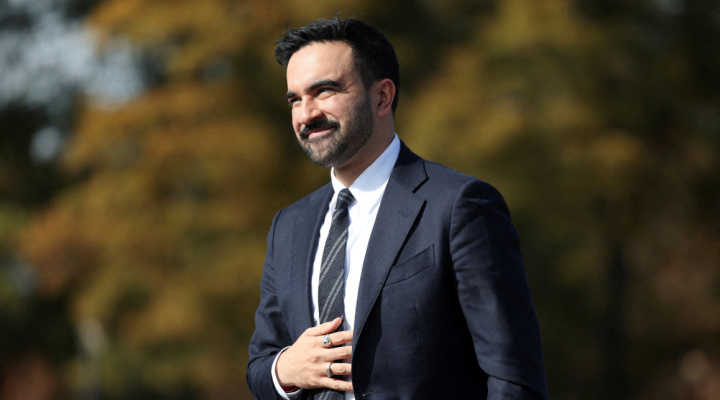
New York City mayor-elect Zohran Mamdani attends a press conference at the Unisphere in the Queens borough of New York City, US, Nov. 5, 2025. Photo: REUTERS/Kylie Cooper
New York City Mayor-elect Zohran Mamdani is facing intense criticism from Jewish leaders and pro-Israel advocates after issuing a statement that appeared to legitimize a gathering of demonstrators who called for violence against Jews outside a prominent synagogue on Wednesday night.
The protesters were harassing those attending an event being held by Nefesh B’nefesh, a Zionist organization that helps Jews immigrate to Israel, at Park East Synagogue in Manhattan.
“We don’t want no Zionists here!” the group of roughly 200 anti-Israel activists chanted in intervals while waving the Palestinian flag. “Resistance, you make us proud, take another settler out.”
One protester, addressing the crowd, reportedly proclaimed, “It is our duty to make them think twice before holding these events! We need to make them scared.”
Footage on social media also showed agitators chanting “death to the IDF,” referring to the Israel Defense Forces, as well as “globalize the intifada” and “intifada revolution.” Community figures described the scene as openly threatening and a stark escalation of anti-Jewish hostility in New York City.
Mamdani, who was elected the city’s next mayor earlier this month, issued a statement that “discouraged” the extreme rhetoric used by the protesters on Wednesday night but did not unequivocally condemn the harassment of Jews outside their own house of worship. Mamdani’s office notably also criticized the synagogue, with his team describing the event inside as a “violation of international law,” an allegation apparently referencing Israel’s settlement policies in the West Bank.
“The mayor-elect has discouraged the language used at last night’s protest and will continue to do so,” Mamdani spokesperson Dora Pekec said in a statement on Thursday. “He believes every New Yorker should be free to enter a house of worship without intimidation, and that these sacred spaces should not be used to promote activities in violation of international law.”
Jewish leaders reacted with disappointment, arguing that Mamdani effectively provided political justification for a protest that targeted Jews for participating in a mainstream, fully legal pro-Israel program. Critics said the state assemblymember’s framing implied that the synagogue’s event, not the threatening chants outside, was the real problem, a position they described as deeply irresponsible amid rising antisemitism in the city.
“Do they think this is clever? Telling Jews not to use synagogues to inform fellow Jews about how to move to Israel, which many Jews consider a commandment, because Jews living in Israel violates international law,” wrote Tal Fortgang of the Manhattan Institute.
Mark Goldfeder of the National Jewish Advocacy Center suggested that Mamdani is failing to secure the safety of all New Yorkers.
“You are already failing on your commitment to protect all New Yorkers. An event to celebrate aliyah is not a violation of international law; it is a protected First Amendment right,” he wrote, referencing the process by which Jews immigrate to Israel.
The World Jewish Congress said the protests “produced scenes early [sic] reminiscent of Kristallnacht,” the infamous Nazi pogroms of November 1938 that terrorized the German Jewish community.
New York Gov. Kathy Hochul (D), who endorsed Mamdani for mayor, strongly condemned the protests.
“No New Yorker should be intimidated or harassed at their house of worship,” Hochul posted. “What happened last night at [Park East Synagogue] was shameful and a blatant attack on the Jewish community.”
Pro-Israel advocates warned that Mamdani’s response normalizes intimidation of Jewish communities and shifts blame onto victims rather than confronting extremist activists. They also noted that support for making aliyah is a core part of Jewish communal life and expressed concern that an elected official would characterize such programming as grounds for protest, especially one marked by calls for violence.
The controversy has heightened tensions in New York’s Jewish community, with many observers calling Mamdani’s remarks a troubling signal that anti-Israel animus is increasingly being used to rationalize hostility toward Jewish religious spaces themselves.
Mamdani’s political ascendance comes amid a spike in anti-Jewish hate crimes within New York City.
The city has been ravaged by a surge in antisemitic incidents since Hamas’s Oct. 7, 2023, massacre across southern Israel. According to police data, Jews were targeted in the majority of hate crimes perpetrated in New York City last year. Meanwhile, pro-Hamas activists have held raucous — and sometimes violent — protests on the city’s college campuses, oftentimes causing Jewish students to fear for their safety.
Mamdani, a far-left democratic socialist and anti-Zionist, is an avid supporter of boycotting all Israeli-tied entities who has been widely accused of promoting antisemitic rhetoric. He has repeatedly accused Israel of “apartheid” and “genocide”; refused to recognize the country’s right to exist as a Jewish state; and refused to explicitly condemn the phrase “globalize the intifada,” which has been associated with calls for violence against Jews and Israelis worldwide.
Leading members of the Jewish community in New York have expressed alarm about Mamdani’s victory, fearing what may come in a city already experiencing a surge in antisemitic hate crimes.
A recently released Sienna Research Institute poll revealed that a whopping 72 percent of Jewish New Yorkers believe that Mamdani will be “bad” for the city. A mere 18 percent hold a favorable view of Mamdani. Conversely, 67 percent view him unfavorably.