
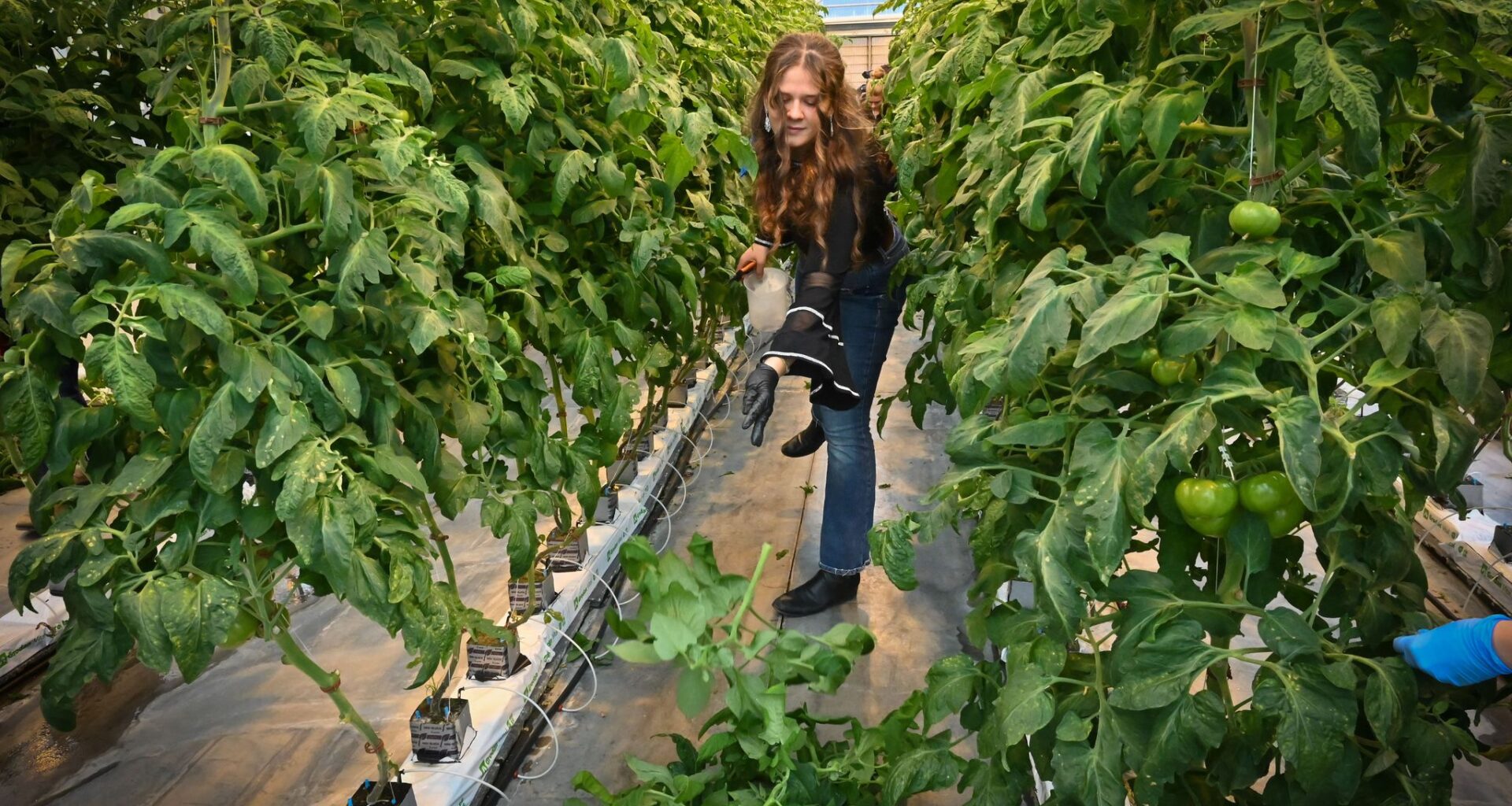
Senior Elianna Tarrants tosses sucker shoots she cut off from tomato plants in a greenhouse at SUNY Cobleskill on Nov. 17 in Cobleskill.
Lori Van Buren/Times Union
Sophomore Stephanie Bernard, right, and junior Victoria Gayne assemble a wreath in a greenhouse assembly room at SUNY Cobleskill on Nov. 17 in Cobleskill. The wreaths will be sold at a holiday sale. Chancellor of the State University of New York John B. King, Jr., second from left, and other officials visited the school last week to get ideas for the future, but it quickly became clear that existing programs need help.
Lori Van Buren/Times Union
President of SUNY Cobleskill Marion Terenzio speaks briefly before leading a tour of parts of the agriculture department on Nov. 17 in Cobleskill. New York State Senator Michelle Hinchey and Chancellor of the State University of New York John B. King, Jr. listen at left.
Lori Van Buren/Times Union
A calamondin orange tree is seen in the plant conservatory at SUNY Cobleskill on Nov. 17 in Cobleskill. SUNY has a crucial role to play in educating new farmers, SUNY Chancellor John King Jr. said.
Lori Van Buren/Times Union
Fish hatchery manager Brent Lehman, second from left, speaks to people taking a tour ot the cold water fish hatchery in the aquaculture facility at SUNY Cobleskill on Nov. 17 in Cobleskill.
Lori Van Buren/Times Union
A tank holds fish in the cold water fish hatchery in the aquaculture facility at SUNY Cobleskill on Nov. 17 in Cobleskill.
Lori Van Buren/Times Union
Ethan Knickerbocker speaks to people taking a tour of the plant conservatory at SUNY Cobleskill on Nov. 17 in Cobleskill.
Lori Van Buren/Times Union
Tomatoes grow in a greenhouse at SUNY Cobleskill on Nov. 17 in Cobleskill.
Lori Van Buren/Times Union
People are seen taking a tour of the cold water fish hatchery in the aquaculture facility at SUNY Cobleskill on Nov. 17 in Cobleskill.
Lori Van Buren/Times Union
A poster is seen outside the cold water fish hatchery in the aquaculture facility at SUNY Cobleskill on Nov. 17 in Cobleskill.
Lori Van Buren/Times Union
Plant conservatory at SUNY Cobleskill on Nov. 17 in Cobleskill.
Lori Van Buren/Times Union
Plant conservatory at SUNY Cobleskill on Nov. 17 in Cobleskill.
Lori Van Buren/Times Union
Plant conservatory at SUNY Cobleskill on Nov. 17 in Cobleskill.
Lori Van Buren/Times Union
Cucumbers are seen in a bin in a greenhouse assembling room at SUNY Cobleskill on Nov. 17 in Cobleskill.
Lori Van Buren/Times Union
Lettuce grows in a greenhouse at SUNY Cobleskill on Nov. 17 in Cobleskill.
Lori Van Buren/Times Union
COBLESKILL — Drones detecting pests or soil conditions. Developing products from raw goods. Fighting off new invasive species.

Agriculture is changing, and the State University of New York wants to prepare the next generation of farmers for the new world.
Article continues below this ad
The state university system has launched the SUNY Agritech Center, which is not intended to be a place but more of a coalition of educators, researchers and farmers. Its first goal: Figure out what SUNY doesn’t yet offer that farmers need to learn.
There is no budget announced yet for the initiative, which is tasked with creating a plan to design new agriculture and technology programs. The eventual goal is for the center to support the state’s farm workforce with education and research while also promoting the use of new technology in agriculture.
State university system leaders visited SUNY Cobleskill last week to get ideas for the future, but it quickly became clear existing programs need help.
In the greenhouses, tomatoes aren’t yet ripe, though they were planted in August. The old roof isn’t letting in enough sunlight.
Article continues below this ad
Greenhouses should keep almost 100% of the sun’s power. But SUNY Cobleskill’s polycarbonate plastic roof is only keeping about 90% — a significant loss in comparison to commercial structures. It’s because the plastic has been damaged over time.
“We’re losing a tremendous amount. It is unfortunate,” interim Plant Science Department chair Melissa Brechner said.
The tomatoes should be ripe by December, in time for the students to harvest and sell them before going home for winter break. The college uses the funds to buy more supplies for the next semester.
“We basically break even,” Brechner said.
Article continues below this ad
Buying a new roof is not in the budget. Brechner didn’t know the exact price, but called it “astronomical.”
Other parts of the college’s agricultural program break even by selling what the students harvest. But there’s no money left for new equipment.
The fish hatchery was built in the summer of 2014 by the hatchery manager and four students, who put in the pipes, filters and pumps that recirculate the water. Every year, the students gather about half a million eggs and nurture the fish, which spend three years growing to adult size. Some are eaten, but most are sold to groups that want to stock waterways.
“What you see is really the living-learning lab,” Marion Terenzio, the college’s president, said. “We have the largest cold water educational hatchery in the Northeast. The only USDA educational meat processing center in the state. The students do all the work.”
Article continues below this ad
They need infrastructure investment to support those programs, she said. She noted that buying one new commercial tractor to train students on the newest equipment can cost $250,000 to $750,000. Then, of course, there’s new technology, like drones used to monitor fields, which are also not cheap.
SUNY Cobleskill opened in 1916 as the Schoharie State School of Agriculture. What started as a school with one building, five faculty members and eight students has grown into a campus that straddles Route 7 and is a primary hub of SUNY’s agriculture and technology programs. There are 1,824 students currently enrolled at the college.
The effort to make over SUNY Cobleskill’s programs comes at a time of dropping enrollment. The college saw its total enrollment fall by 3% this year. Over the last five years, it’s dropped by 12%.
But that doesn’t mean throwing in the towel on agriculture education. SUNY has a crucial role to play in educating new farmers, SUNY Chancellor John King Jr. said.
Article continues below this ad
“We can be the bridge to emerging new technologies,” he said. “Where there are gaps, we need to create new programs.”
SUNY researchers are developing new techniques — from drones to carbon sequestration — while more students need to be introduced to agriculture to consider it for a career, he said.
“Our goal is really to do both,” he said.
A farmer who enrolled at Cobleskill spoke highly of its program on “value-added” products that helps farmers develop ways to turn their raw goods into products, such as processing milk into cheese or berries into jams and sauces.
Article continues below this ad
Bill Morrow raises black Angus beef. The value-added program led him to double his revenue in the last year, he said at a roundtable discussion about what is needed in agriculture education.
“We learned very quickly beef alone was not the way to succeed. Value-added products is the way to survival,” he said.
Another student, who grew up in Queens, said he had no comprehension of the expanse of agriculture until he arrived at Cobleskill. Students start there with a class that has them try many different types of agriculture. Until then, student Daniil Usmanov said, he had one image of a farm: “Pigs, slaughter, that’s it.”
“But if people knew more, more people would join,” he said.
Article continues below this ad
Student Paisley Nudd of Pennsylvania said that even if students grow up in a town or rural area, they still need more exposure to agriculture. More people would become farmers if they realized that the hard work leads to an incredible feeling of triumph, she said.
“In elementary and high school, it’s important to support these efforts to start agriculture education at a younger age,” she said.