
Case 2:25-cr-00122-JKW-DEM Document 140 Filed 11/24/25
1330
Page 12 of 26 PageID#
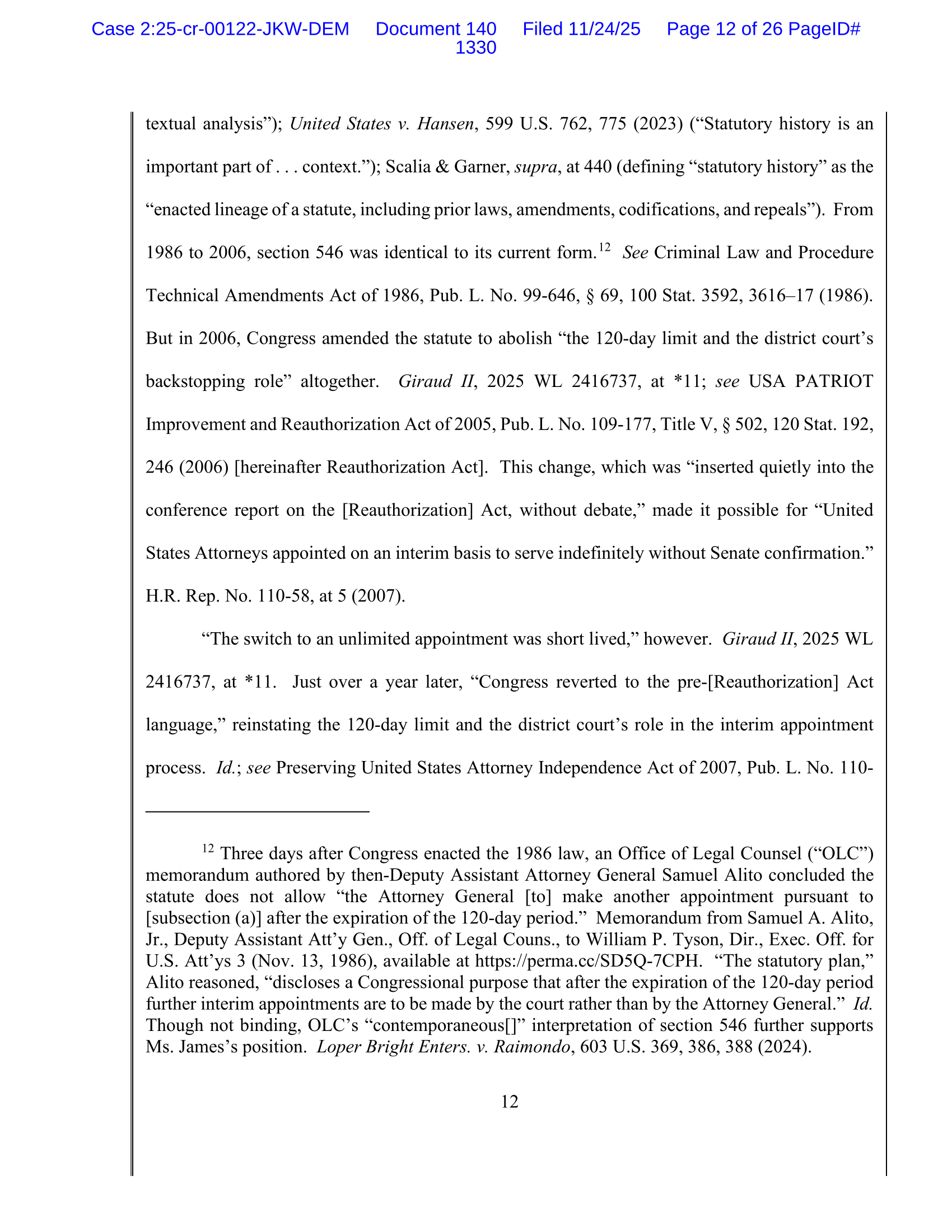
textual analysis”); United States v. Hansen, 599 U.S. 762, 775 (2023) (“Statutory history is an important part of… context.”); Scalia & Garner, supra, at 440 (defining “statutory history” as the “enacted lineage of a statute, including prior laws, amendments, codifications, and repeals”). From 1986 to 2006, section 546 was identical to its current form. 12 See Criminal Law and Procedure Technical Amendments Act of 1986, Pub. L. No. 99-646, § 69, 100 Stat. 3592, 3616–17 (1986). But in 2006, Congress amended the statute to abolish “the 120-day limit and the district court’s backstopping role” altogether. Giraud II, 2025 WL 2416737, at *11; see USA PATRIOT Improvement and Reauthorization Act of 2005, Pub. L. No. 109-177, Title V, § 502, 120 Stat. 192, 246 (2006) [hereinafter Reauthorization Act]. This change, which was “inserted quietly into the conference report on the [Reauthorization] Act, without debate,” made it possible for “United States Attorneys appointed on an interim basis to serve indefinitely without Senate confirmation.” H.R. Rep. No. 110-58, at 5 (2007).
“The switch to an unlimited appointment was short lived,” however. Giraud II, 2025 WL 2416737, at *11. Just over a year later, “Congress reverted to the pre-[Reauthorization] Act language,” reinstating the 120-day limit and the district court’s role in the interim appointment process. Id.; see Preserving United States Attorney Independence Act of 2007, Pub. L. No. 110-
12 Three days after Congress enacted the 1986 law, an Office of Legal Counsel (“OLC”) memorandum authored by then-Deputy Assistant Attorney General Samuel Alito concluded the statute does not allow “the Attorney General [to] make another appointment pursuant to [subsection (a)] after the expiration of the 120-day period.” Memorandum from Samuel A. Alito, Jr., Deputy Assistant Att’y Gen., Off. of Legal Couns., to William P. Tyson, Dir., Exec. Off. for U.S. Att’ys 3 (Nov. 13, 1986), available at https://perma.cc/SD5Q-7CPH. “The statutory plan,” Alito reasoned, “discloses a Congressional purpose that after the expiration of the 120-day period further interim appointments are to be made by the court rather than by the Attorney General.” Id. Though not binding, OLC’s “contemporaneous[]” interpretation of section 546 further supports Ms. James’s position. Loper Bright Enters. v. Raimondo, 603 U.S. 369, 386, 388 (2024).
12