
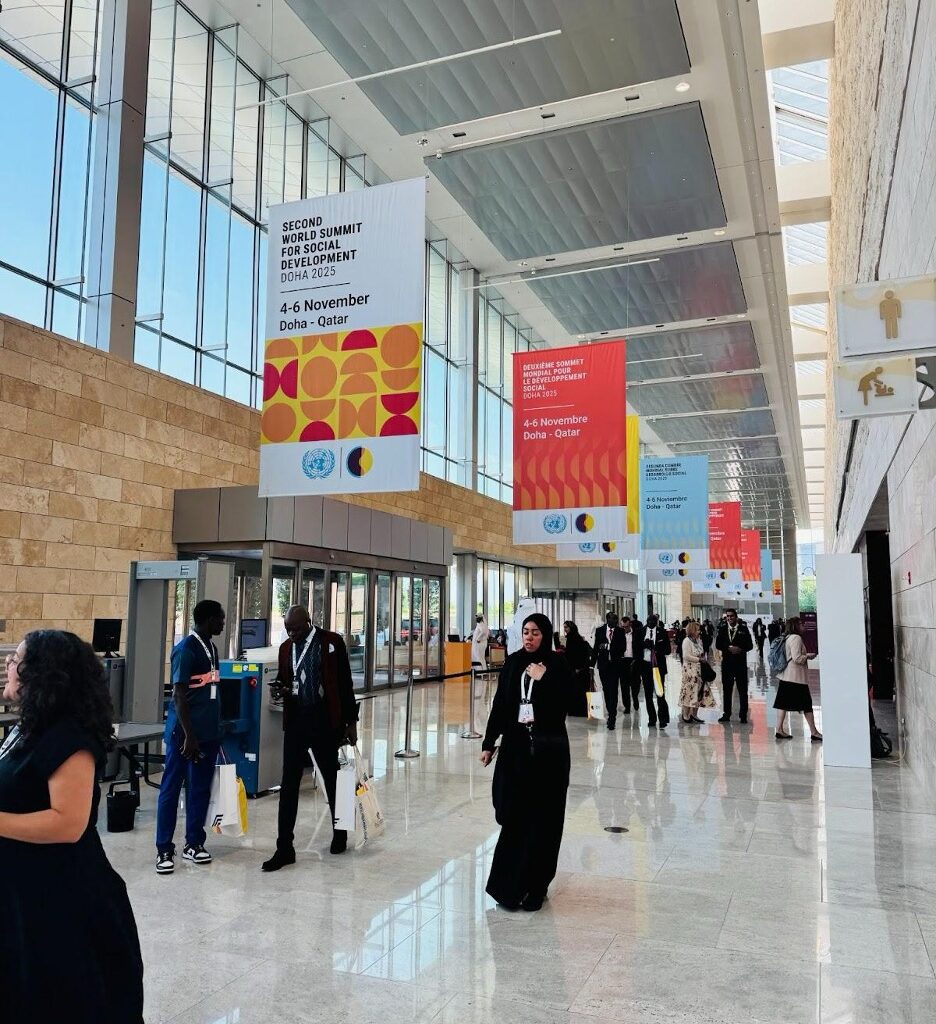
RLS-NYC’s support enabled the Global Policy Forum to participate in the 2nd World Summit for Social Development: Key takeaways from the Summit
Unable to ignore the proliferation of multiple and multidimensional crises, leaders of governments and people’s organizations convened in Doha in November 2025 for the Second World Summit for Social Development (WSSD2). At the first World Summit on Social Development in 1995, Member States adopted the Copenhagen Declaration on Social Development, recognizing the interconnectedness of social justice and social development. The summit moved to the fore the importance of a people-centred approach to sustainable development essential for economic, social and environmental protection.
Three decades after Copenhagen, WSSD2 was held in a dramatically different world, as expressed by Haiti at the opening ceremony:
“Our societies are facing challenges of unprecedented magnitude: inequality, poverty, migration crises, climate change, erosion of human rights, and a proliferation of conflicts. These deeply interconnected realities call for a different approach to development.”
Many across the globe feel that the social contract is broken and that the governance structures are failing them at every level. Copenhagen’s promise of “creating an economic, political, social, cultural and legal environment that will enable people to achieve social development” remains woefully unfulfilled.
A major driver of these failures is the exponential rise in income, non-income and wealth inequalities. Adopting the 2030 Agenda and the Sustainable Development Goals (SDGs) in 2015, Member States recognized the challenges and the goals as interrelated and mutually dependent, and included for the first time – after difficult negotiations – the challenge of inequalities within and among countries (SDG 10).
Owing to increasing state violence and unilateral economic policies, however, countries are backtracking on these commitments – and if not abandoning multilateralism, clearly putting it on a back burner, in the name of national interest. Decades of big power politics have extended their bilateral agendas and global and regional rivalries into multilateral spaces, influencing and steadily undermining the intergovernmental deliberations and outcomes for a people-centred multilateralism.
Nowadays, Member State negotiations reflect the status quo with minimal areas of substantive agreement and risk going backward in areas such as human rights, gender equality, sustainable development and the environment. Replacing global agreements with weaker ones or removing them entirely makes a mockery of the essence of accountability to a “better world for all.”
Diminishing Public Financing Space
The primacy of public financing has been increasingly undermined and emphasis has shifted away from rights-based to market-based solutions. Many countries are locked in a system that generates inequalities and debt and are confronted by a host of new challenges, such as rampant violence, livestreamed genocide, hostile trade warfare and climate catastrophe, the intensity and impact of which were inconceivable three decades ago.
The UN independent expert on the effects of foreign debt and human rights, Attiya Waris, said during the presentation of her report (A/79/142):
“The fiscal social contract refers to this implied agreement between not only the state and their population, but between Member States also at an international level… Countries across the globe, including and specifically developing countries and the LDCs, have faced challenges in the adhering of the fiscal social contract. [T]his is not only because of challenges that are at a domestic level, but because what we face is a fragmented and broken international financial system…. The monitoring and implementation of human rights is largely focused on individual countries, however, global actors such as transnational corporations, the international financial institutions, investment agencies as well as UN agencies do play a critical role in the realization.”
Public finance, the primary resource for social justice and development, has been steadily diverted to incentivizing the corporate sector and market-based solutions; and latterly increasingly directed towards military expenditures, accompanied by decreasing official development assistance (ODA) (see Box 1).
Box 1. Global trends on cuts to foreign aidDutch right-wing government cuts development aid as deficit balloons (Reuters, September 2024)Swedish government pledges further aid cuts in coming years (Development Today, September 2024)French 2025 budget draft includes US$1.5 billion ODA cut (Donor Tracker, October 2024)Switzerland to slash funding for UN agencies (Geneva Solutions, January 2025)Belgium to cut development cooperation funding by a quarter (Belga News Agency, February 2025)Germany slashes development aid to boost defense spending (Deutsche Welle, June 2025)Rubio: USAID officially ceases operations (The Hill, July 2025)UK accused of hypocrisy at landmark UN foreign aid conference (The Independent, July 2025)
UN Secretary-General’s report “The Security We Need – Rebalancing Military Spending for a Sustainable and Peaceful Future” warned that global military spending has surged to “an all-time high of US$2.7 trillion” while progress on the Sustainable Development Goals is faltering; only one in five targets is on track to be achieved by 2030 and an “annual financing gap for the Goals now stands at US$4 trillion.”
Addressing this issues, Surya Deva, the UN Special Rapporteur on right to development, had urged in a Negotiation Brief:
“Instead of funding a war economy, States should invest in people and the planet by financing sustainable development, including to end poverty and hunger, reduce inequalities, eliminate child labour, take climate action, and promote peaceful, inclusive and just societies. States should reinforce the nexus between the three UN pillars of peace and security, sustainable development and human rights in the [FfD4] outcome document.”
While national security tends to dominate the domestic political agenda, countries’ perspectives diverge on the meaning of security from human to military security. During the 2025 UNGA High-Level Week Member States lamented the trade off between military expenditure and social development investment (see Box 2). Along with pushback from some governments, such as Spain, campaigns such as “10 Percent for All” are calling for reductions in military spending. “No sustainable development without sustainable peace and no sustainable peace without sustainable development” echoes throughout discussions at the UN; the focus on military spending may not be the panacea some believe it to be.
Box 2. Member States at the 2025 UNGA High-Level Week Joseph Aoun, President of LEBANON:“Our country is dedicated to investing in quality education and is expanding this investment to encompass knowledge economy. Lebanon, strong with an invaluable human capital stands as an essential crossroads for global trade corridors. While advancing on all these fronts, our country simultaneously shoulders numerous burdens…. [T]here is the issue of providing the necessary means to our legal armed forces so that they may take on task in defending and safekeeping our national integrity.”
Juan Ramón de la Fuente Ramírez, Minister for Foreign Affairs of MEXICO:“[T]here are countries that spend more servicing their debt than they do in investments in health and education for their peoples and expenditure on arms has grown triple the rate of the global economy… The diagnostic has always been clear, the arms race, the immoral concentration of wealth, violations of international law and of human rights, are the fuel that fuel the flames of war and violence.”
WSSD2: Holding Countries Accountable to their Commitments
Looking toward WSSD2, Barbara Adams (GPF) remarked at the 2024 Commission on Social Development: “Rights are not a market commodity. They cannot be provided subject to the ups and downs of supply and demand and the price system. Not only are we undermining public finances, we have also undermined accountability.” She further emphasized that at WSSD2, we all must “hold accountable Member States and ourselves to reducing all forms of inequalities”.
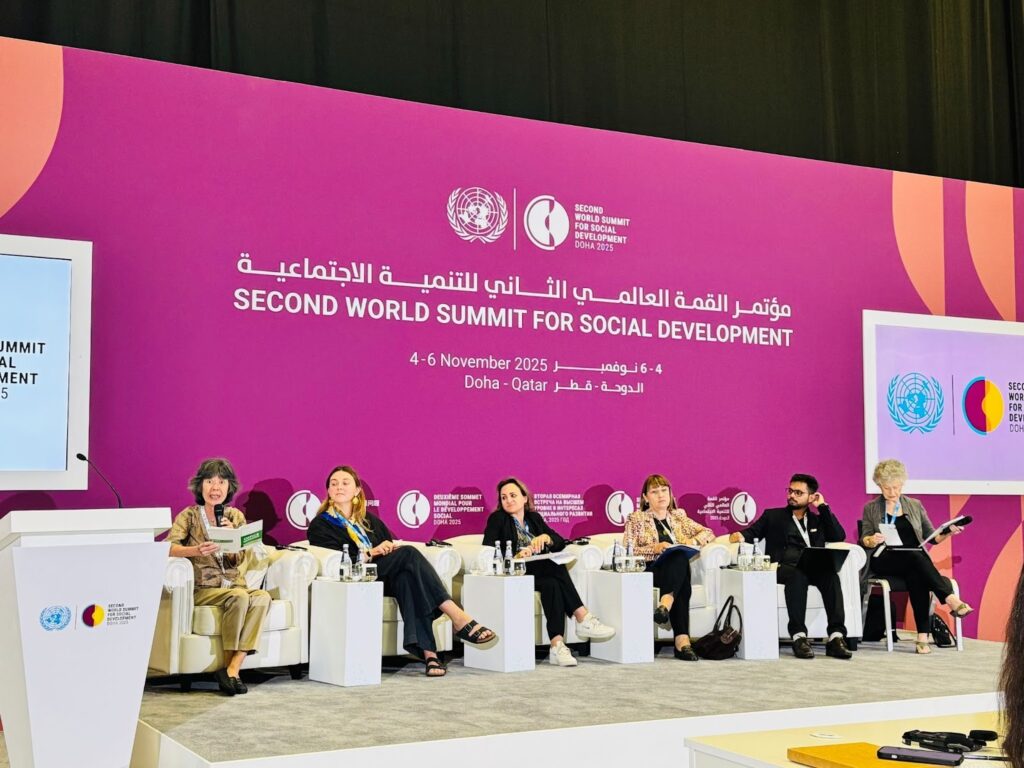
At a WSSD2 Civil Society Forum session, Zahra Bazzi (ANND) underscored accountability as a priority:
“[I]t’s important to speak honestly about accountability, to move from words to actions, especially in the Arab region, where war, instability and exclusion continue to block development…. In such conditions, accountability is not a luxury, it’s a lifeline… [Accountability] is a political duty to the people and to their rights, including the right to development…. [A]ccountability must also be global, to question how international trade, finance and technology systems affect development in fragile and conflict affected states…. True accountability requires rebalancing global power, giving Arab and other Global South countries a fair voice in shaping the rules on debt, taxation, technology transfer and climate finance…. Governments must be accountable to their people. Global systems must be accountable to fairness, to justice, to human rights and our true progress must not be measured by growth, by GDP, but by inclusion, rights and participation of all.”
Fellow panelist Chee Yoke Ling (TWN) warned of the corporate dimension in (the lack of) accountability, especially in the areas of technology and health:
“Technology is actually a political project… [T]he digital economy is highly extractive, polluting, impacts communities and drives inequality. Because, who owns these technologies? Whether it is every level of our history of development, [technology] has been in the hands of a few corporations. We see the height of it in the digital arena…. [T]here’s no accountability of those who, in the name of innovation, [utilize] the World Trade Organization’s agreement on intellectual property…. [M]any of our medicines should be available for manufacturing in most of our regions and countries, but they are locked up in private property rights…. The disease of the majority of people doesn’t get attention because rich companies and innovators, the so-called ‘pharmaceutical industry’ only will design for those who can pay.”
The Doha Political Declaration, negotiated at UNHQ for months leading up to WSSD2, contains 15 action items for implementation. UN Secretary-General António Guterres called it “a booster shot for development” and “a people’s plan”. It will be essential to ensure that Member States are held accountable to their commitments in the Declaration.
With over a hundred “Solutions Sessions”, WSSD2 provided an opportunity for all sectors – governmental, civil society and corporate – to engage in dialogue and share ideas in making the declaration’s commitments a reality on the ground. Along with core social development issues, such as social protection, decent labour and care work, the summit also covered newer ideas, such as “going beyond GDP”. The UN Secretary-General’s High-Level Expert Group on Beyond GDP presented interim findings on a new global framework to measure progress and highlighted the need to complement and go beyond GDP as the sole indicator of development in order to measure a myriad of additional factors, including how “what one nation does can have an effect, positive or negative, on another nation”.
These solutions, however, will have little impact on the deteriorating social contract without accountability. Member States and the big players in the corporate sector must be held accountable, if Member States are to fulfill the commitments of the Declaration and live up to the Copenhagen promise of the enabling environment. For countries like Yemen, facing multidimensional vulnerabilities and crises, failure to establish such an environment is a nonstarter for their path to social development:
“We emphasize here the importance of regional and international cooperation in supporting the Yemeni government’s efforts to overcome the effects of the war and return to the path of development, and to achieve the desired economic and social recovery. In this context, the Yemeni government reiterates its call to alleviate the debt burden on the country, increase official development aid, and direct it in accordance with the national development plan for the least developed countries, and in a way that strengthens its ability to implement the 2030 Sustainable Development Agenda and achieve the desired social equality.”
As the President of the General Assembly Annalena Baerbock said at the closing ceremony, WSSD2 “is not an ending; it’s the beginning [of] walking the last mile together to deliver on the Doha Declaration and the Sustainable Development Agenda 2030”.
 Civil Society Forum
 International Parliamentary Union Forum