
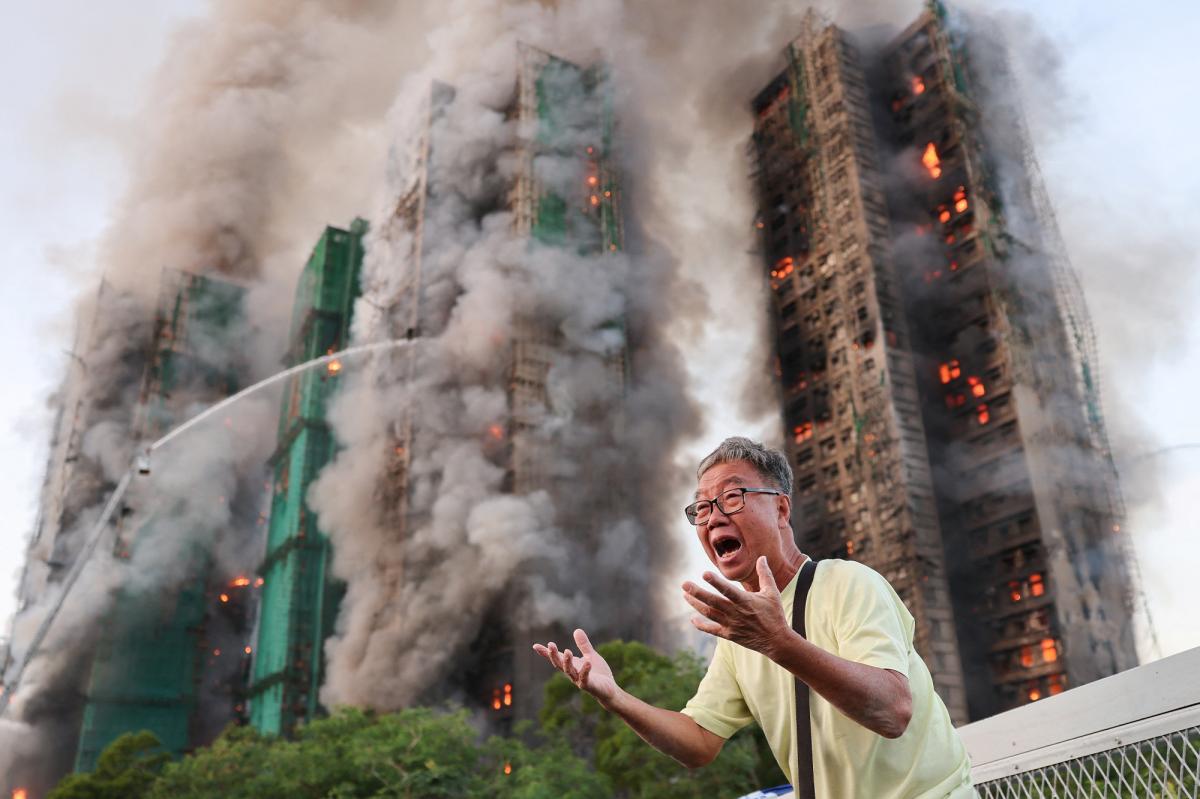
HONG KONG, (Reuters) – A massive fire ripped through multiple high-rise residential blocks in Hong Kong’s northern Tai Po district on Wednesday, killing at least 14 people and injuring scores as authorities struggled to bring the blaze under control.
Firefighters battled the orange flames into the night as thick black smoke billowed from the 32-story towers, which were sheathed in bamboo scaffolding – whose use the government began phasing out in March for safety reasons – and green construction mesh.
The cause of the blaze was not immediately known.
A man reacts to a massive fire that broke out between several high-rise towers in the Tai Po district of Hong Kong on Nov. 26, 2025. REUTERS
Fire authorities said they were grappling to get to the towers’ upper floors due to the intense heat, and containing the blaze was getting tougher after nightfall.
The Wang Fuk Court housing complex, where the fire started, has 2,000 residential apartments comprising eight blocks. The Fire Services Department said it did not yet have a figure for the number of people who might still be inside the buildings.
FIREFIGHTER AMONG THE DEAD
Dozens of shocked residents, many sobbing, watched from nearby walkways as smoke funneled up from the complex.
A resident surnamed Wong, 71, broke down in tears, saying his wife was trapped inside one of the buildings.
The fire reportedly broke out in Wang Fuk Court in Tai Po. REUTERS
A firefighter was among the 14 killed, the director of Fire Services said, and more than 16 people have been injured.
The fire department said it received reports at 2:51 p.m. that a fire had broken out in Wang Fuk Court. By 6:22 p.m. it had been upgraded to a No. 5 alarm, the city’s highest.
Strong winds fanned the flames, causing the blaze to spread to seven of the complex’s eight blocks.
People gathered on a nearby overhead walkway, watching in dismay as smoke billowed from the buildings, some of which were clad in bamboo scaffolding. REUTERS
Harry Cheung, 66, who has lived at Block Two in one of the complexes for more than 40 years, said he heard “a very loud noise at around 2:45 p.m.” (0645 GMT) and saw a fire erupt in a nearby block.
“I immediately went back to pack up my things,” he said. “I don’t even know how I feel right now. I’m just thinking about where I’m going to sleep tonight because I probably won’t be able to go back home.”
Frames of scaffolding were seen tumbling to the ground as firefighters battled the blaze, while scores of fire engines and ambulances lined the road below the development, according to Reuters witnesses.
Firefighters battle the blaze at the high-rise towers in Hong Kong. REUTERS
Hong Kong’s Transport Department said that due to the fire, an entire section of the Tai Po Road, one of Hong Kong’s two main highways, had been closed and buses were being diverted.
It was Hong Kong’s worst fire since 41 people died in a commercial building in the heart of Kowloon in November 1996. The fire was later found to be caused by welding during internal renovations.
A public inquiry yielded sweeping updates to building standards and fire safety regulations in the city’s high-rise offices, shops and homes.
Firefighters transport an injured person away from the burning buildings. REUTERS
SAFETY REGULATIONS HAD BEEN UPGRADED
Hong Kong is one of the last places in the world where bamboo is still widely used for scaffolding in construction.
The government moved to start phasing out the city’s use of its bamboo scaffolding in March, citing safety. It announced that 50% of public construction works would be required to use metal frames instead.
Wang Fuk Court is a housing complex made up of eight blocks, providing close to 2,000 residential units. REUTERS
Scores of fire engines and ambulances lined the road below the complex. REUTERS
Wang Fuk Court is one of many high-rise housing complexes in Hong Kong, one of the most densely populated areas in the world. Tai Po, located near the border with mainland China, is an established suburban district with some 300,000 residents.
Occupied since 1983, the complex is under the government’s subsidized home ownership scheme, according to property agency websites.
According to online posts, it has been undergoing renovations for a year at a cost of HK$330 million, with each unit paying between HK$160,000 and HK$180,000.
Owning a home is a distant dream for many in Hong Kong, one of the world’s most expensive housing markets and where residential rents are hovering around record highs.