
Photo: Kanrapee Chokpaiboon
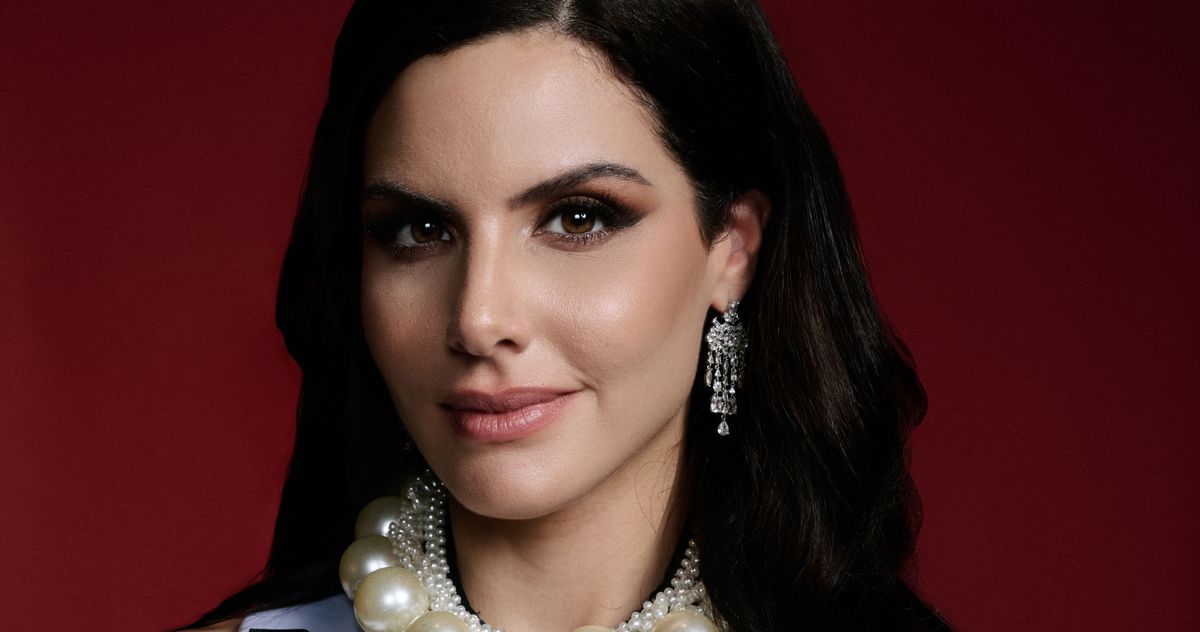
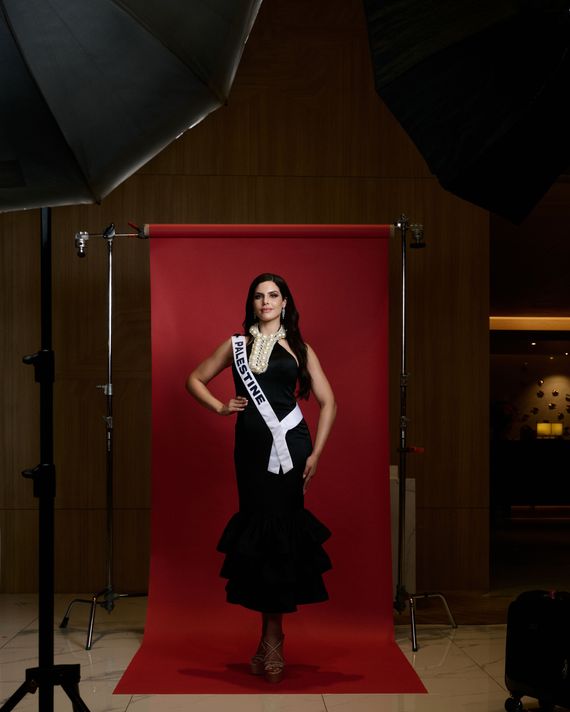
It’s 2 a.m. in a convention hotel off a Bangkok underpass, and 27-year-old Nadeen Ayoub, the first-ever Miss Palestine, is just getting back to her manager’s room. She’s peeling off a corset she’s worn for the last 16 hours. “You see? Look what happens to me,” she says, gesturing at the deep grooves lining her ribs and stomach. She tosses the corset over a table stacked with makeup. It lands on a poof of ivory, one of the 30 gowns she brought for the competition. “It really bites into you,” she says, but she keeps smiling. She knows how it looks to complain about a beauty pageant given what’s happening back at home.
Ayoub is one of 122 women from around the world competing for the 74th Miss Universe crown. Contestants are in the final days of a three-week tour in which they’ve been shunted around the country for photo-ops, a no-contact period treated by pageant organizers like a papal conclave. They have been averaging four hours of sleep, are basted with makeup at the crack of dawn, and spend every day in six-inch heels. (Ayoub’s feet have swelled two sizes.) The contest is quasi-diplomatic, kind of like the Olympics of women’s beauty. Competitors are referred to as delegates and expected to act like it—to literally embody the values, culture, and geopolitics of their countries while serving in the swimsuit round. The winner gets prize money and rent covered in New York City for a year. They also get a lot of attention, which is what most of them are here for.
And they’ve gotten it. This year’s event has been hit by so many scandals it got more news coverage than ever. The director of Miss Universe Thailand was captured on video berating Miss Mexico in a room full of contestants, calling her a “dumbhead” and demanding security remove her. Before the end of the pageant, three of the eight judges had resigned. One of them, Omar Harfouch, accused the Miss Universe Organization of preselecting finalists using a secret jury whose members had relationships with contestants. In the final days, Miss Jamaica fell off a stage and had to be wheeled away on a stretcher (she’s still in the ICU). Later, Miss Cote d’Ivoire relinquished her finalist title and all affiliation with Miss Universe. (Miss Universe did not respond to requests for comment.)
During the competition, everyone from Bella Hadid to Huda Kattan of Huda Beauty, one of Ayoub’s sponsors, supported Ayoub on social media. A clip that appeared to show Miss Israel, Melanie Shiraz, glare at Ayoub onstage also went viral. Shiraz, who says she received death threats over the video, claims the footage was edited. (She did not respond to interview requests.) Ayoub says she received death threats too after Shiraz posted a video in October disputing Ayoub’s legitimacy as a Miss Universe candidate and accusing her of “using her platform not to build bridges, but to spread propaganda.” At the pageant, the two spoke little, other than one time when Shiraz told Ayoub to avoid a slippery patch of floor.
Otherwise, most of the girls have been nice. Miss Canada and Miss Kyrgyzstan want her to win for Palestine. But sometimes it’s like “Mean Girls,” Ayoub says. Miss Iraq keeps stirring the pot, trying to get Ayoub to sympathize with Shiraz. “Like, hello, you’re Iraq,” Ayoub says. “Do you not remember what happened to you?”
Back in the hotel room, there are more pressing matters, such as finalizing tomorrow’s look. What to open with, the white swimsuit or the red? Ayoub’s six-person team swirls around her. She tries the white first, hitching on a matching cape trimmed in traditional Palestinian embroidery. “It’s very Victoria’s Secret, modest Victoria Secret,” she says. “Which is what I’m going for.” Her immaculate red lipstick matches the second suit, which she scrutinizes in the mirror. Everyone agrees it should be the opener. “It’s about the story,” she says, flowing into Arabic for a moment. The red sends the right message: “I’m a Phoenix, rising from the ashes.”
Ayoub was born in Michigan, where her parents briefly moved from Palestine so her brother could get epilepsy treatment. They returned to Ramallah where Ayoub lived until she was six, and then went back to the States, moving between Michigan, Illinois, and Minnesota (Ayoub sometimes lapses into a faint Minnesotan accent.) In her teens the family relocated to Canada, where she studied psychology and literature at University of Western Ontario. During college she did an exchange program with Birzeit University in the West Bank, where she moved after graduating to volunteer with United For Humanity and the Palestine Children’s Relief Fund, visiting sick children at West Bank hospitals, coloring with them and throwing birthday parties. In 2024 she was offered a job in Dubai at the SEE Institute, an organization focused on sustainability education. She now runs a training program to produce content creators who focus on the environment, with the goal of creating more sustainability influencers for brands. She says she goes back to Ramallah via Jordan, where she often stays with family, every few weeks.
She’s been approached by modeling agents throughout her life but competed in her first pageant in 2022, when she went to Miss Earth in the Philippines and became a finalist. Miss Earth is one of the so-called ‘big four’ pageants alongside Miss Universe, Miss International, and the London-based Miss World, which rejected Ayoub in 2022 (insiders told her this was because the UK didn’t recognize the Palestinian state at the time.) After Miss Earth, Ayoub was recruited to model at a fashion show in Italy, where representatives from the Miss Sweden Organization discovered her, and helped set up the Miss Palestine Organization. Ayoub’s sponsors paid Miss Universe $20,000 in franchise dues, and online competitions were held for the Miss Palestine title. The organization says that thousands of women applied, but that Ayoub was chosen for her previous pageant experience and because she seemed like the best person to represent Palestine on an international stage. (This is standard procedure for the Miss Universe Organization, which is a franchise—companies or individuals purchase a license from it, and can hold national pageants, or simply select eligible women to send to the international competition. The business makes money from licensing fees, broadcast rights, and sponsors.) Ayoub planned to compete in Miss Universe in 2023, but postponed due to the war in Gaza.
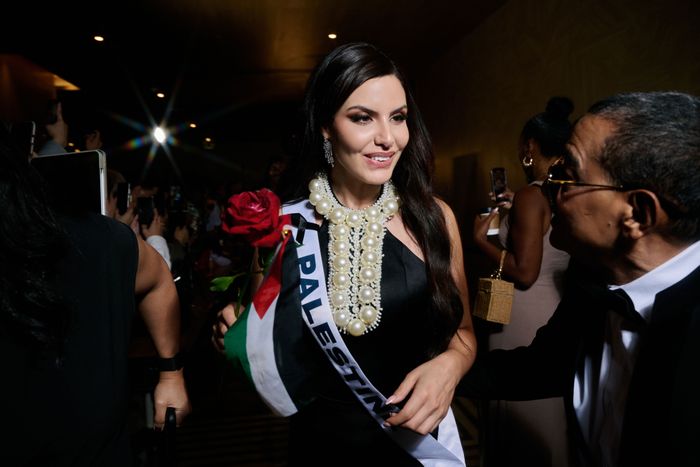
Photo: Kanrapee Chokpaiboon
Ayoub’s manager, Mai Jawadah, is fed up with the chaos of the pageant. The day contestants arrived in Thailand, they did a ten-hour spon-con shoot, posing with everything from suitcases to blood-pressure cuffs. (The ads are broadcast during Miss Universe’s televised events.) At one point, Thai police stormed the shoot and confiscated pillows stamped with the word “PlayTime,” a Filipino online casino. (Gambling is illegal in Thailand.) Jawadah is an ex-musician and amateur boxer who was recruited for the Miss Universe gig from Ayoub’s influencer training program, where she worked on video content. She tells me she “doesn’t give a fuck about pageants,” even though Miss Universe, impressed with the sponsors she’s wrangled for Ayoub, wants her help franchising in the lucrative Middle Eastern market. “I’m doing it for Nadeen, for Palestine,” she says. When she first met Ayoub, she thought she was a little cold, uptight. “But when you get to know her, no. Sometimes we laugh so hard we cannot breathe.” She says Ayoub has “hidden skills,” that she can act and sing and do impressions. “You know Dobby, from Harry Potter? She can do the exact same voice.”
Ayoub says her parents in Canada and her extended family in Palestine will be watching the finals. “The whole country will be watching,” she says. “It gives them hope. They’re seeing me as this figure for Palestine, and I’m showing a different side of Palestine. That our country is beautiful.” Later, I ask Jawadah whether people in Palestine care about Ayoub. “I don’t think they have energy to be happy about it,” she says. She pulls out her phone and shows me three photos of rubble — her house, her parents’, and that of her sister, a Novartis exec who’d bought the place a year before the war began. “In Gaza right now, it’s raining. People are living in tents. They’re thinking, How are we going to sleep? Everything is wet and they have no place to go.”
In the past few years, Jawadah has paid tens of thousands of dollars to get most of her family out of Gaza, but her brother and his kids are still there. A few months ago, her uncle’s leg was amputated after his neighbor’s house was bombed, and a few weeks before the pageant Jawadah’s cousin was shot dead. (At least 69,500 people have been killed in Israeli attacks in Gaza since October 7, according to Gaza’s health ministry.) “He was getting food for his kids. He picked up the food, started to walk back, and they killed him. Snipers,” she says. She considered skipping the pageant. “I was like, How am I gonna to go to Miss Universe when they’re killing my family?”
During Friday’s finals, Ayoub made the top 30 before she was cut. When Miss Mexico, Fátima Bosch Fernández, was crowned, Harfouch called her a “FAKE Miss Universe” and claimed that the organization’s CEO is in business with her father. Jawadah says Ayoub didn’t care about losing, especially after all of the scandals. She’s fielding requests from Greenpeace and has plans to speak at the United Nations. “Yesterday, she was collapsing, by the way,” Jawadah says about Ayoub during the swimsuit fitting. “But you cannot see it. She was so tired. When she’s tired, she starts smiling a lot. And she was smiling a lot.”
Related