
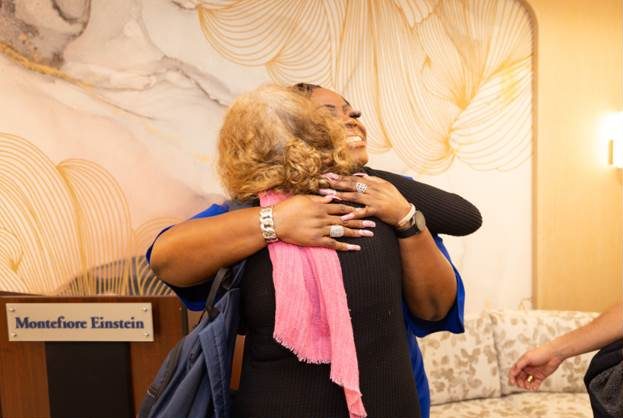
Bronx Borough President Vanessa Gibson hugging Dr. Alyson Moadel-Robblee, deputy director of community engagement and cancer health equity at Montefiore Einstein Comprehensive Cancer Center.
Photo courtesy of Montefiore Einstein
In the Bronx, we’ve always looked out for one another. Our neighborhoods are built on strong relationships, shared struggles, and a deep understanding that no one gets through life alone.
But today that neighborly safety net is being strained by policy failures that hit families where they are most vulnerable. A recent lapse in federal SNAP funding left hundreds of thousands, including many Bronx residents, suddenly without critical food benefits, exposing how fragile basic supports can be.
When families lose consistent access to groceries, chronic conditions worsen, children struggle to learn, and emergency rooms bear the cost.
We know health depends on more than doctor visits –it’s about whether someone has the transportation they need to get to that appointment, whether they have a safe place to live, enough food to eat, and someone to call when times get tough. The SNAP lapse proves that even when communities care for one another, systemic gaps can undo those efforts overnight. That’s why coordinated, reliable social care matters more than ever.
Despite our borough’s deep well of care, the Bronx and New York State still confront stark health challenges. Life expectancy in New York City is at its lowest point since 2009. New York State ranks fourth nationally for the longest emergency room wait times, over three hours on average. 16% of Bronx adults live with diabetes –the highest share of any county statewide– and 20% have asthma, compared to 14% citywide.
Other factors exacerbate these trends, like food insecurity, which affects 39% of Bronx adults. Healthcare deserts leave far too many residents without access to the care they need, with the most people in the South Bronx living in an area without easy access to primary care.
Many of our neighbors face barriers to healthcare that go far beyond medicine. A parent shouldn’t have to choose between paying rent and picking up a prescription. An older adult shouldn’t miss a critical appointment because they don’t have a ride. A child shouldn’t struggle in school because they’re hungry.
These social challenges –transportation, housing instability, food insecurity – directly affect health outcomes, especially in communities like ours.
Known as social determinants of health, these factors are often root causes of chronic illness and premature death. And while our Bronx spirit inspires us to help each other where we can, these problems are simply too widespread and complex to solve on a neighbor-by-neighbor basis.
That’s why I believe so strongly in the promise of Social Care Networks (SCNs) – a bold, statewide program that replicates the Bronx’s culture of caring at a statewide scale. SCNs, like SOMOS in the Bronx, are an innovative model that scales up the values we live by in our neighborhoods. They unite community-based organizations, healthcare providers, and social service agencies to address non-medical needs that shape health.
Whether it’s providing rides to medical appointments, connecting families to food pantries, or helping a tenant avoid eviction, SCNs recognize that caring for someone’s health means looking at the whole picture.
These networks are more than a new program. They are a transformative approach to
healthcare – one that recognizes the dignity of every New Yorker and meets people where they are.
When we invest in these Social Care Networks, we invest in healthier individuals,
stronger families, and more resilient communities. We reduce expensive emergency room visits and hospital stays by addressing the underlying social issues that cause them.
That’s not just better for the individuals who receive these services – it’s smarter and more sustainable for our healthcare system and everyone who participates in it.
Increased support for SCNs will only increase their effectiveness. By integrating social care into the broader healthcare system, we create a model that’s more equitable, more
responsive, and more cost-effective. Quite frankly, it’s a no-brainer.
But to make this work, we need to ensure people actually know about the support that’s
out there. We must work together –from government to healthcare institutions to
community-based organizations– to spread the word, break down barriers, and make sure every New Yorker can access the care they deserve.
This is a model all New Yorkers should support. Because when one community finds solutions, we can learn from them to lift up the entire state. The Bronx has always led with heart and the belief that our neighbors are worth fighting for.
Supporting Social Care Networks is how we bring those Bronx values to life: creating
healthier communities, saving taxpayer dollars, and ensuring no one is left behind.
Together, we can build a New York where health means more than just medicine and
where every resident has the opportunity to thrive.