
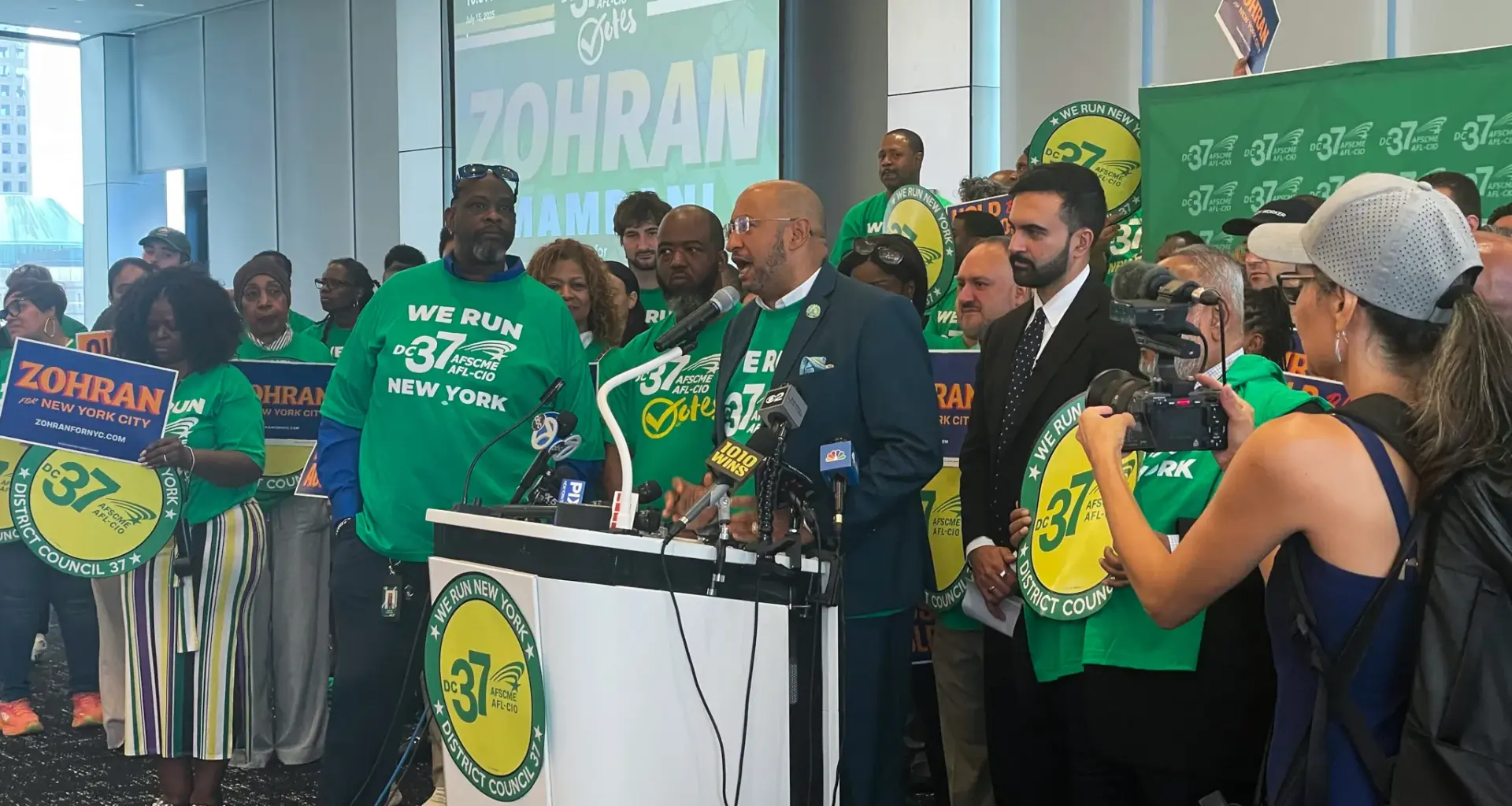
DC 37 Director Henry Garrido speaks about the city workers’ union endorsing Zohran Mamdani in the mayoral election, July 15, 2025. Photo: Shenal Tissera/THE CITY
 At a party during SOMOS, the annual Puerto Rico getaway for New York’s political class, District Council 37 executive director Henry Garrido proudly introduced Mayor-elect Zohran Mamdani to a packed outdoor crowd at the Caribe Hilton of jubilant union officials, political insiders and government lobbyists.
Just days after Mamdani’s election, the public display of support from the union leader — highlighted with a hug — underscored the emerging alliance between the incoming mayor and the leader of New York City’s largest public-sector union.
That bond is about to be tested, or at least leaned on more than ever before, as Mamdani and his still-forming team prepare to craft a new collective-bargaining agreement whose wages and benefits will ripple across every municipal union in New York City.
As Mamdani prepares to deliver on his mandate to uplift New York’s working class and his affordability agenda, while engendering a renewed faith in what he has referred to “public excellence,” the democratic socialist must also contend with the work of being a boss to the city’s 300,000 civil servants, complete with tough decisions and compromises as the city faces a tough fiscal outlook.
For more than a century, New York City labor negotiators have relied on a system known as pattern bargaining. That system, which is not required by law, uses one union to strike a deal on wages, health care and other benefits that then becomes the baseline for every other municipal union. Which union sets that pattern is a matter of intense attention and maneuvering across the city’s labor landscape.
Traditionally, City Hall has pushed for DC 37 or the United Federation of Teachers — the two largest civilian unions — to establish the pattern.
There’s also the matter of the contentious new health benefits plan for city workers and some retirees, designed to reduce costs by some $1 billion annually as part of a union-management health savings pact in prior bargaining. It is scheduled to go into effect the day Mamdani is sworn in but is the subject of lawsuits seeking to stop the switch.
His administration also needs to move to negotiate a new contract with DC 37, which expires next year.
 Zohran Mamdani speaks at a rally with unions that endorsed him, July 2, 2025. Photo: Alex Krales/THE CITY
“Most mayors inherit this challenge,” Joshua Freeman, a labor historian and professor emeritus at Queens College, told THE CITY. “There’s labor broadly, and then there are municipal unions with contractual relationships that have to be worked out. Mamdani hasn’t said very much about that side of labor at all, but his administration is going to have to deal with it.”
Some of Mamdani’s first appointments indicate he’s likely to lean heavily on former government officials with years of experience — and some baggage.
On Monday, he appointed Robert Linn as one of the 400 members of his expanded transition team. Linn served as commissioner of the city’s Office of Labor Relations during the start of the administration of former Mayor Bill de Blasio. He also had that same role for Mayor Ed Koch and has worked in the private sector as the Police Benevolent Association’s chief negotiator during the administration of former Mayor Michael Bloomberg.
Over the years, he’s been involved in contentious labor negotiations, which have upset rank-and-file union members and retirees.
One open question is whether Mamdani will choose to keep the city’s top labor negotiator, Renee Campion, on board. The longtime head of the city’s Office of Labor Relations, Campion, is the primary foe of the unions bargaining directly with the city.
Dean Fuleihan, Mamdani’s pick for first deputy mayor, dodged questions from THE CITY about whether Mamdani intended to ask Campion to stay in his administration.
“We are working through all personnel decisions, and you’re seeing the mayor-elect announce them, and we’re going to continue to do so,” Fuleihan said at a Starbucks Workers United picket line in Lower Manhattan last week.
Mamdani has said he wants to hire 1,000 new teachers per year and keep the police department’s headcount at its current levels, and has pledged to raise the minimum wage to $30 an hour by 2030, which could turn out to be a boon for the city’s lowest-paid civil servants, many of whom earn the minimum wage. He has also promised to work with state lawmakers to reverse certain aspects of Tier 6, the unpopular reform approved in 2012 that slashed pension benefits for future public employees and raised their retirement age.
But he has dodged some of the thornier issues in the public sector throughout the campaign trail as he courted the endorsements of the city’s powerful unions. Speaking to an audience of rank-and-file DC 37 members at a February candidates’ forum, Mamdani said he was “not sure” if he supported removing residency requirements for city workers — drawing some light boos from the crowd, the one negative response he received during the two-hour event.
DC 37 has long pushed to allow its members to live outside the five boroughs. The city’s police officers and firefighters are allowed to reside in nearby counties.
 Incoming first deputy mayor Dean Fuleihan speaks alongside Mayor-elect Zohran Mamdani at the Roosevelt House Public Policy Institute, Nov. 10, 2025. Photo: Ben Fractenberg/THE CITY
Still, DC 37 eventually endorsed Mamdani in the primary as part of a ranked-choice slate led by City Council Speaker Adrienne Adams, and quickly lined up behind him in the general election.
Mamdani has also faced pushback from retired city workers, many of whom do not live in New York City. At issue was another piece of the union-management health savings pact: a proposed move to less expensive Medicare Advantage, fiercely opposed by retirees.
Though he said throughout his campaign that he did not support the switch, Mamdani declined to sign a pledge from the main retiree group that opposed the switchover ahead of the primary, drawing scorn from advocates.
Now he must pick up the pieces after Mayor Eric Adams decided to scrap the Medicare Advantage switch, leaving Mamdani and the unions with the task of how to replace $600 million in pledged annual health care savings.
Those savings were supposed to help boost a key fund that covers some benefits and has reportedly run dry. Together with the $1 billion in projected savings under the health plan for active city workers that is slated to go into effect on Jan. 1, the two deals were meant to bring that fund back to solvency. The group representing the 102 public sector unions and the city are currently locked in a legal battle over who is responsible for the fund.
Though Mamdani hasn’t said how he plans to bridge the gap now that Medicare Advantage is dead, his recent appointments may provide some clues. Fuleihan served a key role in laying the groundwork for the health savings plan in 2014, when he was then-Mayor de Blasio’s budget director. Linn was labor commissioner at the time.
On Tuesday, Marianne Pizzitola, the outspoken head of the NYC Organization of Public Service Retirees, said she is concerned with Mamdani’s latest appointments. She said Mamdani’s campaign ignored her requests to meet after an initial virtual meeting at the beginning of the year.
Fuleihan and Linn, she said, were “orchestrating these deals of leveraging health care — that’s a concern for me.”
“He’s hired the same people that have made these poor decisions in the past. I don’t have any comfort level that they’re not going to guide him on the path that they were on that they took with the previous mayors,” added Pizzitola.
Mamdani’s transition has not responded to requests for comment from THE CITY.



Attorney who turned client’s home-sale proceeds into his own slush fund is disbarred
November 28 |
Brooklyn Eagle Staff
Four plead guilty to conspiracies to misappropriate funds of homeless nonprofit
November 26 |
Special from the U.S. Attorney’s Office for the Eastern District of New York
Dismissal of Comey, James cases won’t be the final word. Here’s what the path ahead may look like
November 26 |
Eric Tucker and Alanna Durkin Richer, Associated Press
Portland Trail Blazers coach Chauncey Billups pleads not guilty in Brooklyn
November 26 |
Philip Marcelo, Associated Press
Leave a Comment