
Material Resistance
Nguyen Wahed
September 12–November 28, 2025
New York
The written statement for Material Resistance: Anna Barlik, Marlena Kudlicka, Magdalena Abakanowicz, and Agnieszka Kurant at Nguyen Wahed asserts that the exhibition is more than merely an exhibition; it’s a philosophy. The show is animated by “the belief that physical form carries its own intelligence and capacity for critique,” the statement claims, and contains “a kind of material philosophy in action: a proposition about how objects think, and how thinking becomes object.” Thus, the show is permeated by an ontological dualism between the immaterial (the conceptual, digital, undifferentiated) and the material (the plastic arts, differentiated and individualized matter). The terms of the word “resistance,” however, are less clear. Where the works emphasize the importance of materiality in “an increasingly dematerialized world,” they also present the viewer with the puzzle of locating the ostensible resistance within them. Through the gallery’s full-glass facade, the work of the four Polish artists appears in layers. Through the glass, we see these layers of the exhibition overlapping like a palimpsest.
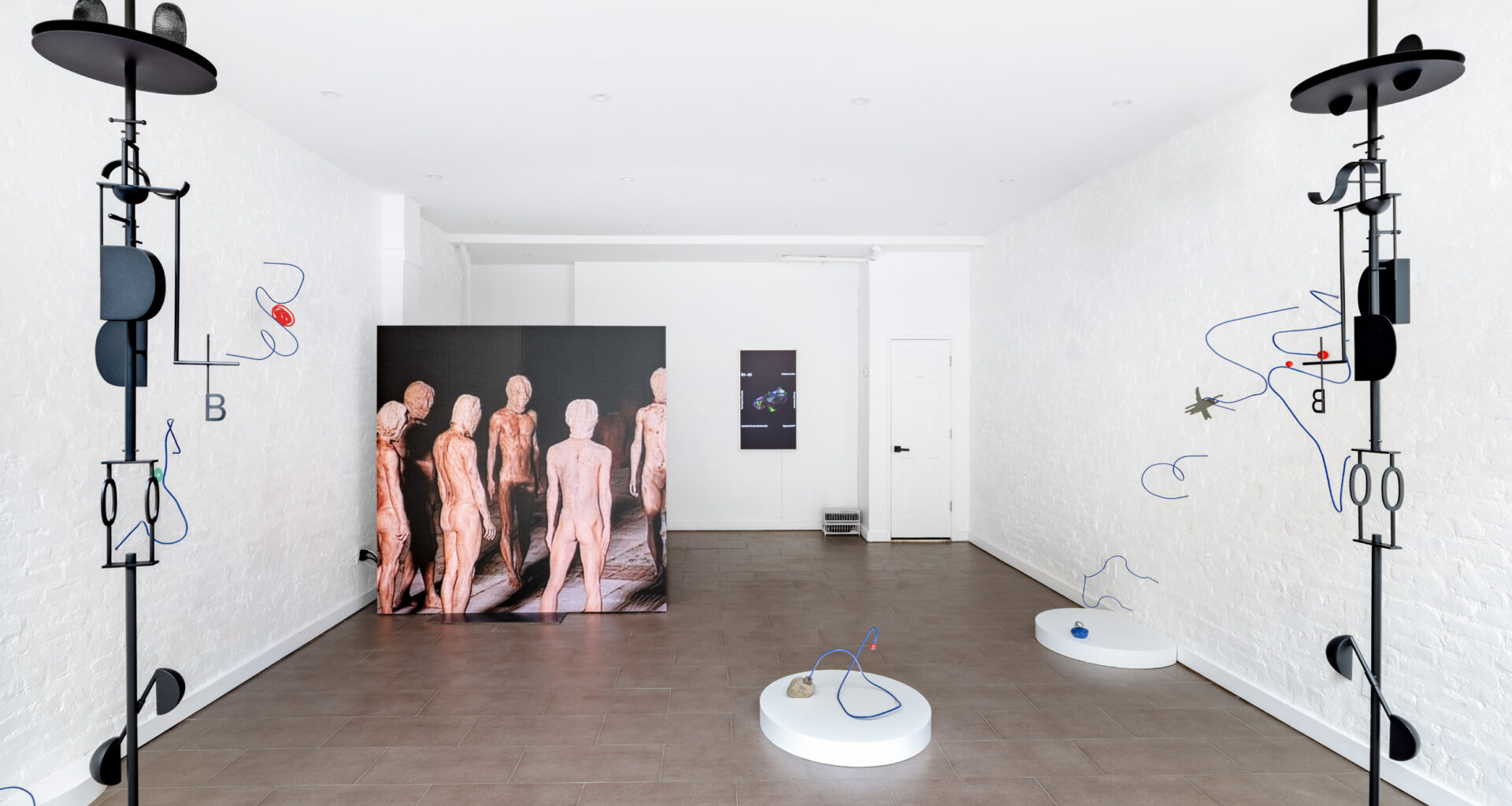
Marlena Kudlicka and Anna Barlik’s sculptures both practice a kind of spatial writing, or annotation. Kudlicka’s black steel sculptures Black Discrete 00 and Black Discrete 01 (both 2025) are elongated abstract forms that hang from the ceiling, accented with graphemes and architectural flourishes. They appear to embody exploded mathematical formulae, detached from their stringent logic of positivism and given spatial form. In contrast, the blue steel filaments of Barlik’s Connections (2025), which she refers to as drawing, take on a more ludic quality; they playfully jut in and out of the white brick walls of the space, decorated with brightly colored spheres and abstract scribbles given 3D form. Their exuberant quality is heightened by their resemblance to the bead maze toys for children one often finds in dentist office waiting rooms. Following the framing of the exhibition, Kudlicka and Barlik’s drawing-cum-sculptures embody a transition from flat, conceptual forms into spatialized, material forms, although what or how they “resist” remains uncertain.
That the two screen-based works are positioned beside one another on the back wall of the gallery invites their comparison, especially as they both interface with the idea of “resistance” in a less puzzling way. On a square video-wall, documentation from Magdalena Abakanowicz’s performance Butoh – Dance – Sculpture (1995) is exhibited for the first time outside of Poland. Abakanowicz—who is known for her sublime large-scale, fiber-art sculptures and “crowds” of headless standing figures—collaborated with the Tokyo-based Butoh troupe Asbestos and its co-founder Akiko Motofuji. The performers in the work resemble her sculptures of headless crowds; their heads are obscured and their bodies are streaked in bronze-colored mud striking an imposing presence on the near life-sized video-wall. Avant-garde aesthetics that were born in the wake of collective catastrophe mobilize the convergent ethos of Abakanowicz’s sculptural language and Butoh’s corporeal poetics. In this way, Butoh – Dance – Sculpture is the work that most lucidly articulates what the “resistance” of materiality might refer to in the exhibition. Modernist movements following the various atrocities of the twentieth century found an abstract, material aesthetic as a salve to the representational artwork that defined authoritarian aesthetics. Material forms offered an oblique means of grappling with the unrepresentable.