
Ground/work 2025
Clark Art Institute
June 28, 2025–October 12, 2026
Williamstown, MA
Sprawling across 140 acres, the second edition of Ground/work at the Clark Art Institute is curated by Glenn Adamson and features six artists: Japanese ceramicist Yō Akiyama, English artist Laura Ellen Bacon, Malian French artist and herbalist Aboubakar Fofana, Black American artist Hugh Hayden, Swiss-German stone carver Milena Naef, and Mexican sculptor Javier Senosiain. I visited on the cusp of autumn on a rainy morning with incremental leaf senescence, where lichens blanket logs and katydids warble in the distance. Each work hinges between life and death, regeneration and decay, rigidity and fragility, making it porous, complicating what’s possible. Rather than assigning negativity to decomposition, the exhibition celebrates life as recomposition.
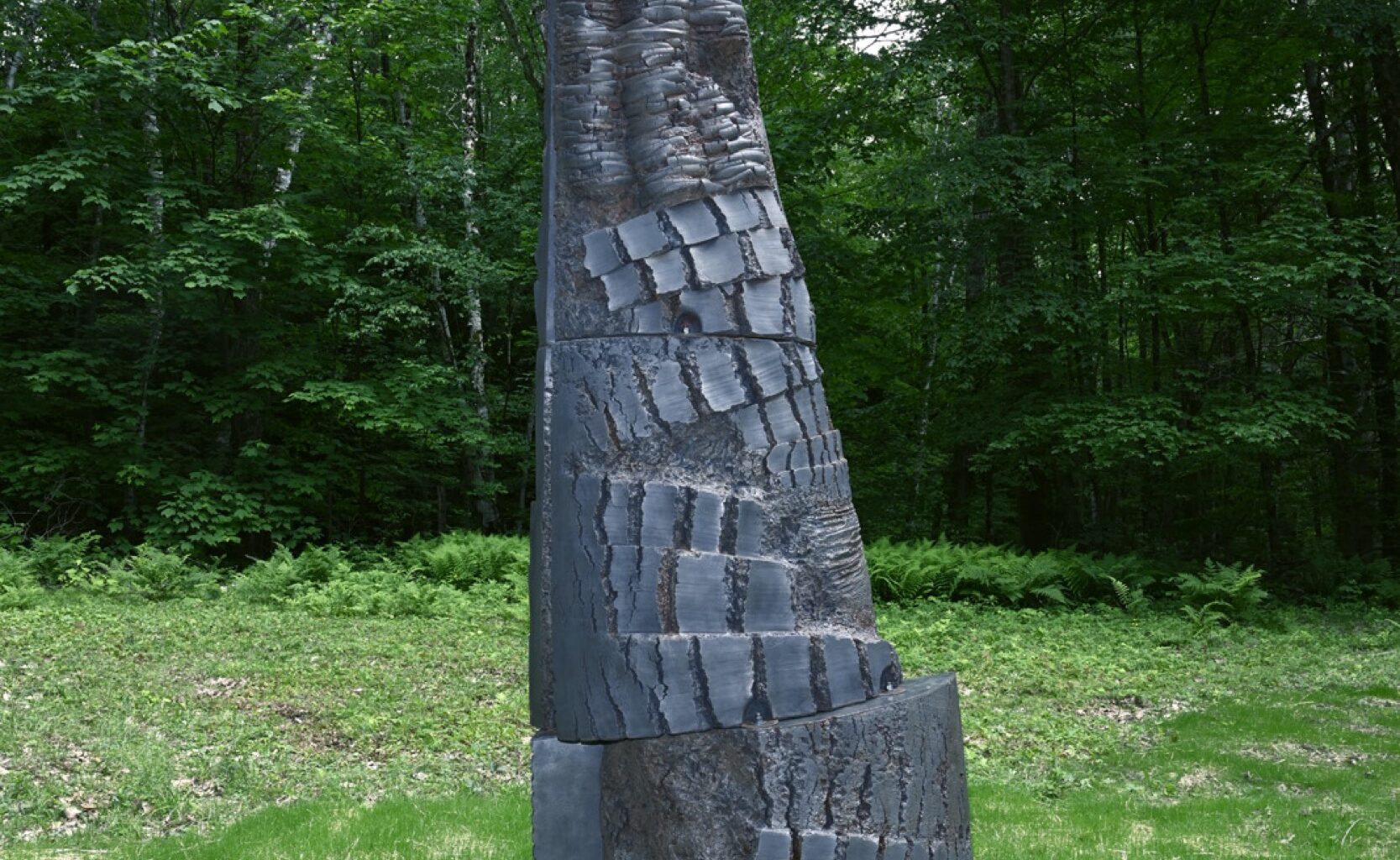
Comparable to the leaves, Yō Akiyama’s Oscillation: Vertical Garden (all works 2025) can change over time. Its towering black ceramic body with iron powder—most visible among the cracks and rings that widen at the bottom—ushers a rainwater cascade down the sides (the title evoking hydroponics). The work emulates a charred tree, still standing, or a fossil responding to the surrounding verdant trees. Nestled in a bottom crack, patinated like the rusty brown of live tree bark, is an eastern red-backed salamander. This moment is a reminder that the Japanese wabi sabi philosophy opens the door to organic harmony through imperfection and impermanence.
Similarly, life bursts forth from Gathering My Thoughts by Laura Ellen Bacon. While the title implies a process, the work is fully formed: a generative swell anchored by the tree’s torso, creating a direct spatial relationship with the tree by weaving around it. Maybe the work embodies a visualization of an a-ha moment. When approaching Gathering My Thoughts, I noticed the nestlike structure hosts spores, spiders weaving their own webs, and that it emits a tart woody, mildewy, smoky smell, suggesting its role as a facilitator of life.
Bana Yiriw ni Shi Folow (Trees and Seeds of Life), by Aboubakar Fofana, showcases cotton in outdoor sculpture. Often, fabrics are too vulnerable to the elements and are replaced by fabricated plastic polymers that keep a thread-like body. Indigo, ochre, river-bed mud, tannin, terracotta, and mangrove-dyed rosette-bundles (still pigmented despite the elements) come from his farm in Mali, embarking on their own transatlantic journey. With care, the bundles—which the artist sees as “seeds”—are protected yet visible in a rusted steel frame. From afar, the structure echoes the other fauna on the site, but upon closer inspection, the circular leaflets symbolize infinity. Instead, Fofana reclaims the site with materials typically associated with the African diaspora, a stark reminder of Williamstown’s prominence in the textile industry and historical role in the slave trade through its reliance on raw materials harvested and processed by enslaved Africans in the deep south.
Where Fofana’s composition emulates vitality and infinity, Hugh Hayden’s work displays decay. The End, a hollow spinal cord with ribs made of hemlock, twigs as offshoots like nerves and arteries, and has wood chips underneath it and pooling from its center is all joined by wooden pegs, making the lines seamless. From the side, it looks like a centipede tipped on its back. While the wood is dead, there are clear signs of life surrounding it, including vegetation and an alcove for a red-spotted eastern newt. Does the ground and foliage serve as the body, and is this work the skeleton? Could it even attract and sustain termite life? Concerned for the preservation of the work I asked, “Does the conservation team spray this or intervene?” I found out that the work is an experiment, for Hayden, in how it devolves over time, noting how the nonbiodegradable metal hinges that hold the vertebrae together deteriorate compared to the organic matter in the work’s composition.