
Editor’s note: One source in this story will remain anonymous due to concerns about personal safety.
The Disabled Students’ Alliance was established in Spring 2024 as a low-commitment club dedicated to fostering community for those with disabilities on campus and, as a secondary mission, filling the gap of disability advocacy at Ithaca College.
In the Fall 2025 semester, I started my studies at IC and promptly joined the DSA after I found it difficult to function the same as able-bodied and neurotypical students on campus. Stigma and invisibility blend together for disabled students, mixing in a way that can leave disabled issues out of conversation. When I joined the DSA, I felt this and decided to look further into the reasons why the DSA might be seen as necessary at IC.
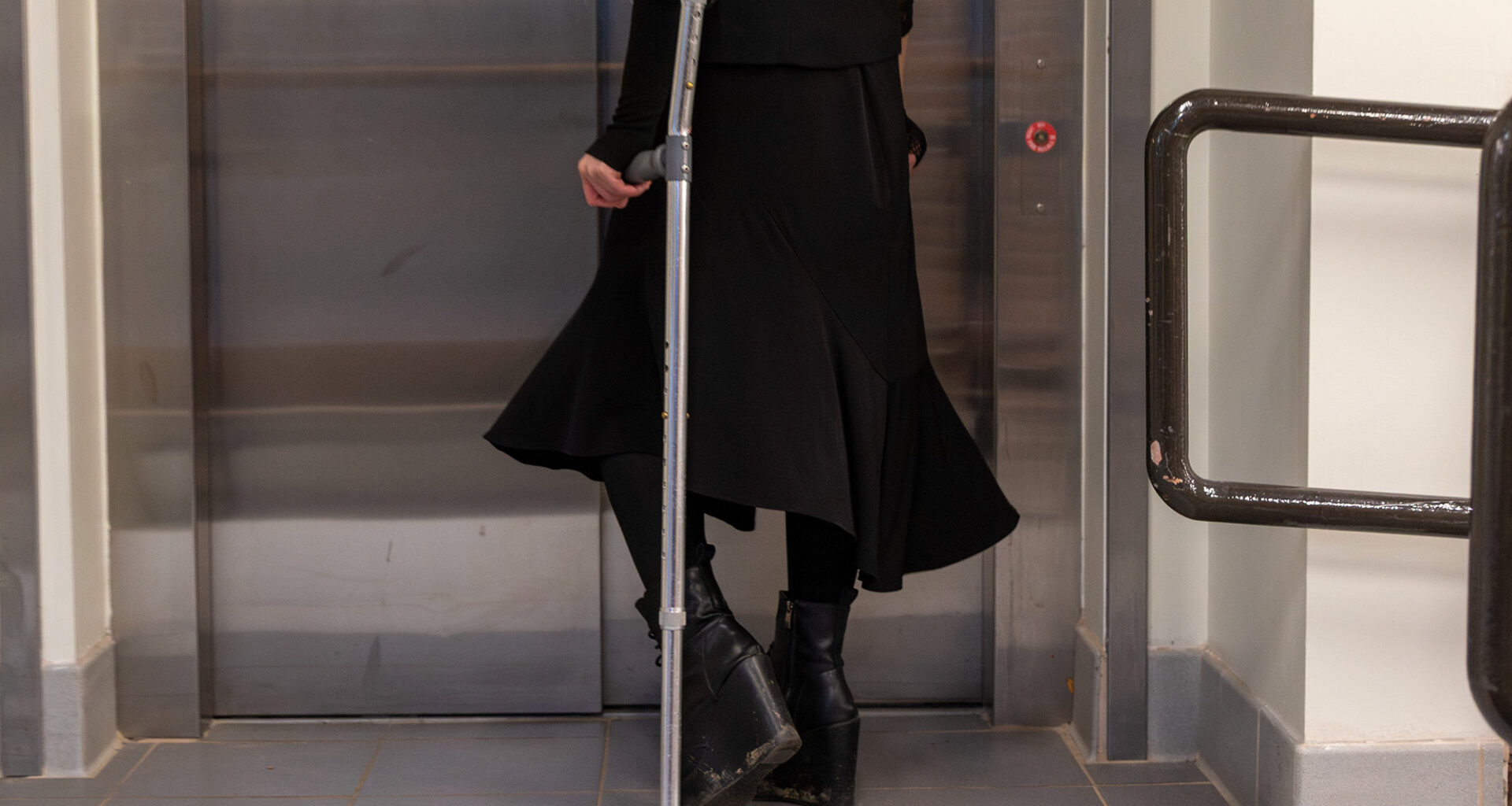
On Thursdays, I attend the weekly DSA meeting in Friends Hall room 301. This room is only accessible by elevator, and the DSA’s request to be located on the second floor of Friends Hall because that would not require an elevator was denied by IC.
The Friends Hall elevator was added early in Spring 2017 with construction beginning in the summer of 2016. The former associate vice president for facilities said in an August 2016 interview with The Ithacan that the elevator was motivated by a desire from IC to be more considerate of the Americans with Disabilities Act of 1990.
Jenny Pickett, associate director for operations and compliance for student affairs and campus life, said IC was not required to make ADA compliance renovations in buildings built before the ADA unless they had made significant renovations in other areas of the same building.
“We are seen as meeting the code of when the buildings are built,” Pickett said. “So if all we ever do is paint and carpet … we don’t hit the monetary threshold that would require us to meet the new ADA code. But if you do a significant enough renovation, then you are required to meet the new ADA code.”
From Oct. 8, 2015 to July 29, 2016, IC was engaged in an active lawsuit by an alumni seeking $10 million over a lack of compliance with the ADA and Section 504 of the Rehabilitation Act of 1973. The suit was dismissed. Additionally, IC was under investigation by the U.S. Department of Education’s Office of Civil Rights from 2009-15, which found IC failed to meet compliance in multiple areas, such as poor pathways and spaces too compact for wheelchairs. Looking at complaints from student and legal bodies, many issues that were relevant a decade ago continue to persist in 2025.
At DSA meetings, it seems as if everyone has more ADA issues each week. In that way, the DSA community offers a respite to the feelings of exclusion many disabled students feel about the broader IC environment.
Ian Moore, director of Student Accessibility Services, said disabled students are a uniquely invisible group at IC. Disabled students have no equivalent to the Unity Center or the Center for LGBT Education, Outreach, and Services.
“At the end of the day, we said it’s a workflow resource thing where we can’t do as much as the Unity Center and the LGBT Center … which primarily are community spaces,” Moore said. “At the end of the day, if I can help prove the case that we should be doing [a disability center], … I don’t want the accommodations office to be the same director. … The person who makes accommodation decisions should not be your community person.”
Moore said disabilities are sometimes silently excluded from IC’s mission of equity, inclusion and belonging. For example, there is no dedicated resource for disabled students at IC other than SAS, and accessible paths are typically located far away from standard paths.
“Some people include the accessibility very clearly,” Moore said. “Some people don’t include the ‘A’ — and I always make the point ‘Isn’t this interesting that we’re talking about this thing and this ‘A’ keeps dropping off the conver[sation],’ and then it gets added and it gets dropped. It’s inconsistent and I make the point that I really wish we had the ‘A’ there because [for] disabled folks, that’s their word and that’s what they want to see, and that’s when they know they are going to be included in that standpoint.”
This exclusion from IC is felt within the DSA. First-year student Ley Lewis said they hear ableist comments both in public and classroom settings on campus.
“Some of my friends have said that they’ve heard people say ‘If you’re disabled, why would you go to an inaccessible campus?’” Lewis said. “That’s basically saying you should only come to Ithaca College if you’re able-bodied.”
First-year student Violet Nichols, another DSA member, said strict attendance policies have given her anxiety and seem hostile towards disabled students. IC has no standardized attendance policy and instead requires professors to clearly outline their class policy as what they deem fit. On certain days when she is scheduled to have four classes in a row, she is occasionally forced to miss classes as a result.
“I’ve never actually had a problem with it, but I’m always scared I’m going to have a problem with it because it says it in their syllabus,” Nichols said.
BB, a DSA member, suffered a severe back injury in Spring 2025. Temporary disabilities are supposed to be covered by SAS. BB’s back injury fit under the category of a temporary disability; however, BB said their worst encounter with discrimination at IC was seeking accommodations for their injury.
“When I called SAS about finding a way to lean back/lay down while taking my finals, the person I spoke to actually laughed at me,” BB said via Discord messages. “They then told me it was unreasonable and compared the request to asking for a hot tub. When I asked if I could take breaks to lay down (since I had an accommodation for that regarding my classes) I was told no because it would be distracting to other students.”
BB then went on to tell me that they have been trying to avoid SAS following the incident, but doing so was difficult since they saw SAS as the only solid resource for disabled students on campus.
Sophomore Chloe Everman, DSA member, has noticed a lot of physically inaccessible campus designs.
“My hyper-obsession problem has been automatic door openers … and in fact it seems like a lot of them have been fixed now, but a good amount of them were just broken,” Everman said. “Multiple of them were broken and did not work. And the fact that it’s just way too many buildings here, way too many entrances here, don’t have them at all.”
Sitting in the college library, there were five doors without ADA buttons on the easiest path between there and my dorm. At a previous meeting, the DSA spoke about missing ADA buttons, including at doors to which accessibility ramps lead.
“I feel like you could go into DSA, pull any student out of there, talk to them, and they would have some shame story with SAS,” Everman said.
Everman later said she is especially concerned for undiagnosed disabled students because SAS requires a diagnosis for accommodations. This was one of the concerns that led to the 2018 founding of the now-defunct club, Disability Education, Alliance and Resources at Ithaca College.
Over the years, students have filled in the gaps as an alliance and a community to advocate for a meaningfully accessible IC experience.
“Life is really, in some cases, different for disabled people,” Lewis said. “On this campus too, which is not very friendly to disabled people.”