
Starbucks agreed to pay $38 million to settle an investigation by the city’s labor and consumer agency that found the coffee giant committed systemic violations of local scheduling laws at its New York City locations between 2021 and 2024, Mayor Eric Adams announced Monday.
A three-year probe by the city Department of Consumer and Worker Protection determined that Starbucks arbitrarily cut workers’ schedules and systematically denied employees the opportunity to pick up additional shifts, keeping them involuntarily part-time. Most Starbucks workers in New York never received a regular schedule, in violation of the city’s Fair Workweek Law, which requires fast food employers to assign schedules with 14 days’ notice.
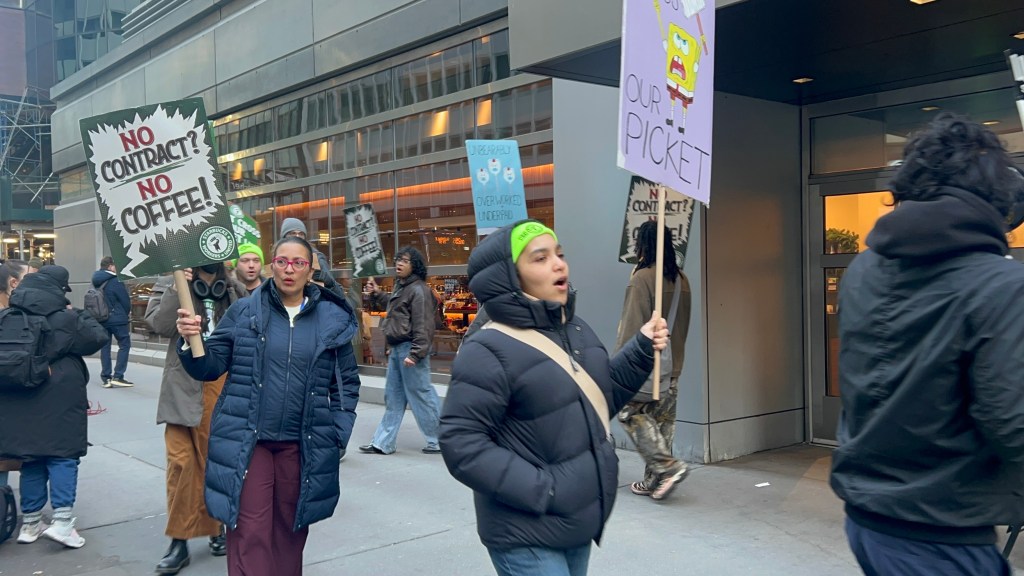 DCWP Vilda Vera Mayuga (left) picketed with striking Starbucks Workers United members in Lower Manhattan, Nov. 20, 2025. Credit: Claudia Irizarry Aponte/THE CITY
The terms of the settlement reveal the breadth of the coffee giant’s violations of the law: Starbucks agreed to pay $35.5 million to approximately 15,000 people who were employed at one of more than 300 New York City locations from July 4, 2021 until July 7, 2024. The company also agreed to pay civil penalties totaling $3.4 million and to comply with the law going forward.
In all, the company violated the law more than half a million times since 2021, logging violations at all but one of its New York City locations, the Starbucks Reserve Roastery in Chelsea, according to DCWP official Elizabeth Wagoner.
Officials said it is the largest worker protection settlement in New York City history.
Seattle-based Starbucks “systematically” violated the law because they “thought they could get away with it,” DCWP commissioner Vilda Vera Mayuga told THE CITY.
“To workers: understand that the government is on your side. DCWP is going to be looking into matters and getting the restitution that you deserve, and we’re going to be enforcing the law — it doesn’t matter how big a company is, if it’s a multi-billion-dollar company,” Mayuga said. “We are committed to holding these companies accountable.”
A Starbucks spokesperson did not immediately respond to a request for comment.
Starbucks’ failure to comply with the law illegally denied workers’ rights to stable and predictable schedules, as well as the opportunity to pick up additional shifts and earn more money. The company routinely unlawfully reduced workers’ schedules such that many did know how much money they would make week to week, officials said. The routine violations made it difficult for workers to plan commitments for child care, education, and second jobs.
“This historic settlement marks a major victory for thousands of Starbucks baristas across New York City,” said Workers United-SEIU international president Lynne Fox, whose union represents some of the workers in the settlement. “For too long, Starbucks has acted with impunity: manipulating schedules, disrespecting workers, and ignoring legal protections put into place by New Yorkers to protect working people from unfair business practices.”
DCWP began its probe after it received dozens of worker complaints beginning in 2022 from several Starbucks locations. The agency expanded its investigation to all Starbucks outposts citywide after uncovering evidence of systematic violations beyond the initial locations, based on worker reports and payroll data from the company, Mayuga told THE CITY.
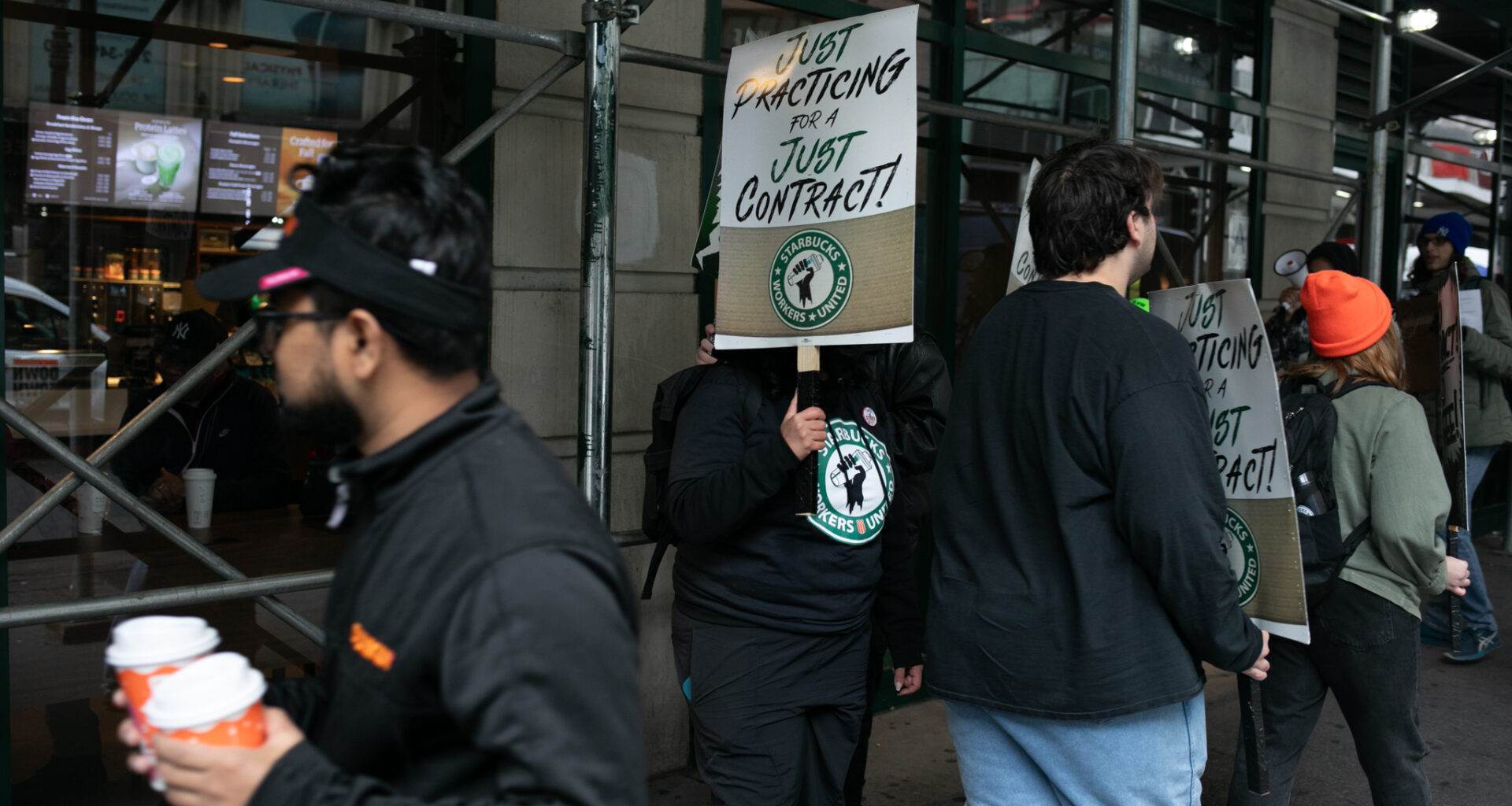
The settlement comes as Starbucks workers across 85 cities nationwide including New York are in an ongoing strike, now in its third week, to protest the company’s alleged refusal to negotiate a collective bargaining agreement with Starbucks Workers United. Wage and scheduling issues are among the sticking points for the union in New York and nationally.
Workers who are covered under the terms of the settlement will automatically receive their restitution in the mail beginning this winter, Wagoner told THE CITY, and will not need to apply. Most employees who worked for Starbucks in an hourly position in New York City will receive $50 for each week worked between July 2021 and July 2024, a sum potentially totaling thousands of dollars.
Workers who experienced a violation of the Fair Workweek law after July 7, 2024 may also be eligible for compensation after filing a complaint with the DCWP.
Related