
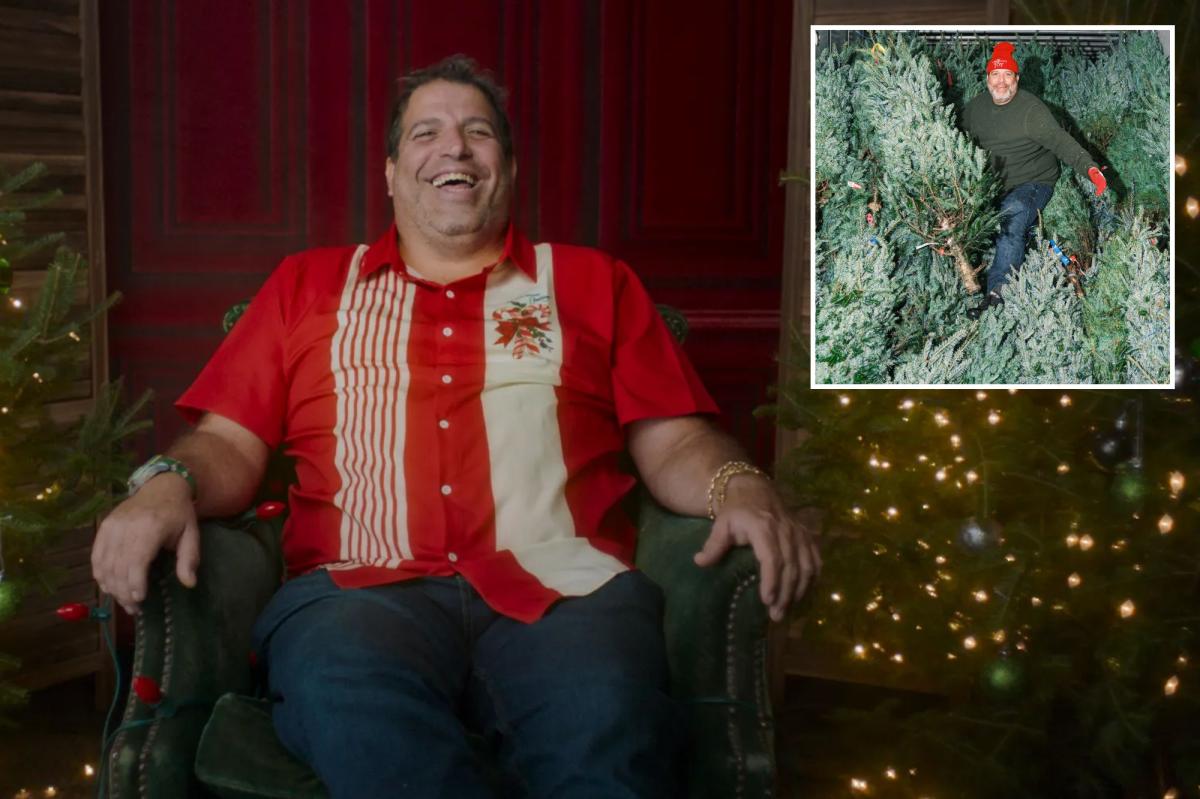
New York City’s Christmas tree sales aren’t a holly-jolly business.
The most statuesque trees worthy of a Manhattan pied-à-terre or Brooklyn brownstone don’t come cheap — or without behind-the-scenes drama that has been kept from New Yorkers, until now.
The Christmas tree sellers that pop up on the streets of NYC in the run-up to the big day have often gone more than $400,000 into debt to buy their supplies.
Then there’s the hush-hush aspect of securing the best trees themselves, often sourced from farms in states including Oregon, Michigan, North Carolina and Tennessee. The exact locations, trade secrets that each peddler is very tight-lipped about.
NYC Tree Shop owner George Smith is one of the city’s big-five dealers. Courtesy of Prime
But most cutthroat of all is the limited time period over which this plays out, with New York City tree sellers duking it out for the biggest profits in a highly competitive four-week window — just before Thanksgiving through the middle of December accounting for their busiest time.
To make matters even more challenging, uncontrollable factors come into play — including bad weather, or big-box stores like Home Depot dropping an abundance of Christmas trees — with pressure mounting to get customers during that small window.
“We deal with everything. The weather — no one wants to buy a tree in the rain. We deal with the economy when people are going through hard times. We dealt with the transit strike [from Dec. 20-22, 2005],” NYC Tree Shop owner George Smith, one of the city’s big-five dealers, revealed to The Post. “We see it all firsthand because we’re on the front line.”
Although the business is centered around one of the most magical times of the year, it requires resilience, determination and a whole lot of street smarts to survive and thrive, as revealed in a new Amazon Prime Video documentary, “The Merchants of Joy,” by filmmaker Celia Aniskovich, whose credits include Netflix’s “Fear City: New York vs. the Mafia” and Lifetime’s “Surviving Jeffrey Epstein.”
The film pulls back the tree curtain on the gritty, intense world of the city’s tree turf wars, and the lively characters behind the firs.
In addition to Smith, the city’s four other top sellers — George Nash, Jane Waterman and Ciree Nash of Uptown Christmas Trees; Heather Neville, the NYC Tree Lady; “Little” Greg Walsh of Greg’s Trees; and Kevin Hammer of Evergreen East Trees, who’s been in the business for nearly 50 years — are featured in the film.
Despite dealing with ruthless New Yorkers for the past 39 years, NYC Tree Shop worker George Smith continues to do the job with a smile on his face. Stephen Yang for the NY Post
Jane Waterman and George Nash of Uptown Christmas Trees took part in the new documentary about the holiday tree trade. Courtesy of Prime
But what’s inspired the sellers to risk their livelihoods, live out of their cars or makeshift shelters for five weeks, keeping their stands open — as required — 24 hours a day? For some, they were born into it. For others like George Smith, it was a twist of fate.
Smith was only 12 years old when, on a grocery store run to “pick up some spaghetti sauce” for his mom in Bay Ridge, Brooklyn, his bike was stolen and he stopped and asked a Christmas tree seller for help.
The stand, at the corner of Fourth Avenue & 68th Street, belonged to “Big” Greg Walsh, the owner of Greg’s Trees, who died earlier this year. He offered Smith a job and told him he could buy himself a new bike with the tips he earned.
“I grew up poor. I didn’t have a lot. So I would spend every day at the stand after school, tying trees and everything else,” Smith, 51, told The Post.
Greg Walsh of Greg’s Trees is featured in “The Merchants of Joy.” Courtesy of Prime
Little did Smith know that a stolen bike and a seasonal job would forever change his life.
The holiday hustle taught Smith how to conduct business with ruthless New Yorkers, which eventually led him to become one of the five families that dominate NYC’s sidewalk Christmas tree business.
And for some, ruthless can be an understatement.
When Nash and others first got involved in the tree trade 30 to 40 years ago, things reportedly got dicey because the mob staked out tree territories for control.
Nash was in the wholesale business and doing well at the time, but he revealed in the documentary that he unknowingly encroached on mafia-fronted tree wholesalers. While he wasn’t threatened with, say, an untimely demise by way of cement shoes, he claims he was extorted and robbed — sending every seller a forceful message not to overstep.
In other words, keep your friends close — and your fir frenemies closer.
People like George Smith (left), posing at one of his stands on 23rd Street and Second Avenue with his 15-year-old son Justin (right), usually break into the Christmas tree business by being born into it or working for someone else before branching out on their own. Stephen Yang for the NY Post
George and Ciree Nash of Uptown Trees check out the wares at one of their stands. Courtesy of Prime
“When I met them, I was blown away. They are authentically themselves. If you walk up to the stands and see one of them, they will be exactly as they are on the screen,” filmmaker Aniskovich told The Post of focusing on NYC’s big five, saying she couldn’t help but fall in love with their outward personalities and passion for what they do.
“I thought, ‘God, this is just magic in a bottle, and I’ve got to find a way to capture it.’”
But before cameras started rolling, Aniskovich admitted, she had no idea how the tree business worked — which involves submitting a free, sealed bid to the NYC Parks Department, in the hopes of winning the rights to sell trees at a high-traffic public space for each of the family’s half-dozen or so stands.
As revealed in the documentary, those locations are announced in a group call with the sellers, in which f-bombs are dropped and hands are thrown in the air, underscoring that some of the frustrated families aren’t too thrilled with their placements, especially if a desired location is swiped by another family.
“I lost a lot of my locations, and I won a lot of locations in the past,” Smith revealed to The Post.
Will Zinterhofer, 25, carries a tree he happily bought for his girlfriend, Mason Rudnick (center), 22, and their friend Sadie Skibeli (right), 22, at the NYC Tree Lady stand at 11th Street and Seventh Avenue in Manhattan. Stephen Yang for the NY Post
With such a small window to sell their trees and earn some revenue, a lot is on the line for each of the sellers. Stephen Yang for the NY Post
Starting in late November, the holiday weeks are often a hustle-and-bustle blur. Before you know it, Christmas trees seem to “grow out of the concrete overnight,” as Aniskovich told The Post, and suddenly appear on street corners throughout the five boroughs, ready to be purchased and decorated.
If only it were that easy.
Since every stand throughout the city is open 24/7, each family needs to hire workers, either local New Yorkers or out-of-towners, who are trustworthy and reliable.
“Little” Greg Walsh, a Gen Z New Yorker who was born into the business and is now carrying on his father’s legacy running Greg’s Trees, is one of the five families who prefer to recruit non-locals.
“We have a lot of kids from Montana who are fly fishermen or rafting guys and skiers, even mountain climbers, outdoorsmen type. They live on site [often in office trailers], and they all become friends,” the 22-year-old told The Post.
“They come here for the best time in New York City. They’re living in prime real estate for free and getting paid,” Walsh explained.
“Little” Greg Walsh (right) made the difficult decision to take a break from college to help his dad, “Big” Greg Walsh (left), with his business, Greg’s Trees. The younger Walsh is now proudly running the enterprise himself and said he gets requests for trees in early November. Courtesy of Prime
Greg’s Trees’ Domino Park, Brooklyn, location manager Charlie May, 31, lives in an on-site trailer for the season. Stephen Yang for the NY Post
Walsh told The Post that these days, some eager customers look to buy trees right after Halloween, an unrealistic ask for the families.
“I’ve had people calling for trees on Nov. 5, like they wanted it that day. There are no trees in the city [that early]; I can’t do that,” he explained.
And even once the holiday season wraps up and their stands are taken down, the families are already planning for the following year.
“You never actually stop doing Christmas. It’s not like there’s a start to finish because when January comes, you’re getting ready for next year,” Smith told The Post. “The documentary shows all the hard work and dedication that goes into it because people take for granted how things happen sometimes.”
Once they’re cut down, the trees travel overnight on trucks to NYC to be set up at each family’s stand. Trees are unloaded (above) shortly just days Thanksgiving at George Smith’s NYC Tree Shop at 23rd Street and Second Avenue. Stephen Yang for the NY Post
Every year, the older Walsh (above) would travel to farms in Michigan, North Carolina and Tennessee to find the exact trees he would want to sell at his NYC stands. Courtesy of Prime
“Little” Greg Walsh, posing at one of his tree stands in Domino Park in Williamsburg, also sells festive wreaths. Stephen Yang for the NY Post
And while they may jokingly view one another as “frenemies,” at the end of the day, the highly competitive stand operators are the only ones who can really comprehend the blood, sweat and Christmas tears that go into the year-round business.
“If someone needs trees or someone needs a couple of [tree] stands, we call one another and help each other out like that, Walsh explained to The Post, “because you’re not calling up your grower in North Carolina to send them on a truck.
“There’s a lot of competition in New York besides us. There are a lot of other guys that sell trees on corners and at delis,” Walsh said. “But it’s the greatest city in the world — wouldn’t want to be anywhere else.”