
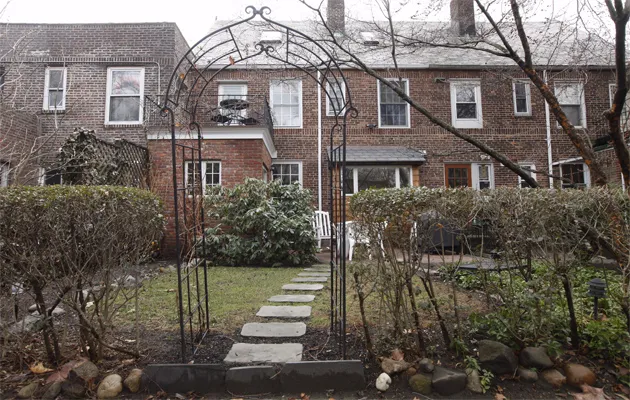
In 1949, Betty Friedan moved to a Queens garden apartment. Though later she would become world-famous for chronicling the discontents of women in post-World War II America, she had nothing bad to say about her years living at Parkway Village. Rather, she felt, she “would never again, ever, be so happy.”
Friedan was not alone; millions of Americans found joy and comfort in garden apartments. Screenwriter Jan Oxenberg remembered Bell Park Gardens, farther out in Queens, as “like a paradise for kids.” Critic Lewis Mumford went so far as to describe Fresh Meadows, which combined garden apartment buildings with taller residential structures and a shopping center, as “a slice of the City of Tomorrow.”
Garden apartments — two- or three-story multi-family buildings, situated around courtyards or surrounded by lawns — were a remarkably successful, mid-20th century effort to provide good housing to families of modest means. They still serve that purpose, not only in New York but all around the country. Yet they are rarely discussed by policymakers, architects, or scholars. At a moment when New York, like most U.S. cities, faces a severe housing crisis, garden apartments, hiding in plain sight, deserve a closer look.
The inspiration for garden apartments came from the “garden cities” built in England in the early decades of the 20th century (from where “garden” in their name comes) and government-built apartments for workers in cities like Vienna, Frankfurt, and Berlin.
U.S. housing reformers, looking enviously across the Atlantic, experimented with creating communities that brought greenery, light, ventilation, privacy, and safe play areas to families with limited income. Sunnyside Gardens in Queens, built in the mid-1920s, was their first effort, now designated a historical district for the influence it had on housing to come.
Garden apartments only became a mass form of housing when the federal government put its weight behind them during FDR’s administration. As part of the New Deal effort to get people back to work, Washington, for the first time, took a direct role in creating civilian homes. Garden apartments emerged as a favorite form of government-aided housing; they were quick to build and relatively inexpensive, while providing a dramatic improvement from the tenements and shacks that housed so many Americans.
Some garden apartments were built as public housing. But most were built by private developers enabled by substantial government aid. Most important, the Federal Housing Administration (FHA) guaranteed mortgages for garden apartment construction, eliminating the risk for lenders and lowering interest costs. In return, developers had to get design approval from the federal agency.
By the late 1930s, the basic template for garden apartment design was in place: low, unadorned buildings, usually made of brick, placed around courtyards, with cars kept to the periphery of large sites. Rooms were small, but apartments had plenty of windows, cross-ventilation, and modern kitchens and bathrooms. Shared outdoor spaces and collective amenities, like playgrounds, laundry rooms, and meeting spaces, promoted community cohesion.
World War II interrupted the construction of garden apartments, but after the war they were built in even greater numbers as a government-supported effort to meet the enormous need for housing for veterans and their families. Queens was an epicenter for postwar garden apartments.
In the dozen years following V-J Day, at least 30 garden apartment complexes were built in the borough, providing more than 23,000 homes. In addition to the FHA’s guaranteed mortgages, New York State and City encouraged the creation of cooperative housing complexes, like Bell Park Gardens, Beech Hills, and Deepdale Gardens, by providing tax breaks. Though federally-funded public housing served only the poor, garden apartments represented an impressive government effort to serve working-class and lower-middle class families.
Eventually, new suburban single-family homes began meeting the postwar housing shortage. But garden apartments provided an alternative for families who wanted to stay in the city, could not afford to buy, or did not want to give up the close-knit communities. In the 1970s, many New York City rental garden apartment complexes converted to co-ops, deepening the identification of residents with their homes. Drive around Queens today and you will see dozens of well-kept garden apartment developments.
The housing solutions of 1935 or 1945 are not necessarily right for today. But garden apartments demonstrate that with political will and government assistance, it is possible to quickly build lots of decent, affordable housing. It is time to mobilize public and private resources to do again what our predecessors accomplished.
Freeman, a distinguished professor of history emeritus at Queens College and the CUNY Graduate Center, is the author of “Garden Apartments: The History of a Low-Rent Utopia,” being published by the University of Chicago Press on Dec. 23.