
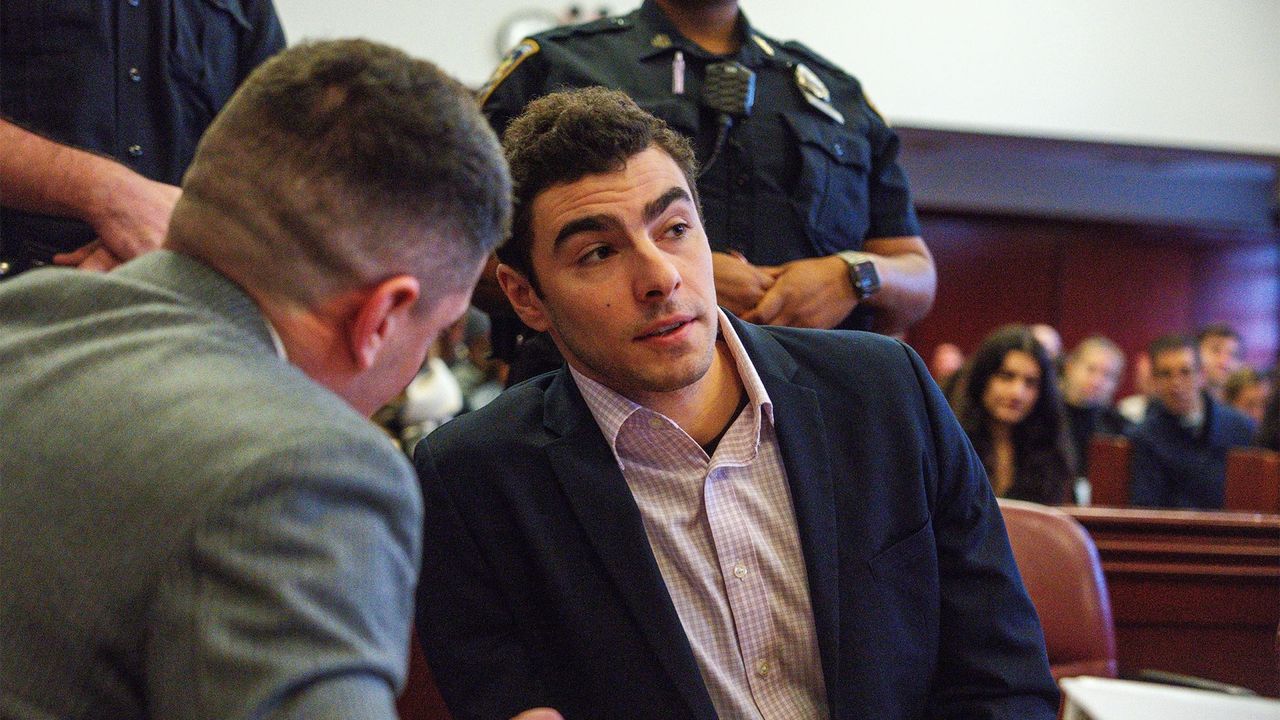
From the courtroom gallery, it was difficult to determine where Luigi Mangione was looking.
Two screens were playing on a loop—a video from almost exactly a year ago, of a faceless assassin gunning down UnitedHealthcare CEO Brian Thompson on a midtown Manhattan street. Rows of court officers, reporters, and Mangione supporters sat behind the accused murderer on Monday, watching him as he watched.
The judge in Mangione’s New York state case ordered this week’s hearing after Mangione’s lawyers sought to suppress several pieces of evidence: the 9mm handgun and a notebook, which included what was described by prosecutors as a “manifesto” outlining his intent to “wack” a health insurance executive, recovered from his backpack when he was arrested, as well as several statements he made in the aftermath. (His attorneys argue that police violated his constitutional rights during his arrest and searched his belongings without appropriate permissions; they also argue that statements Mangione made to corrections officers after his arrest were coerced.)
On Monday, Mangione sat, mostly unreadable, in a gray sportscoat and white tattersall shirt. Last month, his attorneys, who include the husband-and-wife team of Marc and Karen Agnifilo, fixtures of the high-profile defense law circuit, wrote to the Bureau of Prisons requesting that Mangione receive two suits, three sweaters, three pairs of pants, and five pairs of socks in advance of hearing that may stretch out over more than a week. They also asked the judge in Mangione’s state case, which runs parallel to a federal set of charges that could result in the death penalty, to allow him to have his handcuffs unshackled so that he could take notes. (Mangione has pleaded not guilty in both cases.)
From this relative distance, Mangione seemed, as he has over a handful of court appearances since his arrest last year, attentive, responsive, and occasionally twitchy. The pool photos that quickly circulated on social media offered a head-on view: the defendant, smiling with his lawyers, and ostensibly immersed in the proceedings. In the broader Mangione spectacle, the intrigue from onlookers has had less to do with the allegations—even his most ardent advocates rarely profess his innocence—and more with assembling these bread crumbs of personality. From the jury box, the sketch artist Isabelle Brourman, a regular chronicler of Donald Trump’s life and trials and New York immigration hearings, made new images of Mangione.
The testimony has amounted, thus far, to a granular reexamination of the turning point in Mangione’s journey from a well-to-do Maryland family and an Ivy League education to when he sat at a McDonald’s in Altoona, Pennsylvania and reached global notoriety.