
A chemistry start-up residing in Midtown Manhattan, an area otherwise known for corporate offices, luxury brand stores, and pricey apartments, has secured $95 million in series A financing to use artificial intelligence to discover new drugs.
Excelsior Sciences received $70 million from investors, including Deerfield Management, Khosla Ventures, and Sofinnova Partners, and a $25 million grant from New York’s Empire State Development.
The company aims to discover small-molecule drugs using chemistry that laboratory robots, rather than human chemists, can perform. “This is chemistry which machines can do and AI can use. It’s like creating a new chemical language that machines can understand,” says Michael Foley, cofounder and CEO of Excelsior. “It is the opposite of what everyone on Earth is doing, which is developing machines to do chemistry.”
Excelsior starts with about 2,000 small-molecule drugs already approved by the US Food and Drug Administration. The company’s technology allows it to break these molecules into smaller units, called smart bloccs, that serve as building blocks for new molecules.
“It is like taking down the incredibly complex world of synthetic chemistry and shrinking or simplifying it into building blocks which machines can use,” says Jana Jensen, the firm’s cofounder and chief operating officer.
Twelve team members pose together in a laboratory.

The Excelsior Sciences team poses for a photo.
Credit:
Excelsior Sciences
Moreover, starting with FDA-approved molecules increases the odds of finding a molecule that works, Foley says. The approach is one of the differences between Excelsior and other AI-based drug-discovery companies that are leaning on generative AI to build new molecules. “Everyone on the number line is going the wrong way with generative AI, making trillions of new compounds, to what end? How can you learn from that?” he asks.
Foley and Jensen have decades of experience in the pharmaceutical and biotechnology worlds. Foley has founded three biotech companies and previously headed chemical biology research at the Broad Institute of MIT and Harvard. Jensen spent years working at Bristol Myers Squibb, Merck & Co., and Pfizer.
Foley says that, over the course of his career, he has seen drug discovery be outsourced to countries such as China and India. But when the COVID-19 pandemic snarled global supply chains, Foley and Jansen, who were working together at Deerfield, a health-care and biotech investment firm, decided that onshoring was the need of the hour.
They, along with other chemists, cofounded Excelsior in 2024 and incubated it in Deerfield’s research space, Cure, on Manhattan’s Park Avenue. Its laboratories on the 12th floor are equipped with fume hoods, robots, and mass spectrometry and nuclear magnetic resonance machines. For now, their research team consists of just one chemist, and they are in the process of hiring another one. “That is a 100% increase,” Foley jokes. But the company’s scant reliance on human chemists is mostly because its synthetic method is designed for machines to take charge.
For that method, Foley and Jansen turned to chemist Martin Burke at the University of Illinois Urbana-Champaign, who developed a way of joining the smart bloccs via carbon-carbon bonds.
“Small molecules are unique because they have the carbon-carbon bond as their backbone,” says Burke, who is also an Excelsior cofounder. But the traditional process of designing small molecules is not straightforward. “Creating carbon-carbon bonds is so difficult,” Burke says. “Chemists use thousands of different reactions and reaction conditions and millions of different starting materials to make small molecules. That’s the current state of the art. And it’s very artisanal.”
“This is chemistry which machines can do and AI can use. It’s like creating a new chemical language that machines can understand.”
Michael Foley, cofounder and CEO, Excelsior Sciences
In contrast, Burke says his approach of stitching together strings of smart bloccs to make new molecules is machine friendly. The strategy involves adding specialized functional groups to bloccs to regulate synthesis. A similar technology underpins another start-up, Revolution Medicines, that Burke also cofounded., that Burke also cofounded.
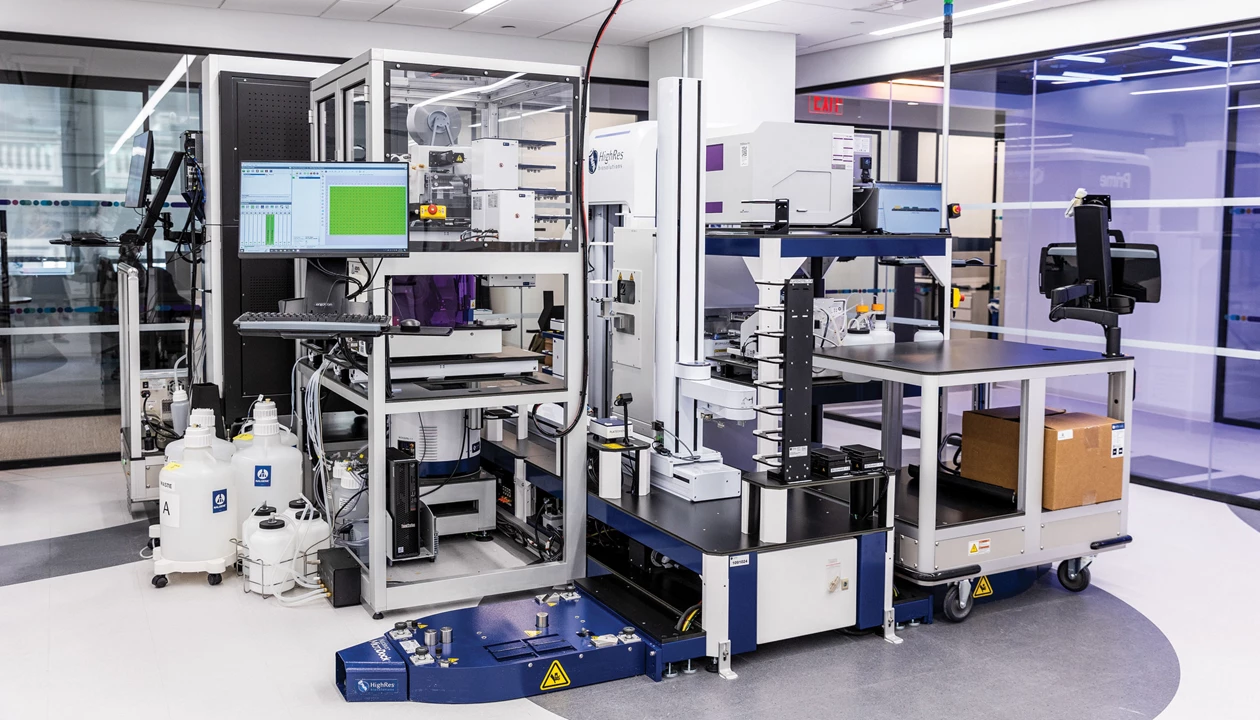
In Excelsior’s labs at Cure, the building blocks, which look like colorful powders, are placed in tiny glass containers. Robotic arms weigh the blocks and feed them to automated synthesizers that use combinations of blocks to produce new molecules, which are tested for their efficacy as drug compounds. The results then improve the AI algorithms the company uses to develop recipes for novel molecules.
Generating large amounts of data quickly helps train AI models, which can then suggest molecules that are the best fits for a target protein. And automation is the way to generate scores of new compounds that serve as data points for training AI algorithms, Foley says.
Through Excelsior plans to develop molecules in-house for a few targets, it expects to generate most of its revenue by synthesizing molecules for drug and biotech companies that otherwise would send the work offshore. “We want to show that every pharma and biotech would rather do it this way because it’s faster and cheaper,” Foley says.
Foley says the only way to reshore manufacturing of compounds in the US is through automation and AI. “I have seen us get into the problem of outsourcing too much, and I want to end my career getting us out of that problem,” he says.

Chemical & Engineering News
ISSN 0009-2347
Copyright ©
2025 American Chemical Society