
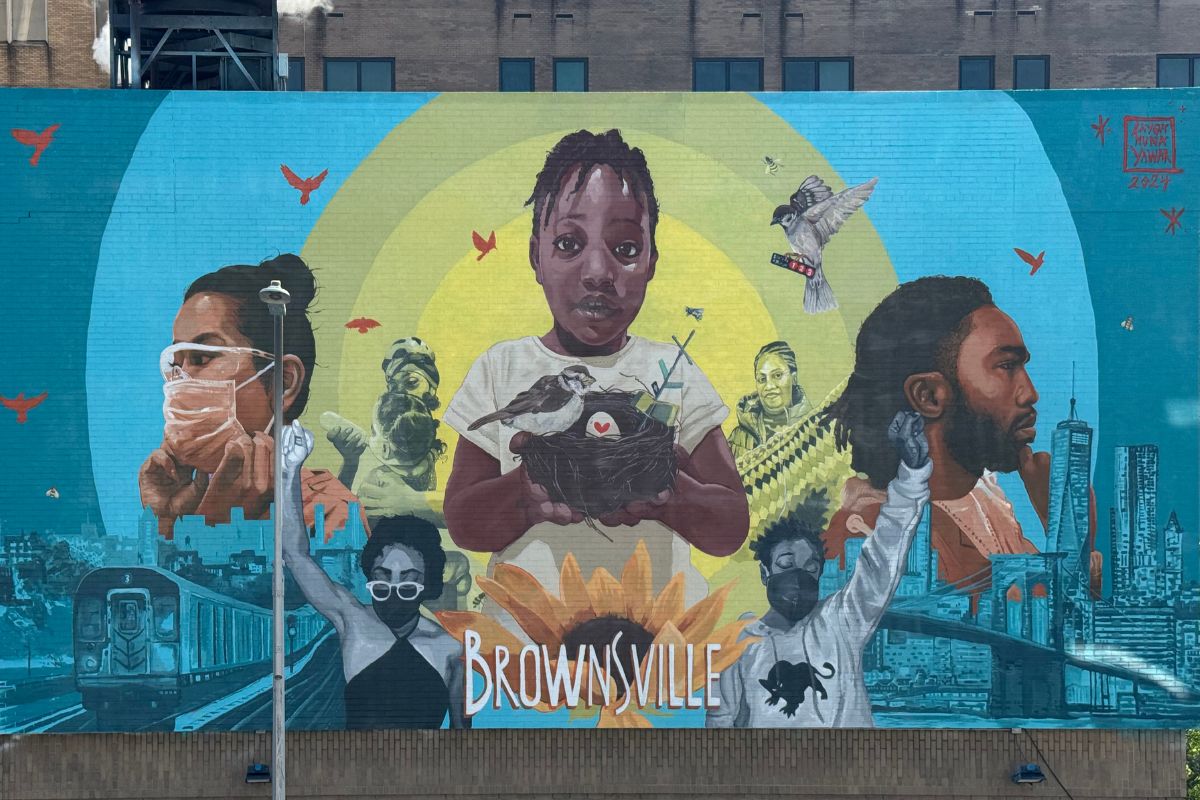
 “Colors of my city” by Layqa Nuna Yawar, layqa.info
Editors’ Note: This article was originally written for the Summer 2025 issue of Nonprofit Quarterly Magazine, “Land Justice: From Private Ownership to Community Stewardship.”
New York City’s community land trust (CLT) movement has grown dramatically to combat displacement and bring land and housing into community ownership. The number of CLTs has multiplied tenfold—from just two 12 years ago on Manhattan’s Lower East Side to more than 20 CLTs across the city’s five boroughs.
Through CLTs, low-income and Black communities and communities of color are reclaiming land for the public good, challenging real estate speculation, and ensuring permanently affordable housing and neighborhood-led development.
Nearly 50 percent of low-income New Yorkers pay more than half their incomes in rent. Over 140,000 sleep in shelters each night. The city lost more than one million affordable apartments in the last two decades, driving out 9 percent of its Black population—nearly 200,000 people.
By combining land ownership with organizing, New York City’s [community land trusts] are transforming neighborhoods.
The New York City Community Land Initiative (NYCCLI), a coalition cofounded by New Economy Project, Picture the Homeless, and other groups in 2013, has spearheaded the growth of the local CLT movement. Through organizing, advocacy, and peer exchange, the coalition has galvanized communities to envision—and fight for—collective land ownership, as a matter of racial justice and self-determination.
What Is a Community Land Trust?
CLTs are community-governed nonprofits that own and steward land for the public good. The model is rooted in Indigenous land practices, as well as civil rights struggles in the US South. By combining land ownership with organizing, New York City’s CLTs are transforming neighborhoods—preserving deeply affordable housing across generations and empowering New Yorkers to shape their communities.
The city’s CLTs now steward more than 1,200 units of permanently affordable housing—up from fewer than 400 units just a decade ago—as well as storefronts for locally owned small businesses, accessible waterfront and green spaces, and community and cultural hubs.
The movement is entering an ambitious new stage, advancing broadly supported policies, including the Tenant Opportunity to Purchase Act (TOPA) and Community Opportunity to Purchase Act (COPA), that stand to channel thousands more properties to community ownership in the coming years. CLTs have secured steady funding in New York City’s budget since 2019, and a growing number are organizing with tenants to take ownership of neglected housing from predatory landlords as a next stage in the fight for housing justice.
Grounding the Coalition in Organizing and a Bold Vision
From the outset, NYCCLI members have pursued CLTs not as ends in themselves, but as vehicles for transforming housing and neighborhood development.
Picture the Homeless, an organization founded and led by homeless New Yorkers, played an instrumental role in organizing for CLTs, beginning in the mid-2000s. Among its campaigns, the group undertook a vacant property count—identifying enough warehoused property to house the city’s entire shelter population—and called on the city to advance CLTs and other solutions to the housing crisis.
New Economy Project, an organization anchoring city- and statewide coalitions for racial and economic justice, began exploring CLTs as a way to stabilize neighborhoods in the wake of the predatory lending and foreclosure crisis. Through community land trusts, public banking, and other initiatives, the organization and its partners sought to transform ownership of economic resources—taking land, housing, and capital out of corporate hands and transferring those assets into democratic community control.
When these organizations initially launched NYCCLI, an essential early step was creating dynamic popular education and organizing tools. One of these was Trustville, a board game in which players take on roles as CLT decision-makers and land stewards. The game and other materials demystified how CLTs work and engaged community groups and their members in NYCCLI campaigns.
In 2014 NYCCLI also launched a demonstration project that created the East Harlem/El Barrio Community Land Trust—the city’s first new CLT in two decades. The coalition drew inspiration from Cooper Square, a CLT formed in 1994 that has provided high-quality housing at extremely low cost for hundreds of New Yorkers. The East Harlem/El Barrio CLT’s acquisition of four neglected city-owned apartment buildings was a movement milestone and generated important learning for others.
Through these and other efforts, NYCCLI members began shifting how policymakers and the public understood the affordability crisis—and the solutions needed to address it at the root.
Building Capacity and Momentum
NYCCLI’s organizing helped secure important breakthroughs with city and state agencies. In 2017, New York State announced that it would distribute $3.5 million to cities statewide for CLT capacity building. New York City, which issued its first request for expressions of interest in CLTs earlier that year, secured $1.65 million for local groups.
On behalf of NYCCLI, New Economy Project launched a two-year learning exchange for community groups seeking to form CLTs. The curriculum, co-designed with City College of New York faculty, combined peer learning and site visits with skill-building workshops, guest presentations, and political education—including a deep dive into CLT movement history.
The exchange equipped groups to move their CLT projects forward, while fostering a shared analysis and bonds that were essential to the coalition’s next stages of growth.
As the learning exchange wrapped up in 2019, NYCCLI members mounted a campaign that secured the first funding in New York City’s budget for citywide CLT organizing. The funding initiative, now in its seventh year, has enabled grassroots CLTs to hire organizers and move land campaigns forward. It also has supported citywide organizations, like New Economy Project and TakeRoot Justice, that provide training, legal and technical assistance, and other support.
Building Power and Advancing Policies to Grow CLTs
As the COVID-19 pandemic deepened inequality and ignited renewed calls for structural change, NYCCLI members—many based in neighborhoods hardest hit by the pandemic—sharpened their organizing and demands for public support.
Sign up for our free newsletters
Subscribe to NPQ’s newsletters to have our top stories delivered directly to your inbox.
By signing up, you agree to our privacy policy and terms of use, and to receive messages from NPQ and our partners.
The coalition drafted and secured the introduction of TOPA in the state legislature and COPA in the city council. Modeled on policies that have preserved thousands of affordable homes in Washington, DC; San Francisco; and other cities, the bills would give tenants and CLTs powerful tools to take buildings off the market and into resident control. Another NYCCLI-led proposal would require New York City to prioritize CLTs when transferring public land for affordable housing or other community development.
More than 150 community, housing, and environmental justice groups—and a majority of city council members—today back the local bills, known collectively as the Community Land Act. NYCCLI has organized dynamic town halls and speak-outs, policy briefings, and other actions to build support for the legislative package, which is making steady progress and would dramatically expand community control of land and housing across the city.
CLTs at the Neighborhood Level
The East New York Community Land Trust (ENYCLT) is just one example of a new generation of CLTs taking root across the city. ENYCLT was formed during the height of the 2020 COVID-19 lockdown by an intergenerational group of organizers and leaders living in the Brooklyn neighborhoods of East New York and Brownsville. They established an initial steering committee that wrote bylaws and elected the group’s first board of directors. The steering committee has since transitioned into a growing dues-paying general membership.
From the beginning, ENYCLT has been grounded in the belief that land is power, and that the community governance model of a CLT is the best way for a low-income neighborhood of color to hold onto land and steward it so it remains permanently affordable and meets the needs of residents.
In its first campaign, ENYCLT mobilized groups—including fellow members of NYCCLI—in a David and Goliath campaign that halted the city’s tax lien sale for three years, shielding tax-distressed homeowners from a system that was notorious for fueling speculation and extracting wealth from communities of color.
The group has also led the resiliency planning in the Jewel Streets, an area of East New York that has long faced environmental injustice and disinvestment.
Then, in 2024, ENYCLT made history. After an eight-month organizing and fundraising campaign—through which the CLT raised donations to subsidize two-thirds of the acquisition cost—they purchased property from an absentee landlord, a 20-unit rent-stabilized building at 248 Arlington Avenue. It was the first purchase of its kind by a local CLT, and the organization is now working with tenants to convert it into a shared-equity housing cooperative, ensuring lasting affordability and community control.
[East New York Community Land Trust] has been grounded in the belief that…a CLT is the best way for a low-income neighborhood of color to hold onto land.
Creating Infrastructure for the Long Haul
How can CLTs continue to grow, secure deeper public investment, and bring more land and housing into lasting community control?
We know that sustained, effective organizing is essential over the long term. Through TOPA, the Community Land Act, and other campaigns, we are creating pathways for CLTs to build power and take land off the speculative market, at scale.
We are also building technical and financial infrastructure for the movement via a shared services project that New Economy Project is co-designing with NYCCLI partners. With this, CLTs will be able to pool resources, share back-office and other expenses, and tap into financing and development support. The groundbreaking initiative will support long-term sustainability through economic cooperation and efficiencies of scale, while preserving authentic community control that is at the heart of the model.
With many CLTs embarking on their first projects, we are at a pivotal moment to design this field-sustaining infrastructure. NYCCLI is cultivating a growing network of legal services organizations and law firms, development consultants, planners and architects, and others with needed expertise to support the next stages of growth.
Lessons from a Growing Coalition
To ensure grassroots and member-led groups continue to lead the coalition…[member] groups have established shared expectations of one another.
The CLT movement in New York City has made major progress—and we see our biggest opportunities still ahead. With an expanding network of CLTs and supporters in all five boroughs, NYCCLI and its members are poised to play an even greater role in the coming years to democratize land, housing, and neighborhood development.
Establishing a shared, long-term vision and mission has been key. While differences and disagreements among groups are inevitable, we have maintained a clear North Star for our work together that is rooted in the experiences of, and solutions identified by, people and communities directly harmed by systemic land and housing injustice.
In recent years, we have formalized NYCCLI protocols to ensure grassroots and member-led groups continue to lead the coalition—now and into the future. Together, groups have established shared expectations of one another related to organizing, conflict resolution, and collective accountability. Through teach-backs and other peer learning, CLTs are sharing in concrete terms how they are practicing land stewardship and community governance as they grow.
This intensive coalition building has yielded powerful results. While a decade ago CLTs were little understood in New York City, today they are front and center in fights for land and housing justice.
Securing land and housing for the people, not profit, is a fight that extends beyond a single generation. Our work is continuous, intergenerational organizing. It is essential to preserving the mission and impact of CLTs over time. While securing land is the first step, building the power of people to steward that land for collective liberation is the enduring goal.
As we work toward a future in which all New Yorkers live in thriving, affordable communities, we celebrate the work we are doing together and milestones we are achieving along the way.