
Last month, the New York Times ran a glowing profile of Iowa City’s fare-free bus pilot program. Since eliminating fares in August 2023, the college town of 75,000 has seen ridership increase, boarding times shrink, and transportation emissions drop—all for roughly $1 million a year.
The piece lands just as Mayor-elect Zohran Mamdani aims to deliver on his campaign pledge to make New York City buses free for all riders. The implication is clear: if Iowa City can do it, so can Gotham.
Finally, a reason to check your email.
Sign up for our free newsletter today.
But Iowa City isn’t Gotham, and the former’s program shouldn’t necessarily be seen as a model for the latter. Moreover, a large body of research shows that fare-free transit often doesn’t deliver on its promises.
The differences in scale alone are enough to cast doubt on the analogy. Iowa City’s system provides 1.6 million rides annually. New York’s buses carry more than 400 million passengers. Iowa City previously charged $1 per ride, accounting for just 8 percent of its transit department’s funding resources. New York recovers 20 percent of bus operating expenses from fares, and those revenues are pledged against $17 billion in outstanding bonds.
But the more fundamental problem is that fare-free transit often fails to achieve its intended policy goals (such as reducing pollution and cutting traffic), while sacrificing the qualities big-city bus riders value even more than price: speed, reliability, and safety.
Two comprehensive reviews by the Transit Cooperative Research Program—in 2012 and 2023—surveyed dozens of fare-free systems nationwide. Both concluded that zero-fare policies reliably boost ridership but rarely achieve their broader goals in large cities. The 2012 review observed that fare-free transit is typically limited to small, university, and resort communities, while larger urban areas have avoided it due to concerns over revenue shortfalls. The 2023 report echoed this, finding that full fare elimination is “more viable for small- to mid-sized transit agencies than for large transit agencies.”
On the question of modal shift—wherein people change their means of transportation—the research is consistently discouraging. Studies from Chile, Estonia, Luxembourg, and multiple U.S. cities show that most new riders are people who previously walked or biked—not drivers. A randomized controlled trial in Santiago, Chile, for example, found that, while free transit significantly boosted ridership, no statistically significant reduction in car trips occurred. Almost all the additional transit trips occurred during off-peak hours, for leisure purposes.
Luxembourg, the first nation to make public transport fully free in 2020, also saw tram and train use surge. But the country’s Ministry of Mobility reported no significant short- or medium-term shift away from cars attributable to the fare policy alone. A 2025 study estimated a modest reduction in transportation-related emissions, but even that effect is difficult to attribute to the policy.
A decade-long experiment in Tallinn, Estonia, saw ridership jump between 20 percent and 30 percent, but it achieved only modest car-to-transit conversion. The pattern repeats: more riders, but not fewer cars on the road.
Other goals proved elusive. When Colorado temporarily eliminated fares in 2022 as an air-quality measure, ridership rose between 15 percent and 20 percent, but air pollution did not decline. Researchers calculated that transit ridership would need to grow by between 74 percent and 192 percent to reduce ozone levels by just 1 percent.
New York recently conducted its own fare-free experiment. From September 2023 through August 2024, the Metropolitan Transportation Authority ended fares on five bus routes—one per borough—serving about 43,000 daily riders. Ridership rose roughly 30 percent on weekdays. But the MTA deemed the pilot a failure—bus speeds didn’t improve, only 12 percent of riders were new to the transit system, and 45 percent of those new riders likely would have walked or simply skipped the trip if fares remained. Of the new riders, only 11 percent switched to the bus from cars or taxis.
Why don’t free buses attract drivers? Because for most car commuters, the fare isn’t the constraint; service quality is. Reliability, frequency, and travel time matter far more than price. New York’s buses average just eight miles per hour, among the slowest in the nation. Eliminating a $2.90 fare does little to make the bus competitive with driving, rideshare, or even walking.
A simple example shows why commuters value time. Consider a worker earning $50 per hour who needs to travel four miles. At New York’s typical bus speed, the trip would take 30 minutes. Driving the same distance at an average of 20 miles per hour would take just 12 minutes. The 18 minutes saved by driving are worth $15 to the worker—more than five times the $2.90 bus fare. For these commuters and many others like them, speed and reliability are paramount, though lower-wage riders are often reliant on buses.
Large-city experiments with fare-free transit offer many cautionary tales. Denver eliminated fares downtown during the 1970s oil crisis. Ridership increased significantly, but buses became overcrowded, vandalism spiked, and the program was abandoned after two years. Austin’s 1989–90 trial produced similar results: severe crowding, increased assaults, and little evidence of a mode shift. Kansas City, which operated America’s largest fare-free program, struggled with persistent operational challenges before announcing plans to reinstate fares earlier this year.
Fare collection does more than just raise revenue—it signals value and ensures use by riders who genuinely need the service. When routes go fare-free, transit agencies report increased vandalism, loitering, and conflicts that make buses less attractive to discretionary riders, the very group most likely to shift from driving.
Fare-free bus routes increase crowding. Lines get longer, creating hardships for seniors and others on bad-weather days. Packed buses also raise tempers and heighten the risks of property crime or unwanted encounters with mentally ill riders.
None of this means that bus fares are sacred. Small systems with low farebox recovery, minimal congestion, and alternative funding sources can make fare-free service work. Iowa City fits this profile, as do many rural, resort, and university-dominated systems that have operated without fares for decades.
But New York does not fit the small-system profile. The city cannot absorb $800 million in annual revenue losses without either raising taxes—which would require state approval that Governor Kathy Hochul has already signaled she won’t provide—or slashing service elsewhere. And service cuts would be self-defeating, since service quality is precisely what keeps potential riders in their cars.
If Mamdani wants fewer New Yorkers driving, the path to that goal runs through faster, more reliable buses, not free ones. Iowa City’s success may be real. Its lessons for New York are not.
Shawn Regan is a senior fellow at the Manhattan Institute. Matthew E. Kahn is a provost professor of economics at the University of Southern California and a visiting fellow at the Hoover Institution.
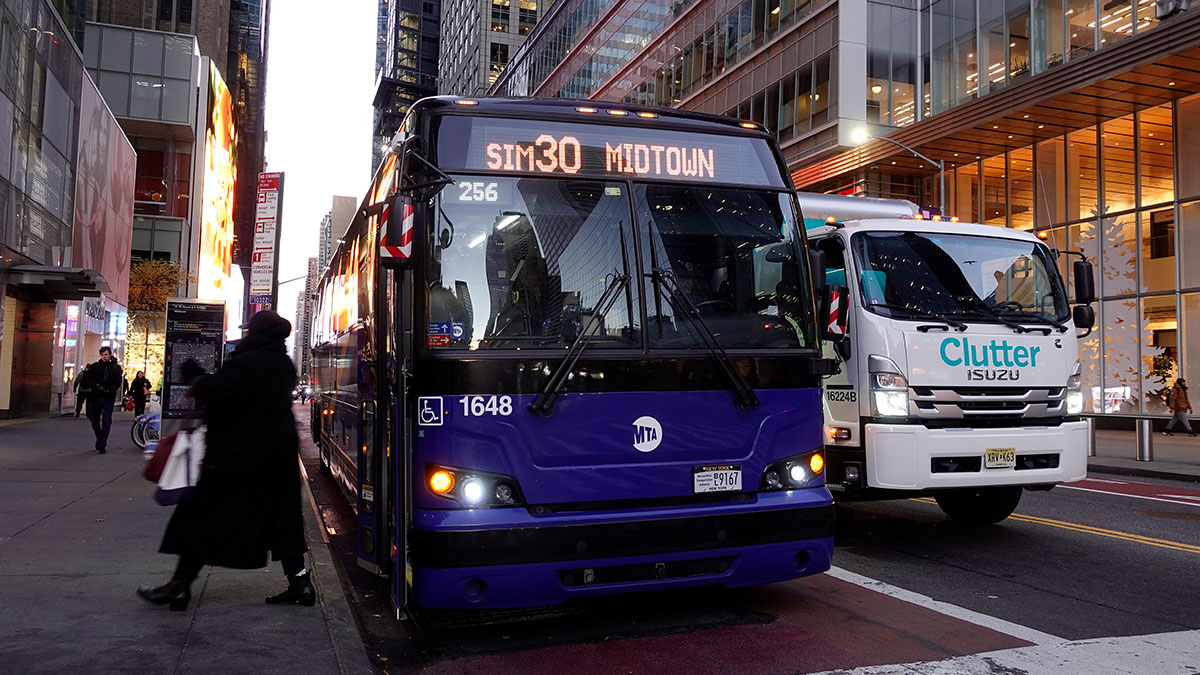
Photo by Gary Hershorn/Getty Images