
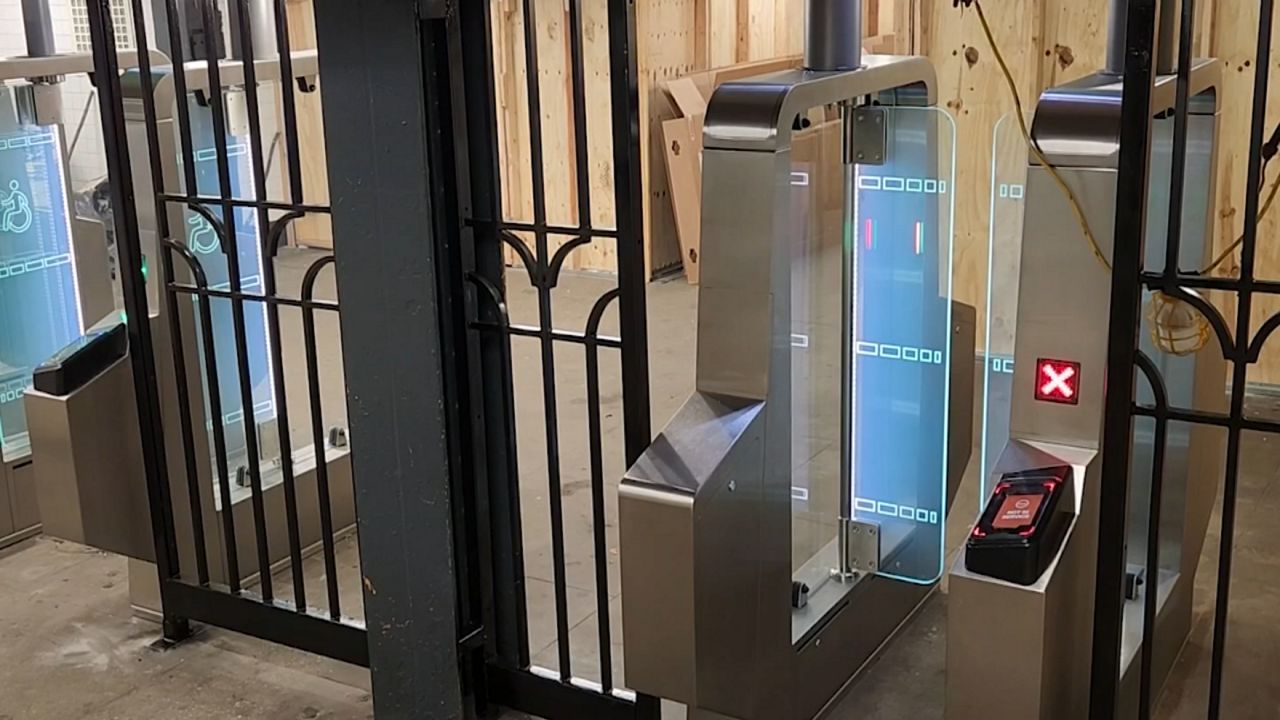
Behind a cordoned-off area at the Third Avenue-138th Street subway station are new, modern fare arrays, part of an MTA pilot. They can also be spotted inside a construction site at Port Authority.
“We’re in the midst of a competition amongst four, you know, really impressive international companies that are making prototype fare gates for us to install in the system,” Jamie Torres-Springer, president of MTA Construction and Development, said. “We’re getting as many of them installed as we can over the next few weeks.”
What You Need To Know
The MTA is conducting a pilot, testing modern fare gates from four companies at 20 stations this year
The new arrays have reduced fare evasion in other cities where they’ve been used with long, double-doors that make it difficult to jump over or climb under
The MTA will eventually install the new fare gates at 150 stations through 2029, covering 75% of ridership
There are four prototypes. In addition to the Third Avenue-138th Street and Port Authority stations, the Fourth Avenue-Pacific Street entrance to Atlantic-Barclays Center is also getting new fare arrays.
“Anything to stop the number of people that are getting on the subway where they open the gate and 30 people run through and pay nothing,” longtime rider John Bate said.
The new fare gates would also replace the emergency exit gate. They would facilitate emergency evacuations, as well as be wide enough for wheelchairs to get through.
The doors would prevent literal turnstile jumping, and would pretty much require crawling on the floor to go under. Some riders see other positives besides fare collection.
“Maybe this is a better way to just even the playing field for everybody,” said Julissa Fulton, who suggested the new fare gates would reduce encounters with police.
While these fare gates have reduced fare evasion in other cities, one rider said he’s seen people piggyback —follow someone closely who paid — and get in. But the new arrays have technology to detect that and set off an alarm — doors can also be adjusted to close more quickly. The MTA is going to see which works best.
“Riders and the public will have an opportunity to see how they work before we see how we move forward,” Torres-Springer said.
Some of the other 20 stations that will see new fare gates include Union Square, Delancey Street-Essex Street, Nostrand Avenue, Crown Heights-Utica Avenue, Jackson Heights-Roosevelt Avenue and Forest Hills-71st
Avenue.
Meanwhile, installation at another 20 stations is expected by the end of 2026 and 150 stations by the end of 2029.