
Jackie Bray has been thinking about how quickly things could spiral out of control.
Bray is the New York state emergency leader whom Gov. Kathy Hochul tasked with averting a Chicago or Los Angeles-style surge of immigration agents and National Guard troops. At the core of the job is a dilemma that the Trump administration has imposed on blue cities and states around the country: How can the state respond to aggressive, spectacle-driven immigration operations without triggering the showdown with federal agents that the administration is trying to provoke?
It’s a problem only made more acute by how geared some of the operations have been towards gaining as much attention as possible, and by their direction away from immigration enforcement, and towards repressing protests in response.
The result, state officials say, is a split approach. New York will fight to delay and block any federal deployment of the National Guard. But when it comes to surges of immigration enforcement officers, the plan is restraint: state and local police will act as buffers between federal agents and protestors, doing what they can to control crowds and de-escalate.
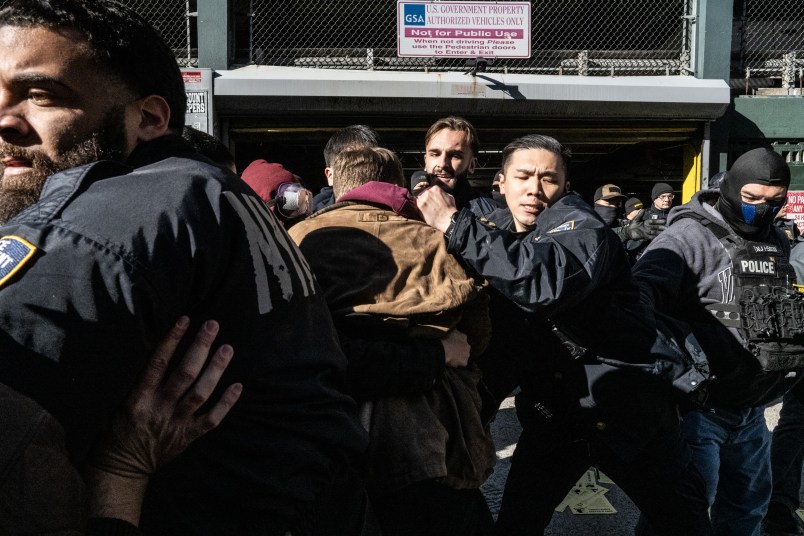
Glimpses of that strategy have already started to emerge. NYPD Commissioner Jessica Tisch reportedly got a heads-up about a high-profile October immigration raid on Manhattan’s Canal Street from the Trump administration; the Daily News reported that she directed officers to steer clear of the area. At a protest in late November, local police placed barricades between demonstrators and a group of Immigration and Customs Enforcement and Border Patrol officers who the activists had surrounded in a parking garage.
The approach has already led to criticism that the state is accommodating, and not fighting, what many regard as an increasingly harrowing example of authoritarianism. State officials respond that their approach is necessary to stop events from spiraling into the kind of escalation that could justify more federal deployments.
“I feel very lucky to not be an elected leader right now,” Bray told TPM.
Outreach
Gov. Kathy Hochul (D) directed Bray, a political appointee serving as director of New York State Division of Homeland Security and Emergency Services, over the summer to work out a plan that would avert the kind of splashy, violent federal presence that overtook Chicago, Los Angeles, and other cities.
For prevention, one model stands out: San Francisco.
There, Silicon Valley executives, along with Mayor Daniel Lurie (D), pleaded with Trump. They argued that a deployment would damage the economy. He replied by calling it off: “Friends of mine who live in the area called last night to ask me not to go forward with the surge,” he wrote on Truth Social.
That’s the plan that New York officials are trying to implement. They’ve convened groups of Wall Street leaders (Bray declined to say whether any had spoken to White House officials); both Hochul and New York City mayor-elect Zohran Mamdani have spoken with Trump directly.
Those meetings have resulted in something less than an adversarial relationship. As Trump shepherded Mamdani through an Oval Office press conference last month, the mayor-elect emphasized areas where the city and federal government could work together.
There are other benefits that the state can provide Trump, whose family business is still deeply rooted in New York. This week, a state gambling board approved licenses for three proposed casinos: one of them is set to be built on a golf course that belonged to the President. The move will net the Trump Organization $115 million.
Chicago and LA warnings
The deployments in Chicago and Los Angeles brought a level of brutality that, at first, helped to obscure their real aim.
The Trump administration cast them as immigration enforcement efforts, albeit with a new level of aggression. But after the White House used local, minor incidents of violence to justify sending troops in, the ICE and CBP operations started to strike observers as pretexts to stage larger-scale repression.
That prompted organizing between cities and states that had experienced the deployments and those that were next. New York’s Communications Workers of America organized one call in September titled “Learning From Chicago and LA and Preparing for Federal Escalation,” between elected officials in New York, Illinois, California, and elsewhere.
“We were just cautioning people to not lose the messaging war,” Hugo Martinez, a Los Angeles city councilmember on the call, told TPM. He said that the administration was seeking grounds to escalate, and that community leaders needed to “try to have as much control as possible over the response that the community has.”
Byron Sigcho-Lopez, a Chicago alderman, was on the call as well.
He took the message to heart. His community, Chicago’s Little Village, became an epicenter of CBP operations. One video that Byron-Lopez recorded of an October encounter with Bovino demonstrates how he internalized the approach: at several points, when demonstrators started to approach federal agents, Byron-Lopez would wave them off.
“They wanted to see escalation,” he told TPM last month.
Bray, the New York state commissioner, said that she had spoken to her counterparts in California and Illinois. For her, a few points became clear: litigation needed to start early. Local law enforcement needed to be prepared for the administration to direct federal authorities to stop communicating with them. Certain sites — like ICE detention facilities — became flashpoints.
Averted, but for how long?
The charm offensive has worked for now, state and city officials told TPM. But nobody can say how long that will last.
City officials are already taking some steps to prepare. The city sold a still-functional but out-of-use prison barge that was anchored near Rikers Island to a scrap company in Louisiana, removing 800 beds that the federal government could have seized for immigration enforcement. The city’s Economic Development Corporation, which is responsible for the project, declined to comment.
New York Attorney General Tish James’ office is preparing legal strategies and lawsuits to file that would challenge any National Guard deployment, one official told TPM.
Community organizers — some of whom have held calls with their counterparts in Chicago, LA, and elsewhere — are preparing as well.
They envision a campaign of resistance that will start with measures already in place, like flyers calling for people to report ICE and CBP operations. That information is then relayed to a network of people who can mobilize in response, organizing through messaging apps and staging spontaneous protests like one that appeared in Manhattan over the weekend and corralled federal agents for roughly two hours.
On the less risky end, that can mean mutual aid programs to provide legal and other forms of support. But some organizers also want to see more disruption. Jasmine Gripper, a state director of the Working Families Party, was on the call with local officials from LA and Chicago. Gripper told TPM that she envisioned a series of tactics that she described as “not letting ICE be at peace in our city.” That means persuading restaurant owners to refuse to serve immigration agents, following agents around with large bullhorns announcing their presence, and finding out where they’re staying and making loud noises at night.
“How do we disrupt at every level and have peaceful resistance and noncompliance to ICE being in our communities and what best can keep our folks safe?” she said.
Bray, the New York State emergency and homeland security commissioner, told TPM that she’s devoting around half of her schedule to trying to avert a federal escalation and to planning for one if it does happen.
The aggression in federal operations in Chicago shocked her, she said. Federal agents walked around in fatigues, unidentified while wearing masks, as if they were an occupying foreign power. In one incident in Chicago, law enforcement rappelled from a helicopter into a dilapidated apartment building for a showy immigration raid.
“Why? Tell me what the strategic, tactical, operational, requirement for that is?” Bray asked.
It’s illegal to block federal agents from doing their job, Bray said. The overriding risk is that things spiral out of control. In California, federal law enforcement cut off communication with local cops as operations there ramped up. Bray told TPM that the state will do what it can to make sure that those lines of communication stay open, even when that means having police prevent demonstrators from blocking federal agents.
“You get images where people will say to me, ‘well, wait a second, look, isn’t that the NYPD helping?’ No, they’re not helping,” Bray said. “They’re doing crowd control. They’re making sure that there aren’t violent clashes in front of a government building. That’s their job. That’s not cooperation with feds. But, you know, this is gonna test us all.”