
New digital technologies rely on powerful computing systems, and countries that don’t build and operate these systems face growing risks to their sovereignty. Canada now operates in a world where artificial intelligence, scientific research, and national security all depend on advanced infrastructure known as supercomputers. These systems train complex AI models, process massive volumes of data, and support the tools used by governments and industries each day. Without this capacity at home, countries must lean on foreign technology, raising concerns about security, reliability, and long-term control.
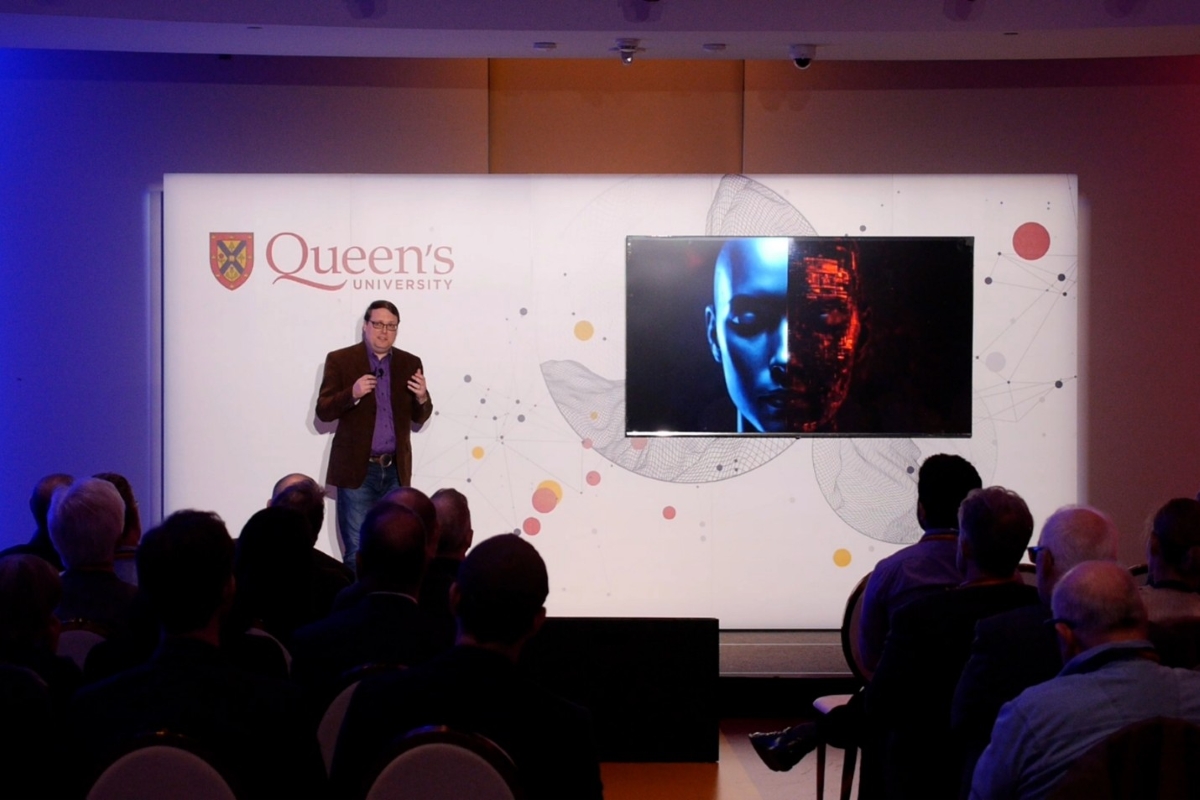
In a presentation at the Queen’s Micro Summit: What’s Canada’s Next Move, Dr. Ryan Grant (Electrical and Computer Engineering) outlined how Canada can strengthen its position by developing more of its own advanced computing systems. A domestic ecosystem that supports new hardware, software, and research methods would give the country greater control over the technologies that shape its digital future.
Stronger capacity at home also creates space to design systems that reflect national priorities. With reliable infrastructure in place, Canada can test emerging tools more effectively, protect sensitive information, and guide how values and safeguards are built into new technologies. This approach supports long-term interests and reduces the need to rely on standards set elsewhere.
Recent federal investments in computing infrastructure give Canada a chance to accelerate this work. New resources can support specialist training, help emerging companies build new technologies, and create spaces where researchers and industry partners collaborate on next-generation systems. These efforts position Canada to play a more active role in the evolving digital landscape and to develop technology that is both trusted and competitive.
Dr. Grant brings world-leading expertise in advanced computing and the systems that support it. His research spans cloud computing, high performance networks, hardware–software interfaces, and power management for large-scale computing centres. At Queen’s, he works with Ingenuity Labs and leads the Computing at Extreme Scale Advanced Research lab, one of the largest supercomputing architecture groups in the world. Before joining the university, he worked at Sandia National Laboratories in the United States, a global leader in supercomputer design, where he helped develop technology now used in many of the world’s most powerful systems. His work continues to focus on building the talent and tools needed to support secure and trusted digital infrastructure.
Watch Dr. Grant’s full presentation.
The Queen’s Micro Summit series brings together researchers whose work helps Canadians better understand the forces shaping the nation’s future. Delivered in short and engaging TED Talk style presentations, each event connects academic insight with real-world questions that matter to people. The series reflects the strength of Queen’s research community and its reputation for translating discovery into public awareness and action, encouraging informed discussion and supporting a deeper understanding of Canada’s place in a rapidly changing world.