
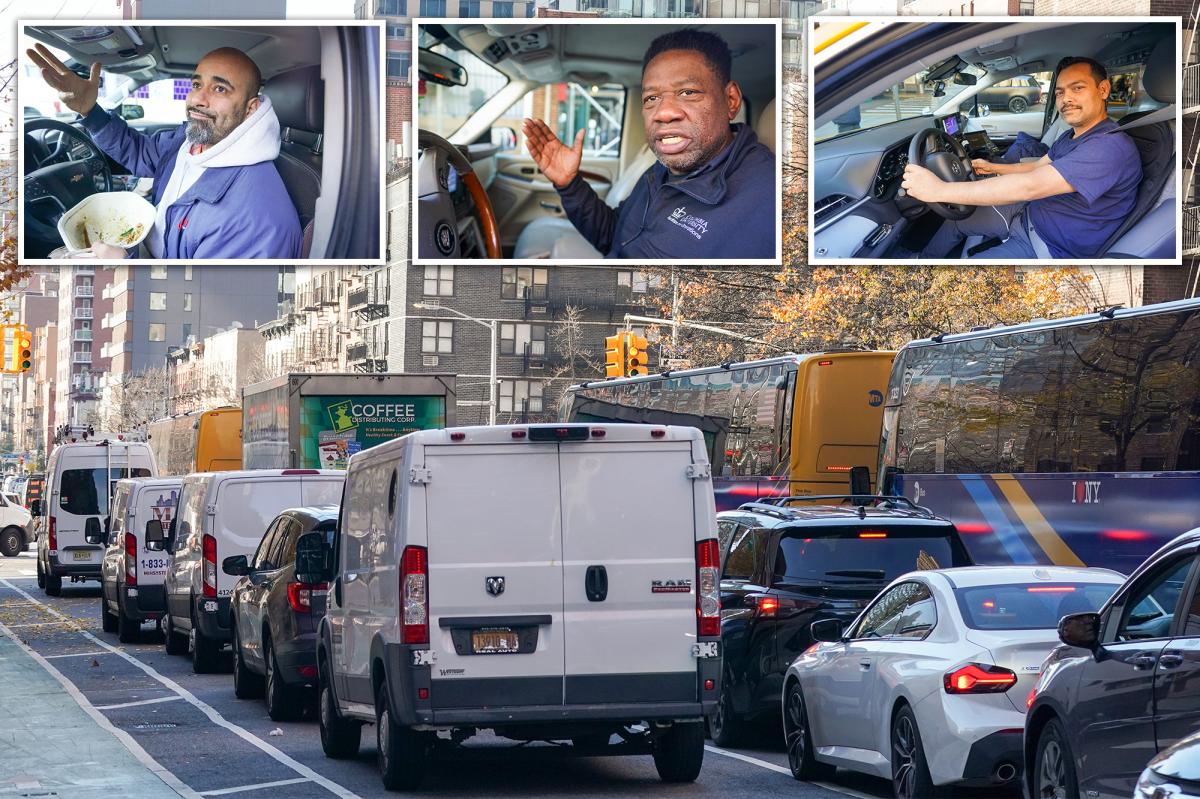
Gov. Hochul and MTA leaders have hailed the controversial congestion pricing as a success that’s driving down traffic in the heart of Manhattan — but other analysts are saying not so fast.
Drivers, meanwhile, are fuming that traffic still stinks and they’re just paying more after nearly a full year of the toll.
The cash-hungry Metropolitan Transportation Authority added insult to injury to some gridlock weary commuters as they claimed “polling” showed drivers are warming up to the congestion toll even though some reported it’s still hell on wheels downtown.
Some drivers are saying that the traffic is still terrible despite the implementation of congestion pricing at the start of the year. Robert Miller
“This program has been nothing short of transformational, making streets safer, reducing gridlock across the region, and unlocking generational upgrades to mass transit, benefitting millions,” Hochul crowed in September.
“Congestion pricing is working, it is legal, and the cameras are staying on.”
But yellow cabbie Mohammad Haque observed, “It hasn’t changed anything, especially south of 60th.”
He added: “From what we’ve seen, the traffic is even worse. In my opinion, they’re just taking the money and not helping the city at all. Traffic is still there and we’re losing time – and the MTA, they’re just taking the money.”
Haque said that traffic has remained unchanged south of 60th street. Robert Miller
The MTA predicted the $9 toll would raise $500 million in the first year, the MTA has already exceeded its revenue projection.
The MTA, meanwhile, claims that traffic is down 11% due to the congestion zone.
But crossings to and from New Jersey into the congestion zone suggest the change was much smaller — dropping less than 5% year over year, according to Port Authority data for April, the most recent available month.
Experts also questioned the MTA’s rosy stats.
The MTA predicted the $9 toll would raise $500 million in the first year, the MTA has already exceeded its revenue projection. Christopher Sadowski
Nicole Gelinas, a senior fellow at the Manhattan Institute, said the data collection by the MTA is a “crude way of doing it, and it hurts confidence in the program.”
“The cameras were set up ages before congestion pricing started,” she said. “The MTA should have collected real data for comparison during the long delay.”
Start your day with all you need to know
Morning Report delivers the latest news, videos, photos and more.
Thanks for signing up!
To determine the congestion toll’s success, the MTA compared current traffic data in the congestion zone to old traffic data from the same area. But, the baseline figures were just estimates of how many cars would have entered the zone if the toll never existed, critics said.
Alison Conway, a CUNY civil engineering professor, said the MTA only used a single day in October to pull numbers, which leaves “room for a lot of uncertainty in how representative that day is.”
Crossings to and from New Jersey into the congestion zone suggest the change was much smaller — dropping less than 5% year over year. Robert Miller
“Although I assume it was carefully selected by [the New York MTA Council] to avoid any atypical conditions.” Conway said.
She noted the method was “basic, but reasonable.”
“Again, the one concern would be if there were unusual circumstances in any year,” she said, like a major weather event or construction, “that might make that adjustment factor unusually high or low, leading to an over- or under-estimate of a true baseline value.”
Port Authority data also provides insight into how much traffic could be coming into the congestion zone.
MTA CEO Janno Lieber argued the program has made drivers happier. Robert Miller
Crossings at the Lincoln and Holland tunnels dropped year-over-year by about 6.7% in January and around a 10% in February — with smaller declines of about 5.4% in March and 4.9% in April.
Overall traffic on the New York to New Jersey crossings was down just 0.4% year-over-year — and it was up on the George Washington Bridge, which drivers used to avoid the congestion zone.
By contrast, the MTA is reporting an 8% drop in vehicles entering the congestion zone in January, 12% in February, 13% in March, and 12% in April, suggesting its congestion-zone counts show much steeper declines than what Port Authority sees just at the Hudson River tunnels, but doesn’t account for other ways drivers could enter Manhattan.
The MTA said in a statement it adjusted the October data for seasonality differences using bridge and tunnel data from the MTA, NYC DOT and the Port Authority.
MTA Chair and CEO Janno Lieber presented the New Capital Dashboard Program via online access to the press and public inside the MTA’s training room at Grand Central Terminal in Manhattan, NY on December 1, 2025. James Messerschmidt
MTA CEO Janno Lieber on Tuesday at an NYU Law School event argued the program has made drivers happier, pointing to unspecified polling to prove his case, adding there’s been about 20 million fewer vehicles on the road this year while pedestrian and air quality is improving.
“You know, who loves congestion pricing? The drivers are now, in polling recently, are letting us know they love it because they’re saving so much time,” the agency head said.
“The people who drive to work in Manhattan who spend 50 bucks to park actually do value their time. I’m not shocked.”
When asked what poll he was referring to, the MTA initially sent a September survey of 800 people – not just drivers – in which 59% participants said they supported the program.
Haque said that, despite claims from the MTA and Lieber, he does not notice a difference regarding city traffic. Robert Miller
The agency then sent a second poll that does cite three-in-four drivers who said they have faster commutes into the central business district – but the data is early February, when the program was just a month old.
Drivers like Haque, the cabbie, aren’t sharing the same upbeat attitude as Lieber.
“I don’t notice any difference. Look at the traffic here – from morning until 8 p.m. every day, every single day. They took lanes away for buses, lanes for bikes – what’s congestion pricing doing?” he said.
“Someone should ask them what they’re doing with all this money. New York should do something about traffic, but not this. This is not good for us. This is not good for the city.”
Howard said that he has paid an extra $2,000 in tolls compared to last year due to congestion pricing. Robert Miller
Electrician Deacon Howard, of Staten Island, said the program that can charge $9 to drivers and more for truck drivers also said “it’s not relieving traffic because people still have to drive.”
He estimated he’s stuck forking over around $2,000 more compared to last year.
“It’s the same traffic, just more fees. I don’t see no difference. Four years ago it took me an hour and a few minutes to get to work,” Howard, 62, said. “Now it takes me an hour and five minutes to work. So where’s the difference?”
Rad Perez, a construction foreman from Chinatown, also argued the daily fee “hasn’t alleviated anything.”
Perez also said that the additional fee has not changed anything. Robert Miller
“As contractors, we have to charge our clients to drive below 60th, so someone’s paying it and we’re still driving,” Perez said.
“So congestion pricing is doing nothing. All that money is going nowhere I can see. Being in New York for 50 years, I knew it was never going to work, and now they’re just charging more taxes, more fees, taxes on top of fees and fees on top of taxes, and it’s just never ending.”
Other drivers said depending on the day, traffic isn’t as bad or wasn’t as frustrating at the start of the tolling.
“In the beginning with the congestion it was good because there were less cars in the city. So the traffic was not that bad. But right now, it’s really bad,” said taxi driver Eric Oppong, 33.
“People don’t care. They still come to the city and there’s traffic everywhere. Sometimes it takes an hour to go 1.5 miles. Us taxi drivers hate the commute, I mean, I thought the congestion thing was gonna help, but it really didn’t.”