
New York’s population is still lagging its pre-pandemic baseline, with most counties across the state — including nearly every county in the Finger Lakes and Central New York — reporting losses since 2020, according to a new analysis of Census Bureau estimates released by the Empire Center. The report finds that the state has shed 238,000 residents since 2020, a 1.2% decline, even as the U.S. population grew 2.6% over the same period.
The central driver of the decline remains domestic outmigration. New York lost almost 900,000 more residents to other states than it gained from 2020 to 2024, including record outflows in 2021 and 2022. Those losses were partially offset by strong international immigration and a positive natural change, but not nearly enough to stabilize population levels.
Upstate counties continued a long-term pattern of stagnation or decline, while New York City — which saw steep losses during the pandemic — has recovered only about one-third of the residents it lost earlier in the decade.
What are the biggest challenges identified?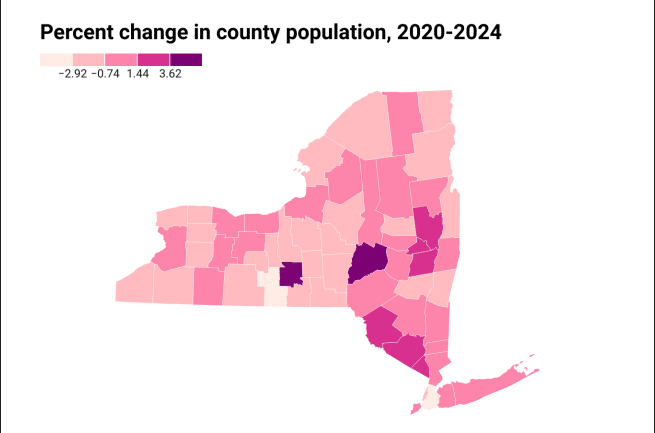
The report highlights several statewide issues:
Domestic outmigration remains severe, far outweighing gains from international immigration and births.Affordability pressures and economic conditions continue to drive departures, especially from upstate regions with aging populations and limited job growth.Urban recovery is uneven. New York City’s 2023–24 rebound has not erased earlier losses, and upstate’s decline has accelerated in some communities.Population loss is widespread. Outside the New York City metro area, 44 of 48 upstate counties recorded more deaths than births.How does this break down by county across our region?Cayuga CountyPopulation change: –1,564Percent change: –2.1%Summary: Cayuga saw one of the more significant percentage declines in the region, reflecting the broader upstate trend of deaths outpacing births and continued outmigration.Schuyler CountyPopulation change: –710Percent change: –4.1%Summary: Schuyler experienced the largest percentage decline of any county outside New York City. The steep drop underscores the vulnerability of small rural counties with aging populations.
Seneca CountyPopulation change: –743Percent change: –2.4%Summary: Seneca’s decline is among the more severe in the Finger Lakes, continuing a multiyear pattern of population loss.Ontario CountyPopulation change: +333Percent change: +0.2%Summary: Ontario is one of the few upstate counties to show a modest gain, though growth is minimal. It reflects relative economic stability compared to neighboring counties.Yates CountyPopulation change: –334Percent change: –1.0%Summary: Yates posted a moderate decline, less severe than many other rural counties, but still below pre-pandemic population levels.Wayne CountyPopulation change: –1,542Percent change: –1.4%Summary: Wayne’s losses are consistent with regional trends and reflect steady net outmigration.Steuben CountyPopulation change: –3,110Percent change: –3.1%Summary: Steuben recorded one of the steepest declines in the region, mirroring broader challenges in the Southern Tier.Tompkins CountyPopulation change: +5,718Percent change: +5.8%Summary: Tompkins posted the largest percentage gain of any county in New York, driven largely by the return and growth of the student population and international migration.Monroe CountyPopulation change: –5,465Percent change: –0.7%Summary: Monroe saw the largest nominal decline among upstate counties. Its losses reflect both suburbanization patterns and the region’s struggle to attract new residents.
Onondaga CountyPopulation change: –4,410Percent change: –1.0%Summary: Onondaga’s decline, though less severe than many rural counties, represents a significant setback for Central New York’s largest population center during a period when major economic investments were expected to stabilize or grow the county.What’s the statewide context?
Only a handful of upstate counties grew between 2020 and 2024, and most that did saw increases of less than 1 percent. Tompkins County is a major outlier, with growth tied largely to higher education and international arrivals. Meanwhile, shrinkage was widespread, and in some counties severe enough to raise concerns about long-term sustainability.
New York’s overall losses — second only to West Virginia in total decline — may also cost the state congressional representation after the 2030 Census, continuing a decades-long pattern of political and economic influence shifting away from the Northeast.
What happens next?
The report concludes that reversing the trend will require a major shift in state and city policy, focused on affordability, economic opportunity and regulatory reform. Without changes that address the underlying causes of domestic migration, New York is positioned to continue losing residents in the years ahead.
Get the latest headlines delivered to your inbox each morning. Sign up for our Morning Edition to start your day. FL1 on the Go! Download the free FingerLakes1.com App for iOS (iPhone, iPad).

FingerLakes1.com is the region’s leading all-digital news publication. The company was founded in 1998 and has been keeping residents informed for more than two decades. Have a lead? Send it to [email protected].