
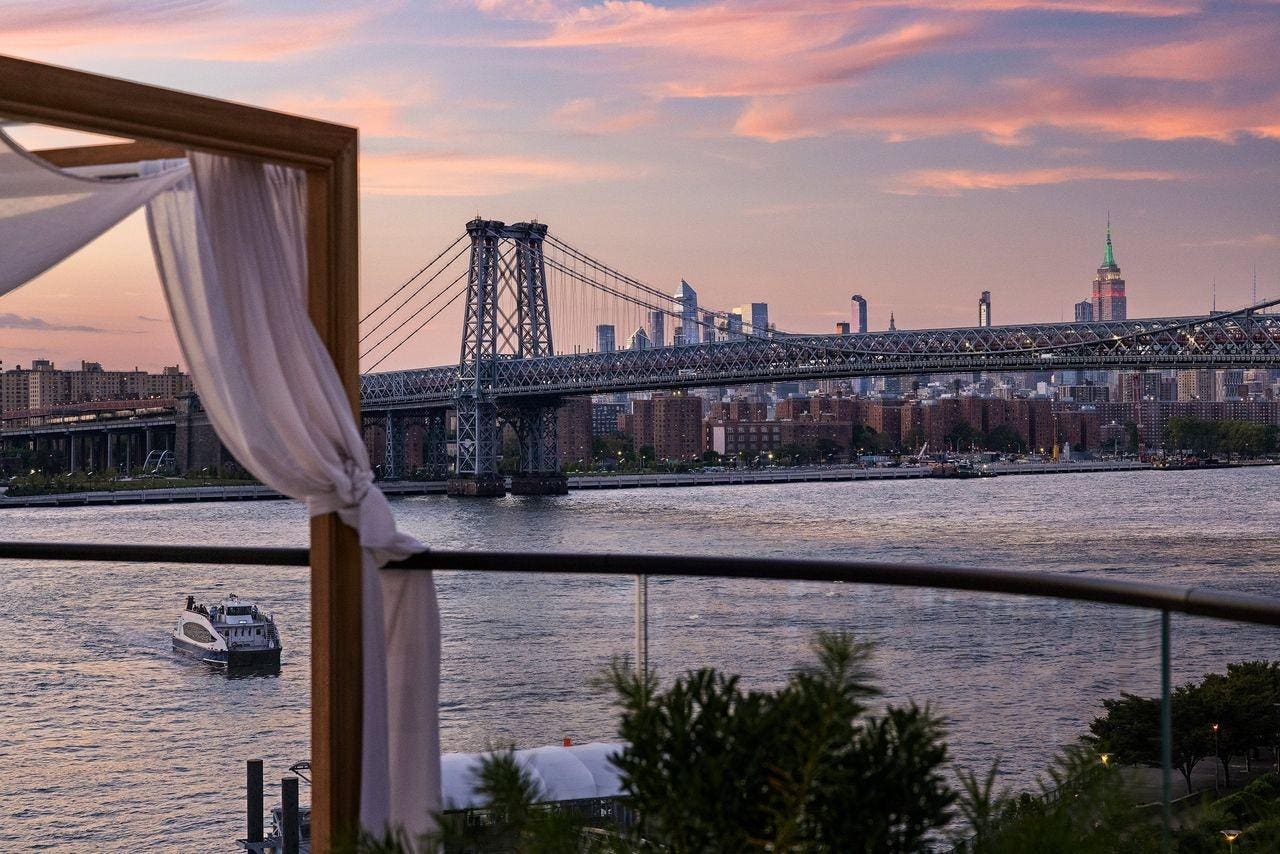
The waterfront view from Two & Three Williamsburg Wharf in South Williamsburg, Brooklyn, with ferry in left foreground.
Naftali Group
Consider these news snippets.
NYC Ferry breaks ridership records in summer of 2025. Tishman Speyer secures $331 million loan for tower on Jersey City’s Gold Coast, next to the Paulus Hook Ferry Terminal. Steve Cohen backs ferry routes from Manhattan to City Field and LaGuardia. New York City considers reintroducing Brooklyn stop 60 years after discontinuation of Staten Island-to-Brooklyn ferry.
On first blush, these appear to be a few headlines with ferries as a common topic. On closer examination, however, they suggest an emerging theme. NYC Ferry has grown beyond being merely a means of scenic water transit and is becoming a critical part of New York City real estate landscape. In fact, growing demand among New Yorkers for commuting by ferry is starting to help determine where residential projects end up being clustered.
“As developers, we pay close attention to how renter demand is shifting, and it is clear New Yorkers are increasingly seeking a better lifestyle,” says Danielle Naftali, executive vice president of marketing, sales and design for Naftali Group, developers of Two & Three Williamsburg Wharf. “The ferry is accelerating this trend by making the waterfront both practical and desirable, giving residents a more connected way to live.”
Linked to stop
Situated in the South Williamsburg enclave of Brooklyn at 478 and 482 Kent Avenue respectively, Two & Three Williamsburg Wharf is a 3.75-acre master-planned development and resort-style destination near the East River waterfront.
Appetite for residences at Two & Three Williamsburg Wharf appears tied to the development’s nearness to the South Williamsburg ferry stop, which is approximately 10 minutes away on foot. It offers 334 design-forward apartments across its two towers.
Williamsburg native David J. Maundrell III, executive vice president of New Development at Corcoran, overseeing leasing for Two & Three Williamsburg Wharf, has observed first-hand the wholesale metamorphosis along the waterfront. “Since being implemented, the NYC Ferry has played a key role in providing direct East River access throughout the city, but in particular neighborhoods in North Brooklyn,” he says.
Seven minutes
In Long Island City, New York City developer TF Cornerstone has created Malt Drive, an amenity-rich project featuring two towers, one 25 and the other 38 stories tall, and offering a total of almost 1,400 rental residences, 30 percent of them designated affordable. It is the developer’s ninth new residential development in LIC’s Hunter’s Point South neighborhood. The name represents a bit of wordplay reflecting the site’s legacy as a sugar cane-processing facility transitioned to beer distribution center.
Malt Drive, a new street created for the development, sits less than two blocks from the nearest stop on the NYC Ferry, that being the Hunter’s Point South ferry landing that is served by two different NYC Ferry routes.
A ferry ride from that ferry station across the East River to Manhattan’s East 34th Street takes seven minutes. During peak hours, ferries travel that route every 25 to 35 minutes. During off-peak hours, they do so about every 40 to 60 minutes.
Commuting by ferry is a convenient, 12-month-a-year experience, and one could argue a more enjoyable exercise that venturing below street level to the subway system, says Zoe Elghanayan, senior vice president with TF Cornerstone.
“We see our close proximity to the ferry as an added bonus to our Malt Drive residents, nearly 40% of whom work in Midtown Manhattan,” she notes. “As Long Island City continues to grow, so will the number of ferry riders.”
If you think the ferries are exerting an outsized impact at present, just wait a bit. NYCEDC recently completed its first systemwide design change since NYC Ferry launched in 2017. Its aim: Shortening commute times and enhancing connections while also incorporating two new landings, one in Harlem and the other in Sunset Park.
It also plans to expand the East 34th Street terminal and develop a long-term vision for NYC Ferry’s future.