
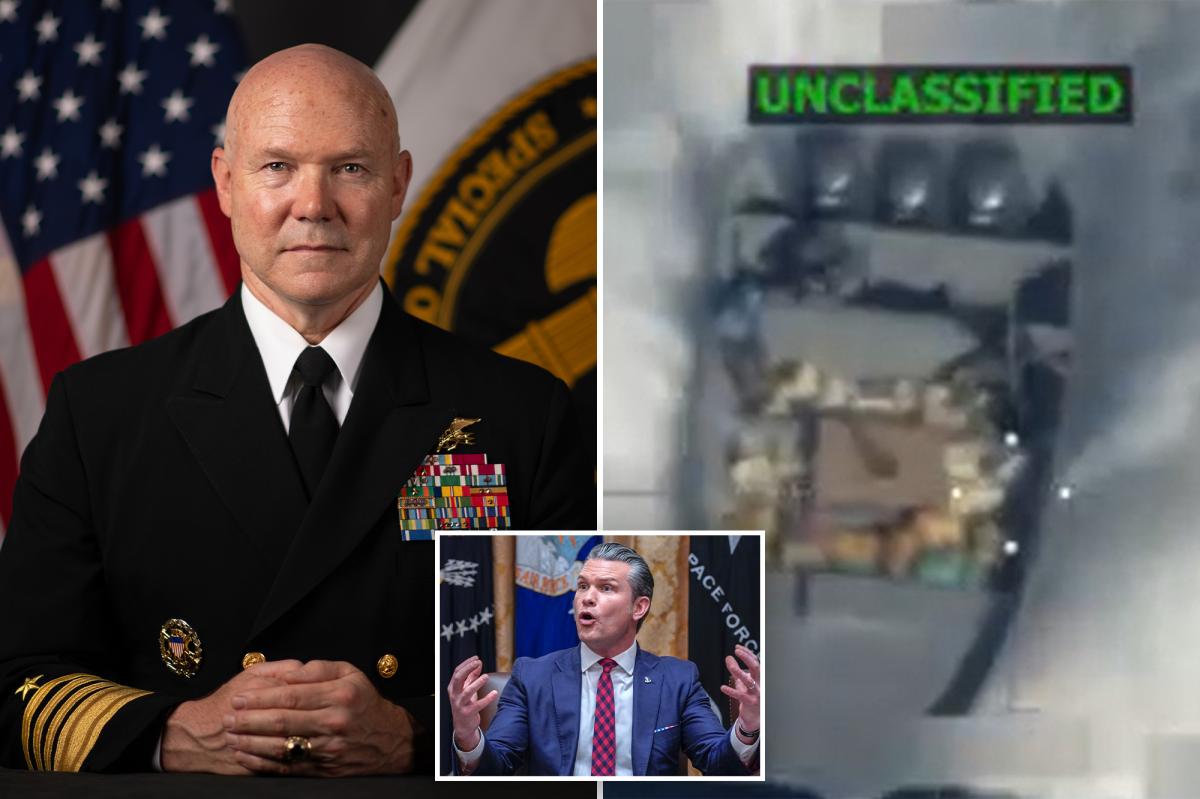
WASHINGTON — The Navy admiral who directed strikes against a suspected drug-running boat in the Caribbean Sea on Sept. 2 told House and Senate lawmakers later Thursday he believed survivors of the initial US attack were trying to complete their deadly mission when he ordered follow-up strikes.
Adm. Frank Bradley, head of US Special Operations Command, gave the final order for both the initial missile hit and several additional strikes that killed 11 people following a directive by War Secretary Pete Hegseth to destroy the boat and its narcotic cargo.
Bradley and a group of Pentagon officials briefed lawmakers and played footage of the controversial strike to provide context.
Adm. Frank Bradley ordered the strike on the suspected drug smugglers off the coast of Venezuela in September. United States Navy
“I saw two survivors trying to flip a boatload of drugs down the United States back over so they could stay in the fight, and potentially, given all the context — we heard of other Narco terrorist boats in the area coming to their aid to — recover the cargo and recover those Narco terrorists,” Sen. Tom Cotton (R-Ark.) told reporters afterwards.
“Look, this is not like a firefight from Payton, Afghanistan, that has three people,” he continued. “This was witnessed by literally hundreds of uniformed and civilian personnel at the Pentagon, at Fort Bragg, at other installations.”
“…It’s my expectation, and my deep hope, this will continue.”
The Wall Street Journal, citing three Pentagon officials, reported that surveillance video of the operation did not reveal two survivors until an hour after the initial hit — after Hegseth says he stopped monitoring the video feed.
That left Bradley to decide whether the pair should still be considered combatants subject to further attacks — or to classify them as “out of the fight” and order a rescue attempt.
According to the officials who spoke to the Journal, Bradley ordered the additional strikes after noting that other suspected drug boats were nearby and the survivors were thought to be attempting to communicate with their cohorts by radio.
Aerial video shows the moments before the lethal strike on a vessel in the eastern Pacific Ocean on Nov. 9, 2025. US Secretary of Defense Pete Hegseth’s X Account/AFP via Getty Images
Lawmakers exited the briefing with wildly different takes on the strikes, depending on their political affiliation.
“What I saw in that room was one of the most troubling things I’ve seen in my time in public service,” Rep. Jim Himes (D-Conn.), the top Democrat on the House Intelligence Committee, vented to reporters.
“You have two individuals and clear distress, without any means of locomotion, with a destroyed vessel, [who] were killed by the United States.”
Sen. Jack Reed (D-RI), the top Democrat on the Senate Armed Services Committee, similarly said that he was “deeply disturbed” by the briefing.
Start your day with all you need to know
Morning Report delivers the latest news, videos, photos and more.
Thanks for signing up!
“This briefing confirmed my worst fears about the nature of the Trump Administration’s military activities, and demonstrates exactly why the Senate Armed Services Committee has repeatedly requested – and been denied – fundamental information, documents, and facts about this operation. This must and will be the only beginning of our investigation into this incident,” Reed said in a statement.
Controversy has surrounded the Sept. 2 mission since the Washington Post reported Nov. 28 on the strikes against survivors. The New York Times followed that up with a report Tuesday that Hegseth’s initial order did not specify what should happen if anyone survived the initial strike.
Bradley gave his side of the story in a closed-door briefing to members of the GOP-led House and Senate Armed Services Committees, which have opened investigations into the operation.
House Intelligence Committee Chairman Rick Crawford (R-Ark.) tore into his Dem colleagues such as Himes, who he referenced in all but name, for suggesting they were troubled by what they learned.
Pete Hegseth speaks during a cabinet meeting in the White House on Dec. 2, 2025. MediaPunch / BACKGRID
“Those who appear ‘troubled’ by videos of military strikes on designated terrorists have clearly never seen the Obama-ordered strikes, or, for that matter, those of any other administration over recent decades,” Crawford sniped in a statement.
“I am deeply concerned by the public statements made by others that seek to ignore the realities of targeting terrorists to score political points. I call upon them to remember their own silence as our forces conducted identical strikes for years.”
Notably quiet after the briefing was Senate Armed Services Chairman Roger Wicker (R-Miss.), who had expressed some apprehension about the Trump administration’s strikes on alleged drug boats. Wicker declined to comment when asked by The Post and reporters from other outlets.
President Trump indicated Wednesday that he would support releasing full surveillance video of the Sept. 2 strike, of which only snippets have been made public.
“Whatever they have, we will certainly release,” said Trump, who has stood by the War Department amid accusations that the strikes may have constituted a war crime.
Since Sept. 2, the US military has carried out 21 operations against suspected South American drug smugglers in the Caribbean Sea and eastern Pacific, killing more than 80 people — and the White House has suggested that additional strikes are coming.